GS 2: GovernanceGS 3: Science & TechnologyGS 2: International RelationsPrelimsGS 3: Infrastructure: Energy, Ports, Roads, Airports, Railways etc.
What is the Saudi-U.S. nuclear deal about?, Pg14
US-Saudi civil nuclear deal ignites proliferation debate, tied to Abraham Accords, impacting Iran and regional stability.
Practice MCQs
775 Students attempted
Key Highlights:
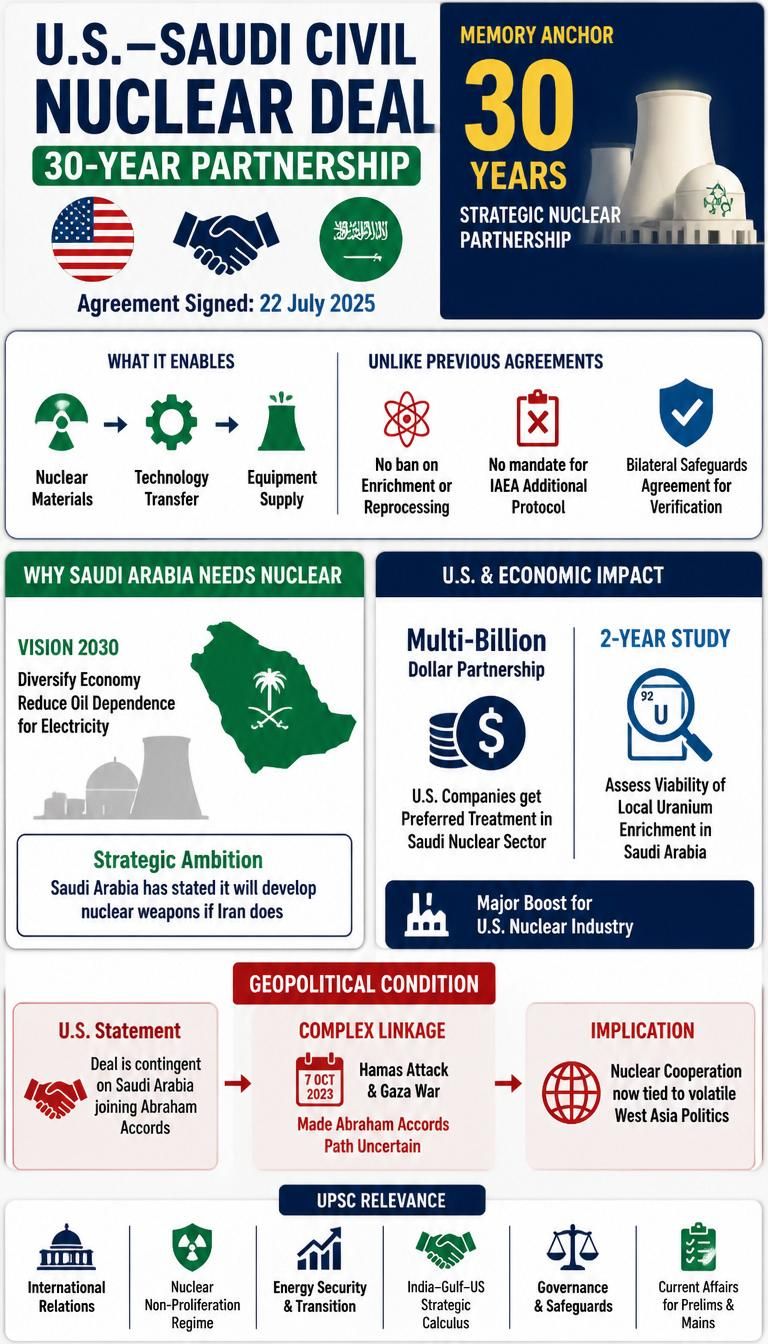
- A civil nuclear cooperation agreement was signed on July 22 between the U.S. and Saudi Arabia, aiming for a 30-year partnership.
- The deal facilitates the transfer of civil nuclear materials, technology, and equipment from the U.S. to Saudi Arabia.
- U.S. President Donald Trump later stated the deal is contingent upon Saudi Arabia joining the Abraham Accords.
- Unlike previous agreements, this deal reportedly does not require Saudi Arabia to forgo uranium enrichment or reprocessing.
- Saudi Arabia is not mandated to adopt the International Atomic Energy Agency’s Additional Protocol under this agreement.
- The agreement includes a bilateral nuclear safeguards agreement for verification in proliferation-sensitive areas.
US-Saudi.jpg
Detailed Insights:
- The U.S. Department of Energy anticipates a multi-billion dollar partnership, with U.S. companies gaining preferred treatment in Saudi Arabia's nuclear sector development.
- A joint two-year study is proposed to assess the commercial viability of local uranium enrichment in Saudi Arabia.
- Saudi Arabia's pursuit of nuclear power aligns with its Vision 2030 to diversify its economy and reduce reliance on oil for electricity generation.
- Crown Prince Mohammed bin Salman has previously indicated Saudi Arabia's potential to develop nuclear weapons if Iran does.
- The U.S. nuclear industry is expected to significantly benefit from this cooperation agreement.
- The linkage of the deal to the Abraham Accords has become complex following the October 7, 2023, Hamas attack and subsequent events in Gaza.
- Saudi Arabia now conditions normalization with Israel on a credible pathway to an independent Palestinian state with East Jerusalem as its capital.
- The U.S. and Israel accuse Iran of a secret nuclear weapons program, while Iran asserts its program is peaceful under the Nuclear Non-Proliferation Treaty.
- Allowing Saudi Arabia to enrich fuel could potentially harden Iran's stance on its own enrichment capabilities.
Key Concepts Involved:
- Civil Nuclear Cooperation Agreement: An international pact for peaceful nuclear energy use, including technology and material exchange.
- Bilateral Nuclear Safeguards Agreement: A mutual agreement ensuring nuclear materials and technology are used for peaceful purposes, often with verification.
- Abraham Accords: A series of normalization agreements between Israel and several Arab nations, brokered by the United States.
- International Atomic Energy Agency’s Additional Protocol: An agreement granting the IAEA broader inspection rights to verify peaceful nuclear material use.
- Uranium Enrichment: The process of increasing the concentration of uranium-235, crucial for both nuclear power generation and weapons.
- Nuclear Non-Proliferation Treaty (NPT): An international treaty aimed at preventing the spread of nuclear weapons and promoting peaceful nuclear energy.
- Vision 2030: Saudi Arabia's strategic plan to diversify its economy and reduce its dependence on oil.

SuperKalam is your personal mentor for UPSC preparation, guiding you at every step of the exam journey.
Download the App


STUDY RESOURCES
CONTACT US
ⓒ Snapstack Technologies Private Limited