GS 2: GovernanceGS 2: PolityGS 3: Science & TechnologyGS 2: Social JusticePrelims
'Safeguard essential': Top court on withholding children's Aadhaar details under APAAR scheme, Pg8
Supreme Court mandates pan-India opt-out for children's Aadhaar details in APAAR scheme, upholding privacy and informed consent under DPDP Act.
Practice MCQs
775 Students attempted
Key Highlights:
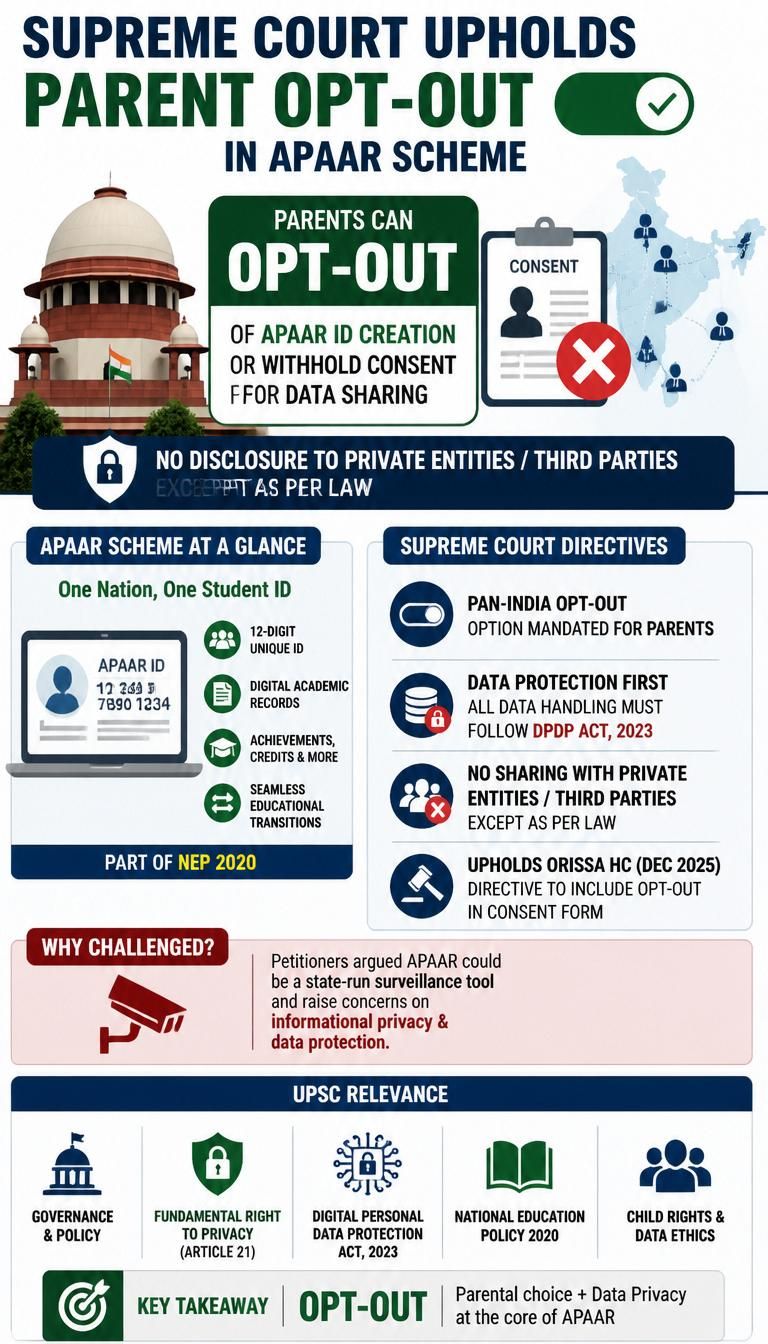
- The Supreme Court has directed the Central Board of Secondary Education (CBSE) to implement a pan-India option for parents to refuse consent for sharing their children's Aadhaar details under the Automated Permanent Academic Account Registry (APAAR) scheme.
- This directive mandates that parents can opt out of the APAAR ID creation or withhold consent for sharing data.
- The Court also ruled that any personal information collected under the APAAR scheme must not be disclosed to private entities or third parties, except as per law.
- The ruling aligns with a December 2025 judgment by the Orissa High Court, which called for amending the consent form to include an opt-out option.
- The Supreme Court emphasized that all data handling under APAAR must strictly adhere to the provisions of the Digital Personal Data Protection Act, 2023.
APAAR ID.jpg
Detailed Insights:
- The APAAR scheme, part of the National Education Policy (NEP) 2020, aims to create a "One Nation, One Student ID" for all students in India.
- It assigns a unique 12-digit ID to students to digitally store academic records, achievements, and credits, facilitating seamless educational transitions.
- Petitioners challenged the scheme, arguing it could function as a state-run surveillance mechanism and raise concerns about informational privacy and data protection.
- The Supreme Court deemed concerns about misuse of voluntarily provided data "misconceived" but stressed the authorities' obligation to protect personal data.
- The Court highlighted that the collection of information under APAAR, even without a statutory mandate, does not absolve authorities of data protection responsibilities.
- The Digital Personal Data Protection Act, 2023, governs the collection, processing, storage, retention, sharing, and use of personal information by Data Fiduciaries.
- The CBSE is now responsible for ensuring that the consent forms for APAAR explicitly provide an option for parents to refuse or withdraw consent.
Key Concepts Involved:
- Automated Permanent Academic Account Registry (APAAR): A unique 12-digit ID for students in India to digitally store academic records, part of the "One Nation, One Student ID" initiative under NEP 2020.
- Digital Personal Data Protection Act, 2023: India's comprehensive law governing the processing of digital personal data, ensuring data privacy and protection.
- Data Fiduciary: Any person or entity that determines the purpose and means of processing personal data, bearing accountability for its lawful and secure handling.

SuperKalam is your personal mentor for UPSC preparation, guiding you at every step of the exam journey.
Download the App


STUDY RESOURCES
CONTACT US
ⓒ Snapstack Technologies Private Limited