GS 1: Indian SocietyGS 2: Social JusticeGS 3: EconomyPrelimsGS 3: Indian Economy, Planning, Mobilization of Resources, Growth, Development and Employment
Deeper jobs problem: Stir a sign demographic dividend is at risk, Pg13
India's youth unemployment hits 16.2%, risking demographic dividend as graduate job prospects dwindle and LFPR declines, sparking deeper economic concerns.
Practice MCQs
775 Students attempted
Key Highlights:
- The recent National Eligibility-cum-Entrance Test (NEET) paper leak and subsequent protests highlight a deeper underlying jobs problem in India.
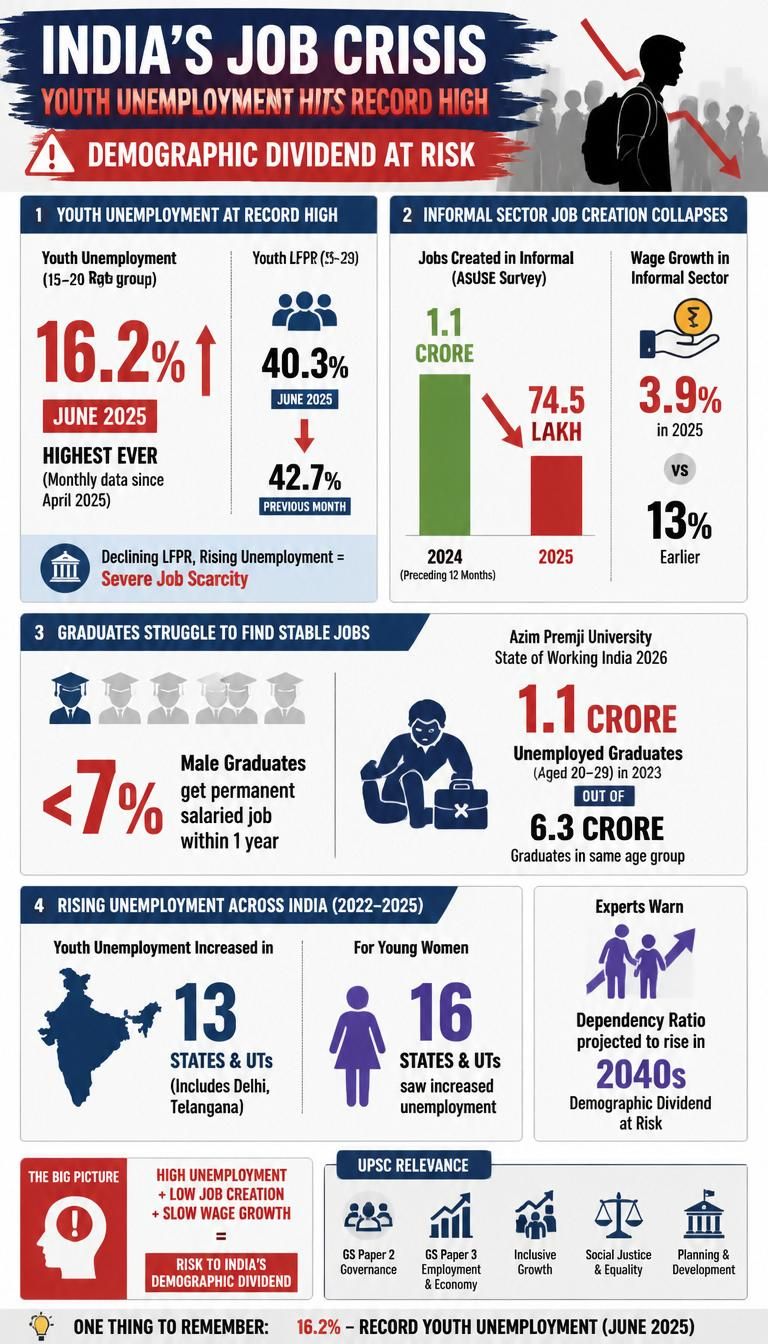
- Youth unemployment (15-29 age group) reached 16.2% in June, the highest recorded since monthly data collection began in April 2025, according to the Periodic Labour Force Survey (PLFS).
- This rise in youth unemployment occurred despite a decline in the overall youth Labour Force Participation Rate (LFPR), which fell to 40.3% from 42.7% over the same period.
- The informal sector's job creation significantly decreased to 74.5 lakh in 2025 from 1.1 crore in the preceding 12 months, as per MoSPI's Annual Survey of Unincorporated Sector Enterprises (ASUSE).
- Less than 7% of male Indian graduates secure a permanent salaried job within a year, as per Azim Premji University's (APU) State of Working India 2026 report.
- Experts warn that India's Demographic Dividend is at risk, with the Dependency Ratio projected to rise by the 2040s.
Job Crisis.jpg
Detailed Insights:
- The Ministry of Statistics and Programme Implementation (MoSPI) cautioned that monthly PLFS data can be volatile due to seasonal and academic factors.
- Despite the volatility, youth unemployment has consistently risen across all six categories (gender, urban/rural) for the 15 months data is available.
- A declining LFPR typically suggests a lower unemployment rate, but India's youth unemployment has increased, indicating a severe job scarcity.
- Annual data from 2022 to 2025 shows increased youth unemployment in 13 states and Union Territories, including major regions like Delhi and Telangana.
- For young women, the employment situation is even more challenging, with 16 states and UTs reporting increased unemployment during the same period.
- Wage growth in the informal sector has sharply declined to 3.9% from 13%, impacting the earning potential of a large segment of the workforce.
- The Azim Premji University (APU) report, State of Working India 2026, highlighted that 1.1 crore out of 6.3 crore graduates aged 20-29 were unemployed in 2023.
- Graduate youth unemployment has been a long-standing issue, rising from 35.02% in 1983 to 39.33% in 2023 for those under 25.
- India's median age is expected to increase from around 29 years to 38 by 2050, necessitating immediate action to leverage the current young workforce.
- The Observer Research Foundation emphasizes that India's growth model must evolve to ensure long-term momentum as the population ages.
Key Concepts Involved:
- Periodic Labour Force Survey (PLFS): A household survey conducted by MoSPI to estimate employment and unemployment indicators in India.
- Labour Force Participation Rate (LFPR): The percentage of the population that is either employed or actively looking for work.
- Current Weekly Status (CWS): A method in surveys where a person's employment status is determined based on their activity during the seven days preceding the survey date.
- Usual Status: A method in surveys where a person's employment status is determined based on their activity during the 365 days preceding the survey date.
- Demographic Dividend: The economic growth potential that can result from shifts in a population's age structure, mainly when the share of the working-age population is larger than the non-working-age share.
- Dependency Ratio: A measure showing the number of dependents (aged 0-14 and over 65) to the total population aged 15-64.

SuperKalam is your personal mentor for UPSC preparation, guiding you at every step of the exam journey.
Download the App


STUDY RESOURCES
CONTACT US
ⓒ Snapstack Technologies Private Limited