GS 2: GovernanceGS 1: Art & CulturePrelimsGS 1: ArchitectureGS 2: Important International Institutions, Agencies and Fora
28 years on tentative list, Sarnath now a UNESCO World Heritage Site, Pg2
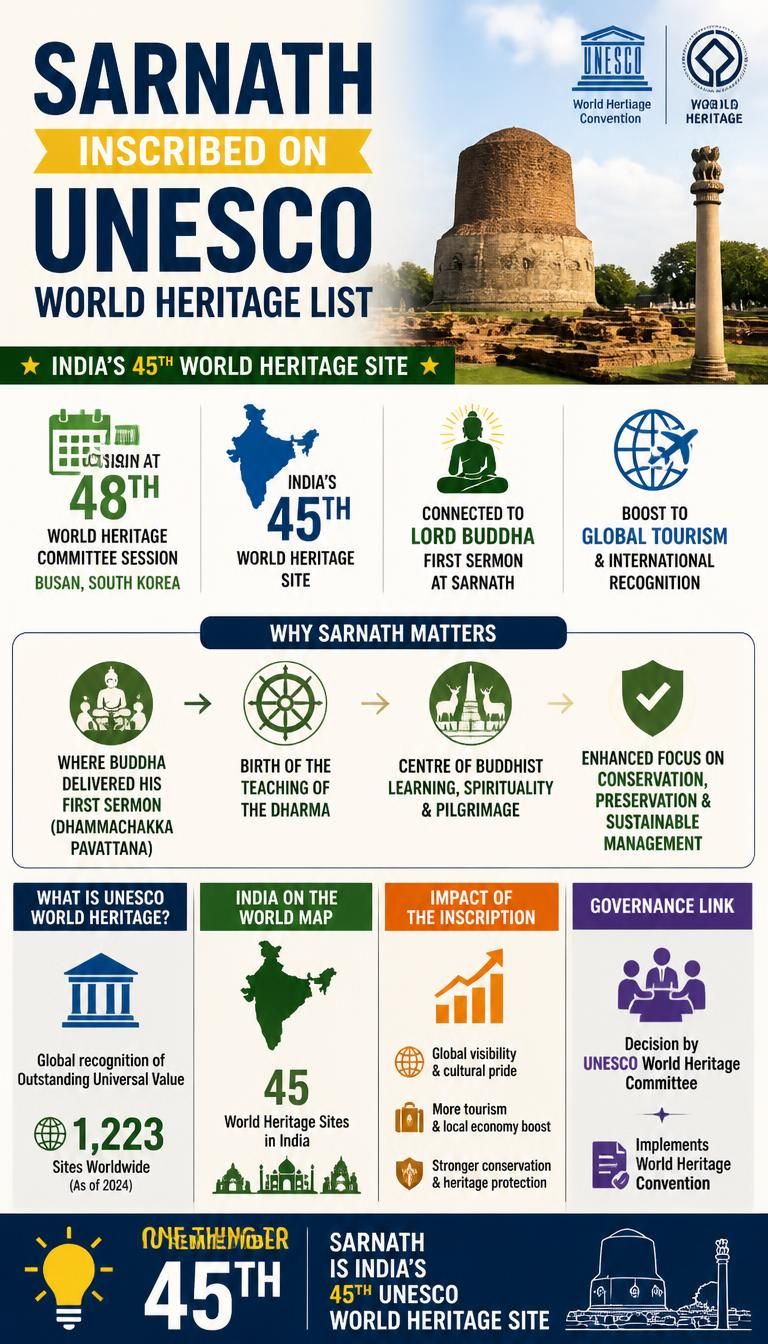
Sarnath, where Buddha delivered his first sermon, achieves UNESCO World Heritage status, becoming India's 45th site after 28-year wait.
Practice MCQs
775 Students attempted
Key Highlights:
- The ancient Buddhist site of Sarnath has been inscribed on the UNESCO World Heritage List.
- Sarnath is now India's 45th and Uttar Pradesh's fourth World Heritage Site.
- The announcement was made during the 48th session of the UNESCO World Heritage Committee held in Busan, South Korea, from July 19 to 29.
- Sarnath is revered as the place where Lord Buddha delivered his first sermon after attaining enlightenment.
- The site had been on UNESCO's tentative list since July 3, 1998.
Sarnath.jpg
Detailed Insights:
- Sarnath's inscription is expected to strengthen Uttar Pradesh’s Buddhist Circuit on the international tourism and cultural heritage map.
- The first sermon delivered by Lord Buddha at Sarnath is known as Dharmachakra Pravartan, signifying the "turning of the wheel of dharma."
- Uttar Pradesh's other three World Heritage Sites are the Taj Mahal, Agra Fort, and Fatehpur Sikri, all located in the Agra region.
- The Archaeological Survey of India (ASI) recently updated the site's plaque to credit local royal family member Babu Jagat Singh with its discovery, moving away from colonial narratives.
- Prime Minister Narendra Modi highlighted that this recognition celebrates India's profound civilisational and spiritual heritage.
- Conservation architect Abha Narain Lambah emphasized Sarnath's integrated cultural and spiritual heritage, which has remained alive for nearly 2,500 years.
Key Concepts Involved:
- UNESCO World Heritage List: An international designation for sites of outstanding universal value, recognized by the United Nations Educational, Scientific and Cultural Organization.
- Dharmachakra Pravartan: The pivotal event where Lord Buddha delivered his first sermon, outlining the Four Noble Truths and the Noble Eightfold Path.
- Buddhist Circuit: A network of pilgrimage sites in India and Nepal associated with the life and teachings of Lord Buddha.

SuperKalam is your personal mentor for UPSC preparation, guiding you at every step of the exam journey.
Download the App


STUDY RESOURCES
CONTACT US
ⓒ Snapstack Technologies Private Limited