GS 3: Environment & EcologyPrelimsGS 3: Conservation, Pollution and Degradation
Great Indian Bustards Released into Thar Desert in Landmark Rewilding Drive
Rajasthan and Wildlife Institute of India release captive-bred Great Indian Bustards into Desert National Park to revive the critically endangered population.
Source: Indian Express (Pg. 10)
Practice MCQs
796 Students attempted
Key Highlights:
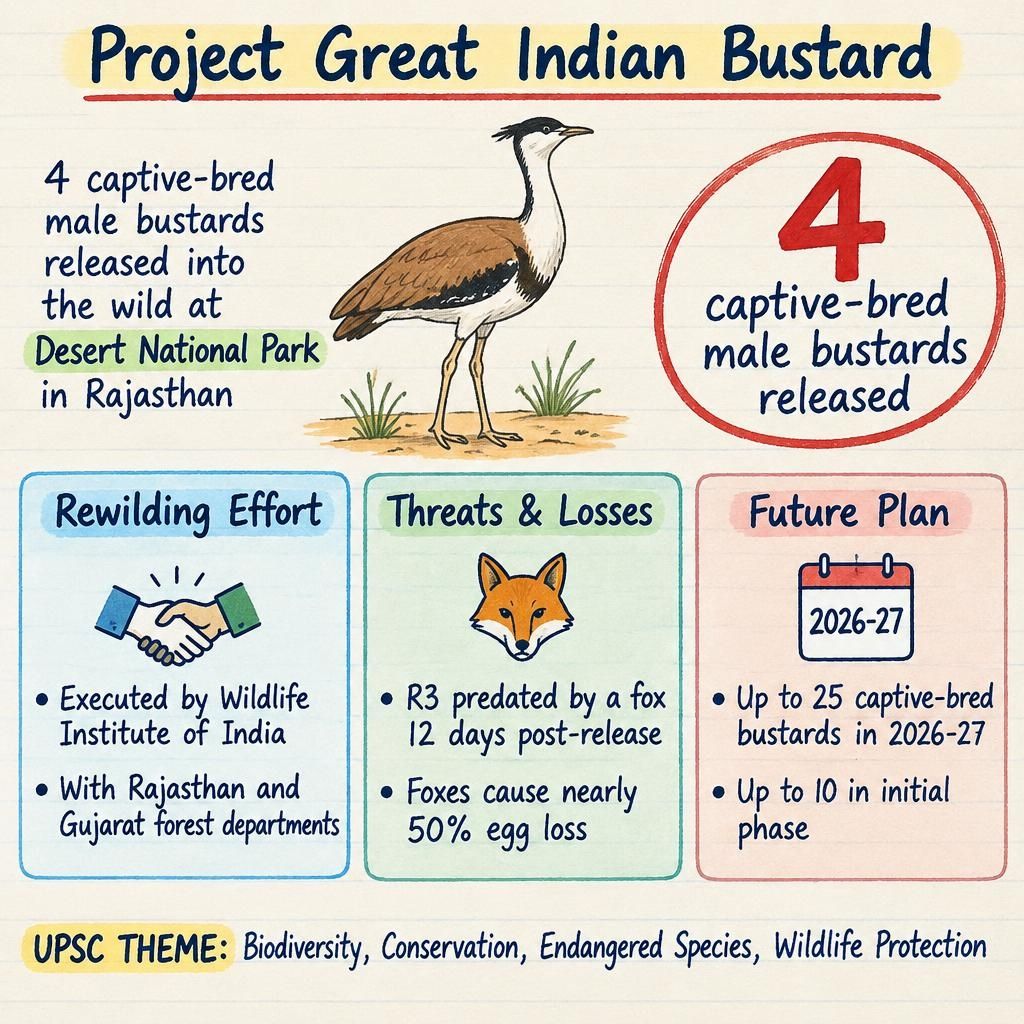
- Four captive-bred male Great Indian Bustards were released into the wild at Desert National Park in Rajasthan under Project Great Indian Bustard.
- The pilot rewilding initiative was executed collaboratively by the Wildlife Institute of India alongside the forest departments of Rajasthan and Gujarat.
- One released bustard, identified as R3, was predated by a fox 12 days post-release just outside a fenced predator-proof breeding enclosure.
- Wildlife authorities have sanctioned the phased release of up to 25 captive-bred bustards across 2026–27, with up to 10 scheduled in the initial phase.
- Ground-nesting bustards face intense predation pressure in the Thar landscape, where foxes cause nearly 50% egg loss and reduce hatching success to 40%.
Project GIB.jpg
Detailed Insights:
- The bustard is listed as Critically Endangered on the IUCN Red List and protected under Schedule I of the Wild Life (Protection) Act, 1972.
- Wild populations have fallen below 150 individuals, with the Thar desert sustaining over 90% of the entire surviving global population.
- The species receives international protection under Appendix I of the Convention on the Conservation of Migratory Species of Wild Animals and CITES.
- Captive breeding facilities at Sam and Ramdevra operate under the Centre's Species Recovery Programme to safeguard ex-situ genetic stocks.
- Transmission delays of up to 36 hours in GPS transmitters and weak cellular networks severely restrict timely predator interventions in remote rangelands.
Scientific/Technical Concepts Involved:
- Rewilding: The planned ecological release of captive-bred wildlife into native ecosystems to establish self-sustaining, viable wild populations.
- Telemetry Tracking: The remote monitoring of wildlife movements and spatial behaviour using automated GPS transmitters and satellite communication.
- Fission-Fusion Dynamics: A flexible social grouping behaviour where animals continuously split into sub-groups and merge into larger flocks.

SuperKalam is your personal mentor for UPSC preparation, guiding you at every step of the exam journey.
Download the App


STUDY RESOURCES
CONTACT US
ⓒ Snapstack Technologies Private Limited