GS 2: GovernanceGS 2: Social JusticePrelimsGS 2: Statutory, Regulatory and Quasi Judicial BodiesGS 2: Health Sector
FSSAI Action Against Bisleri Exposes Regulatory Gaps in Packaged Drinking Water
FSSAI sanctions prosecution against Bisleri after toxic contaminants breach statutory limits, exposing severe regulatory gaps across India's packaged drinking water industry.
Source: The Hindu (Pg. 8)
Practice MCQs
796 Students attempted
Key Highlights:
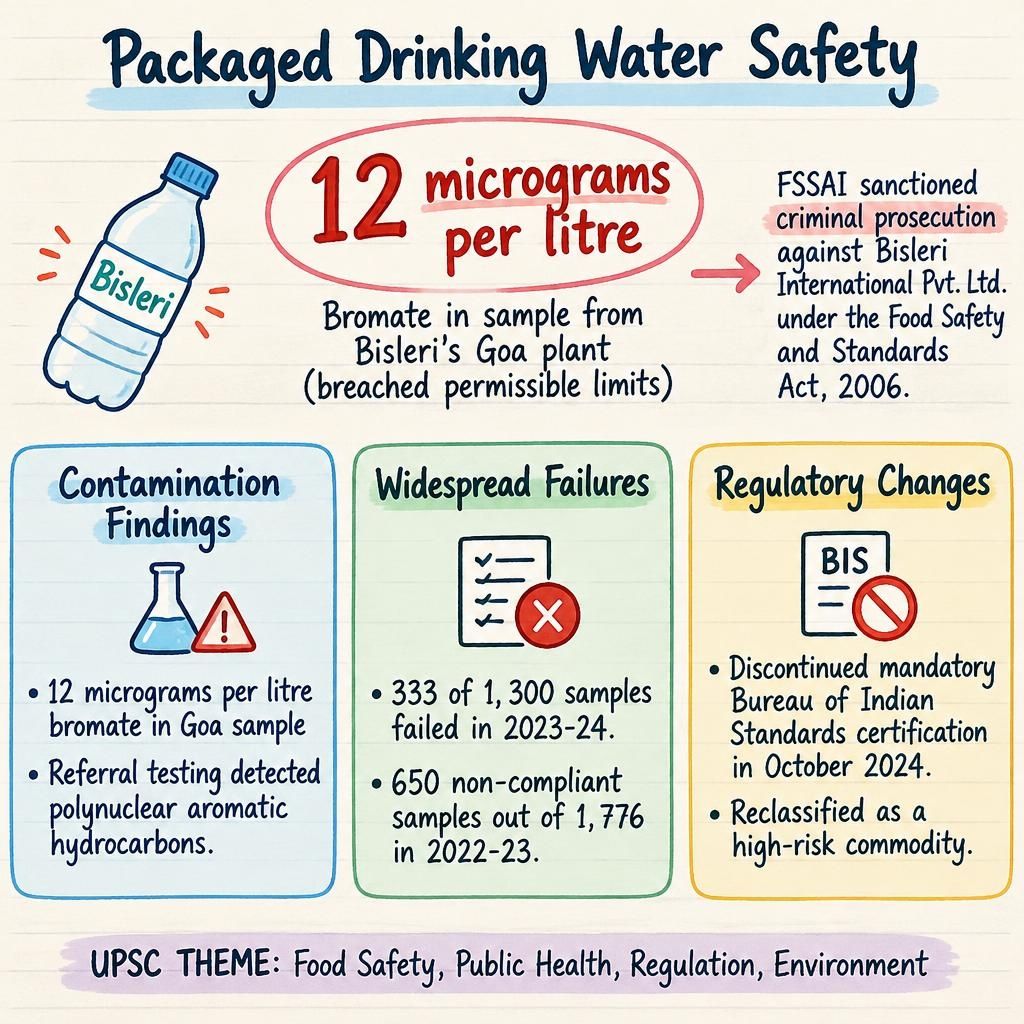
- The Food Safety and Standards Authority of India sanctioned criminal prosecution against Bisleri International Pvt. Ltd. under the Food Safety and Standards Act, 2006.
- A regulatory sample collected from the company's Goa plant breached permissible bromate limits with 12 micrograms per litre, while referral testing detected polynuclear aromatic hydrocarbons.
- Official parliamentary data showed 333 of 1,300 packaged drinking water samples failed statutory safety tests in 2023-24, following 650 non-compliant samples out of 1,776 in 2022-23.
- Packaged drinking water constitutes the primary source of potable water for 15% of urban and 6% of rural households across India.
- The national food regulator discontinued mandatory Bureau of Indian Standards certification for bottled water in October 2024, reclassifying it as a high-risk commodity.
Drinking Water Safety.jpg
Detailed Insights:
- The Food Safety and Standards (Food Products Standards and Food Additives) Regulations, 2011 separate treated packaged drinking water from natural mineral water regarding treatment thresholds.
- Under the Food Safety and Standards Act, 2006, Section 59 establishes graded criminal liabilities for unsafe food, extending from financial penalties to life imprisonment.
- Revised compliance frameworks effective from January 2026 enforce biannual quality testing through facilities certified by the National Accreditation Board for Testing and Calibration Laboratories.
- Groundwater extraction for commercial bottling remains subject to strict no-objection guidelines framed by the Central Ground Water Authority to prevent aquifer depletion.
- Prevailing regulatory benchmarks lack mandatory testing protocols for microplastics and plasticiser migration caused by heat exposure during storage and distribution.
Scientific/Technical Concepts Involved:
- Bromate: A potentially carcinogenic inorganic compound formed when ozone used in disinfection reacts with bromide present in raw water.
- Polynuclear Aromatic Hydrocarbons: Carcinogenic organic compounds formed during incomplete combustion that contaminate water via industrial runoff or deteriorating pipe linings.
- Disinfection By-products: Secondary chemical contaminants created inadvertently when water treatment chemicals interact with natural organic or inorganic precursors.
- Microplastics: Synthetic polymer fragments smaller than five millimetres that leach into drinking water through plastic bottle degradation and heat.

SuperKalam is your personal mentor for UPSC preparation, guiding you at every step of the exam journey.
Download the App


STUDY RESOURCES
CONTACT US
ⓒ Snapstack Technologies Private Limited