GS 2: PolityGS 3: Disaster ManagementGS 3: Environment & EcologyPrelimsGS 3: Disaster and Disaster Management
Climate Compensation and the Federal Question in India
Devastating disasters in Kerala and Himachal Pradesh demand India overhaul federal climate finance and enforce corporate liability against major polluters.
Source: The Hindu (Pg. 6)
Practice MCQs
796 Students attempted
Key Highlights:
- The U.S. Supreme Court heard arguments on whether federal law preempts Boulder County from using state tort law to seek climate damage compensation from oil companies.
- Following the 2024 Wayanad landslides that caused 298 deaths, the Union provided Kerala ₹529.50 crore as a 50-year loan rather than a grant.
- For the 2023 Himachal Pradesh floods causing ₹9,042 crore in losses, the Union released ₹633.73 crore in immediate relief and ₹2,006.40 crore for reconstruction nearly two years later.
- The Air (Prevention and Control of Pollution) Act, 1981 and the Environment (Protection) Act, 1986 were enacted under Article 253 to implement the Stockholm Conference of 1972.
- Under Article 270, revenue from the ₹400-per-tonne Clean Environment Cess was retained entirely by the Union rather than shared with States.
- The Sikkim High Court initiated a suo motu petition to mandate district-level climate-risk assessments and shift toward an anticipatory climate governance model.
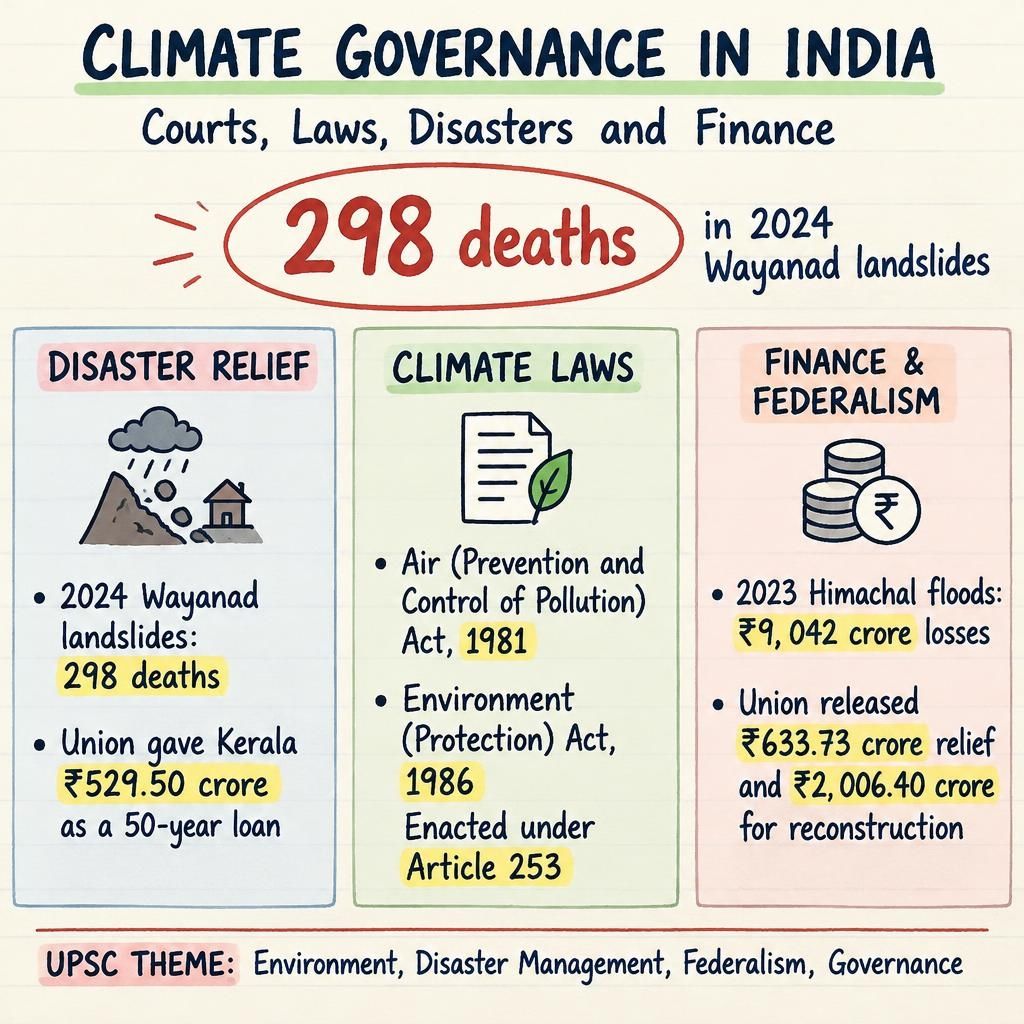
Climate Governance.jpg
Detailed Insights:
- Centralised lawmaking under Article 253 enables the Union to occupy legislative fields, leaving States with limited authority over climate policy.
- Because disaster is absent from the Seventh Schedule, the Disaster Management Act, 2005 relies on concurrent entries, leaving States fiscally dependent.
- In M.K. Ranjitsinh vs Union of India, the Supreme Court of India recognized a fundamental right against climate change impacts under Article 21.
- Precedents like M.C. Mehta vs Union of India and Vellore Citizens Welfare Forum vs Union of India established strict corporate environmental liability frameworks.
- Despite adjudicatory powers under the National Green Tribunal Act, 2010, fossil fuel polluters rarely compensate sub-national governments directly for loss and damage.
- The Finance Commission could address this vertical asymmetry by integrating disaster vulnerability metrics into horizontal revenue devolution formulas.
Key Concepts Involved:
- Polluter Pays Principle: Legal doctrine requiring entities responsible for environmental degradation to bear the financial costs of mitigation and compensation.
- Federal Preemption: Constitutional doctrine where national legislation overrides sub-national laws in areas of conflicting jurisdiction or treaty implementation.
- Absolute Liability: Rule holding enterprises engaged in hazardous activities strictly liable for damages without any common-law defenses.
- Fiscal Devolution: Constitutional transfer of financial resources, cesses, and statutory grants from the Union to State governments.

SuperKalam is your personal mentor for UPSC preparation, guiding you at every step of the exam journey.
Download the App


STUDY RESOURCES
CONTACT US
ⓒ Snapstack Technologies Private Limited