GS 3: Science & TechnologyPrelimsGS 3: Space Technology
BepiColombo Spacecraft Enters Mercury Orbit on Joint ESA-JAXA Mission
Joint ESA-JAXA mission BepiColombo enters Mercury orbit after an eight-year voyage to probe the planet's magnetic field and polar ice.
Source: The Hindu (Pg. 2)
Practice MCQs
796 Students attempted
Key Highlights:
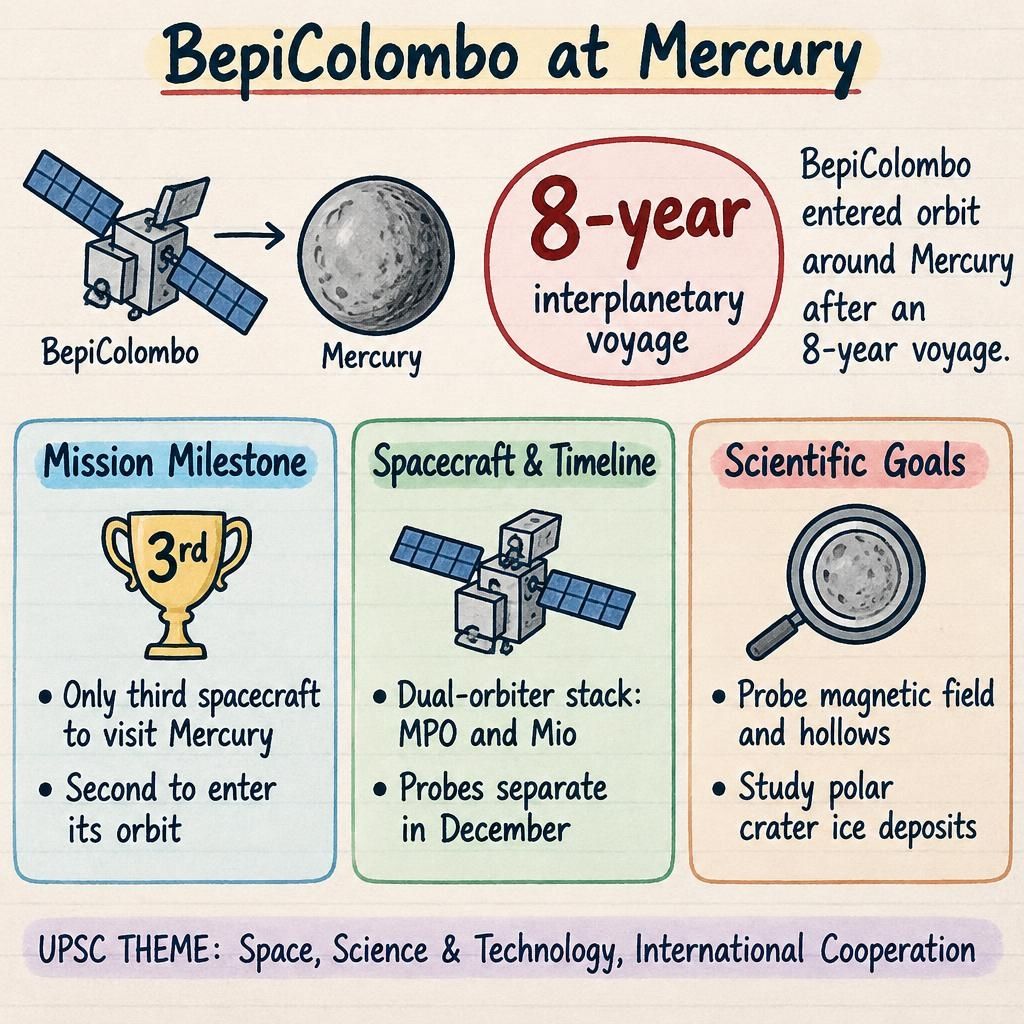
- The joint European Space Agency and Japan Aerospace Exploration Agency mission BepiColombo entered orbit around Mercury after an eight-year interplanetary voyage.
- BepiColombo is only the third spacecraft to visit Mercury and the second to enter its orbit, following Mariner 10 and MESSENGER.
- An unexpected software anomaly led to a premature thruster shutdown during the orbital insertion burn, monitored by the European Space Operations Centre.
- The spacecraft is a dual-orbiter stack comprising the Mercury Planetary Orbiter and the Mercury Magnetospheric Orbiter, also named Mio.
- The constituent probes are scheduled to separate in December, with routine scientific investigations commencing in April 2027.
- Scientific goals include probing Mercury's global magnetic field, mysterious surface depressions known as hollows, and polar crater ice deposits.
BepiColombo.jpg
Detailed Insights:
- Prior to orbital capture, BepiColombo executed nine planetary gravity assists across flybys of Earth, Venus, and Mercury.
- Mercury is the only terrestrial planet other than Earth that sustains an active, self-generated intrinsic magnetic field.
- Permanently shadowed regions inside Mercury's deep polar impact craters shield volatile water ice from daytime temperatures exceeding 400 degrees Celsius.
- The Mercury Planetary Orbiter focuses on surface geomorphology and composition, while Mio investigates the surrounding magnetosphere and exosphere.
- The mission must withstand extreme thermal environments where solar radiation is over ten times more intense than in Earth orbit.
Scientific/Technical Concepts Involved:
- Planetary Dynamo: The physical mechanism whereby a rotating, convecting, electrically conducting liquid core generates a persistent planetary magnetic field.
- Gravity Assist: An orbital mechanics technique utilizing a celestial body's gravitational pull and velocity to alter a spacecraft's flight path.
- Hollows: Shallow, rimless geological depressions on Mercury formed by the sublimation or depletion of volatile minerals exposed to space.
- Solar Electric Propulsion: A propulsion technology that utilizes solar electricity to ionize and accelerate noble gas propellants to generate thrust.

SuperKalam is your personal mentor for UPSC preparation, guiding you at every step of the exam journey.
Download the App


STUDY RESOURCES
CONTACT US
ⓒ Snapstack Technologies Private Limited