GS 2: GovernanceGS 2: PolityPrelimsGS 2: Government policies and interventions for development in various sectorsGS 2: Devolution of Powers and Finances up to Local Levels
What do the Centre’s steps mean for Ladakh?, Pg15
Centre's new proposals for Ladakh face rejection from civil society groups demanding statehood and Sixth Schedule status, despite new district creation.
Practice MCQs
789 Students attempted
Key Highlights:
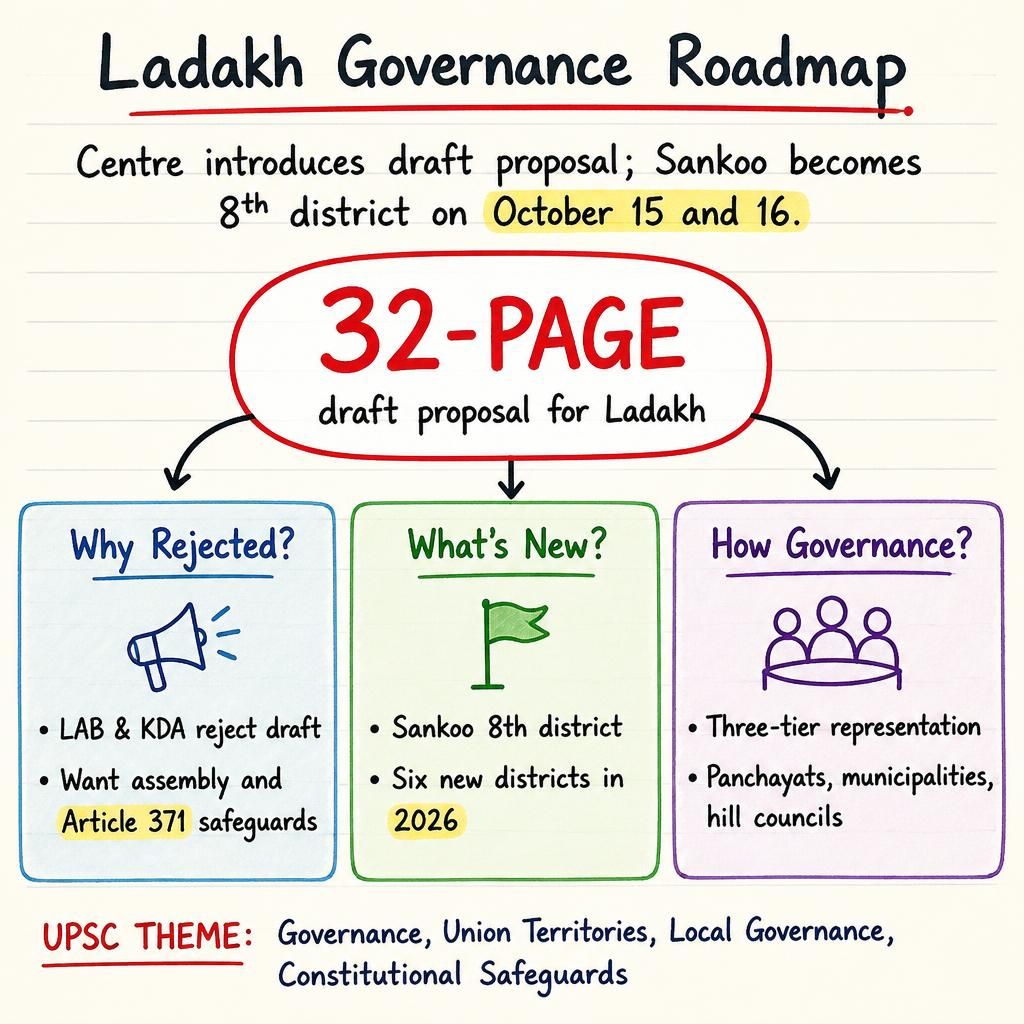
- The Centre introduced a 32-page draft proposal for Ladakh and announced Sankoo as the eighth district on October 15 and 16.
- The Leh Apex Body (LAB) and Kargil Democratic Alliance (KDA) rejected the draft, citing its failure to address demands for a legislative assembly and constitutional safeguards under Article 371.
- Another group, the Civil Society Forum of Ladakh, welcomed the Ministry of Home Affairs (MHA) roadmap, leading to internal friction.
- Ladakh has been witnessing protests since its formation as a Union Territory (UT) in 2019, demanding Statehood and inclusion in the Sixth Schedule of the Constitution.
Ladakh Governance.jpg
Detailed Insights:
- Ladakh was carved out as a Union Territory from the erstwhile State of Jammu and Kashmir in 2019 and currently operates without a legislature.
- In 2023, the MHA constituted a High-Powered Committee (HPC) under Nityanand Rai to protect Ladakh's unique culture, language, land, employment, and empower Ladakh Autonomous Hill Development Councils (LAHDCs).
- Talks in May 2026 indicated the Centre's promise of a "customised model of governance" with a UT-level elected body possessing executive, financial, and legislative powers, along with Article 371 safeguards.
- The LAB and KDA criticized the MHA's latest draft as a "North-East Frontier Agency-type arrangement," which they believe falls short of a UT with a legislature and concentrates substantial power with the Lieutenant Governor.
- The creation of six new districts in 2026, including Sankoo, Sham, Nubra, Changthang, Zanskar, and Drass, aims to improve administrative access and local representation.
- These new districts are expected to lead to the formation of additional hill councils, allowing locals to elect 26 members for each, enhancing participatory governance.
- The administration is also pushing for a three-tier representation system through elections for panchayats, municipalities, and hill councils to empower local representatives.
Key Concepts Involved:
- Union Territory (UT): An administrative division in India directly governed by the Central Government.
- Sixth Schedule: A provision in the Constitution of India that allows for the formation of autonomous administrative divisions in certain tribal areas.
- Article 371: Special provisions granted to certain states in India, allowing for unique governance arrangements to protect their distinct cultural and economic interests.
- Ladakh Autonomous Hill Development Councils (LAHDCs): Local self-governing bodies in Ladakh responsible for local administration and development.
Previous12/12

SuperKalam is your personal mentor for UPSC preparation, guiding you at every step of the exam journey.
Download the App


STUDY RESOURCES
CONTACT US
ⓒ Snapstack Technologies Private Limited