GS 2: GovernanceGS 3: EconomyPrelimsGS 3: Indian Economy, Planning, Mobilization of Resources, Growth, Development and EmploymentGS 2: Government policies and interventions for development in various sectors
RBI's trade reporting norms worry individual service exporters, MSMEs, Pg13
RBI's new foreign exchange reporting norms create compliance hurdles for individual service exporters and MSMEs, hindering payments and ease of doing business.
Practice MCQs
789 Students attempted
Key Highlights:
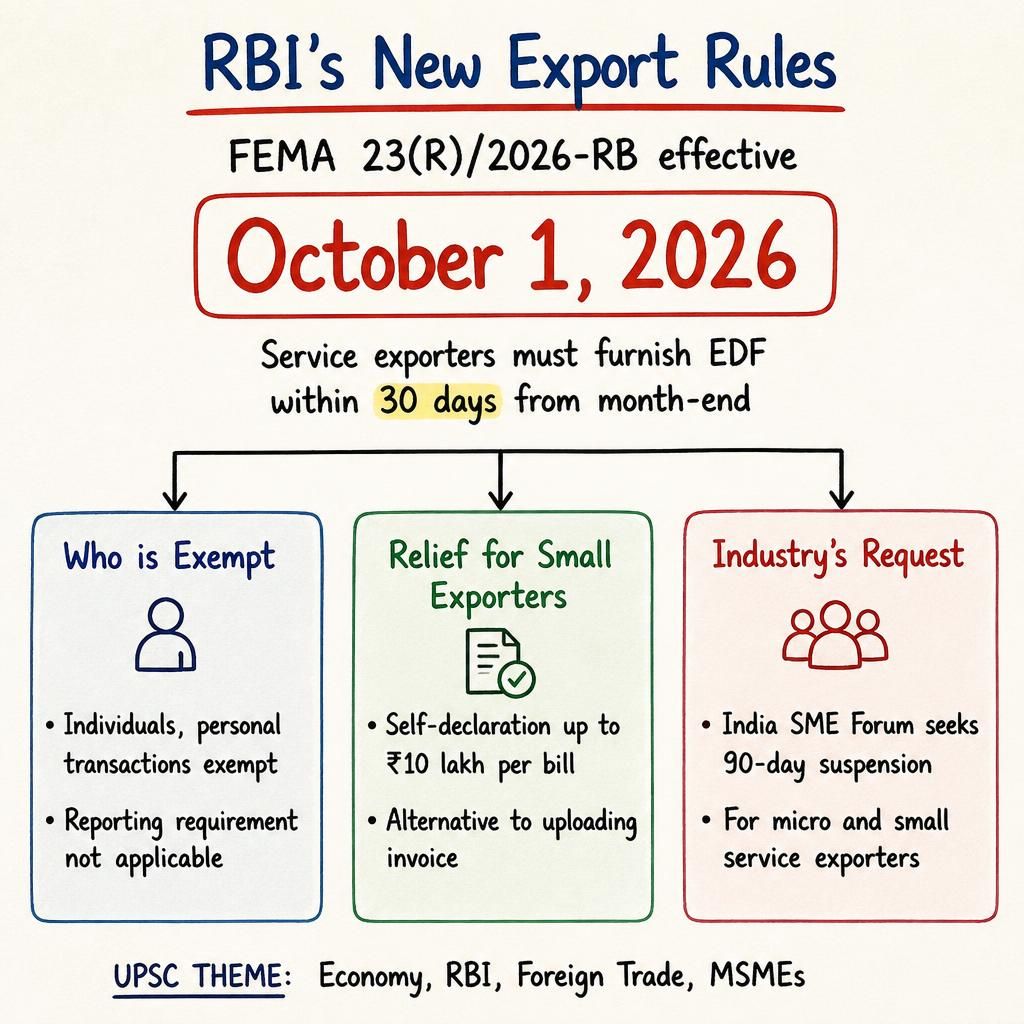
- The Reserve Bank of India (RBI) implemented new Foreign Exchange Management (Export and Import of Goods and Services) Regulations, 2026, effective October 1, 2026.
- These regulations mandate service exporters to furnish an Export Declaration Form (EDF) within 30 days from the end of the month in which the invoice was raised.
- Individual service exporters and Micro, Small and Medium Enterprises (MSMEs) reported difficulties, as banks required them to fill out a complex, multi-page EDF, leading to payment delays.
- RBI Governor Sanjay Malhotra and Deputy Governor Rohit Jain clarified that individuals undertaking transactions of a personal nature are exempt from these reporting requirements.
- For small exporters, a self-declaration can be used for transactions up to ₹10 lakh per bill as an alternative to uploading an invoice.
- The India SME Forum requested a 90-day suspension of recurring EDF filings for micro and small service exporters to allow for a simpler mechanism.
RBI Rules.jpg
Detailed Insights:
- The new regulations, officially FEMA 23(R)/2026-RB, aim to consolidate and strengthen the framework for both exports and imports of goods and services.
- The stated intent of the RBI behind these regulations was to simplify processes and enhance the ease of doing business.
- The EDF requires comprehensive details including customer and country information, currency, transaction value, contract specifics, and service classification.
- MSMEs and individual exporters face significant compliance costs, particularly for high-frequency, low-value digital service transactions, due to the detailed reporting.
- The responsibility for reporting on the Export Data Processing and Monitoring System (EDPMS) lies with the banks and authorized dealers, not the individual exporters.
- The period for realization and repatriation of export proceeds for services has been reduced to nine months, or 12 months if the transaction is invoiced or settled in Indian Rupees.
- Initially, only a few banks had a clear policy framework for these new regulations, contributing to the confusion among exporters.
- The India SME Forum proposed solutions such as simplified, technology-enabled compliance, including de minimis treatment and aggregate/self-declaration mechanisms for smaller exporters.
- The RBI had indicated it would issue Frequently Asked Questions (FAQs) to further clarify the reporting obligations, addressing the widespread confusion.
Key Concepts Involved:
- Foreign Exchange Management Act (FEMA): The primary legislation in India governing foreign exchange transactions and payments.
- Reserve Bank of India (RBI): India's central bank, responsible for regulating the country's monetary policy and foreign exchange.
- Export Declaration Form (EDF): A mandatory declaration submitted by exporters to their authorized dealer bank, stating the full value of goods, services, or software exported.
- Micro, Small and Medium Enterprises (MSMEs): Businesses classified based on investment in plant and machinery or equipment and annual turnover, crucial for economic growth.

SuperKalam is your personal mentor for UPSC preparation, guiding you at every step of the exam journey.
Download the App


STUDY RESOURCES
CONTACT US
ⓒ Snapstack Technologies Private Limited