GS 2: GovernanceGS 3: EconomyPrelimsGS 3: Indian Economy, Planning, Mobilization of Resources, Growth, Development and EmploymentGS 2: Government policies and interventions for development in various sectors
What Would It Take To Triple The Size Of India's Economy, Pg4
Jamie Dimon predicts India's economy will triple in 10 years, highlighting the significant challenge of achieving such growth in US dollar terms.
Practice MCQs
782 Students attempted
Key Highlights:
- Jamie Dimon, Chairman and CEO of JPMorgan Chase & Co., projected India's economy could triple in size over the next decade.
- India's current annual Gross Domestic Product (GDP) is approximately $4.2 trillion.
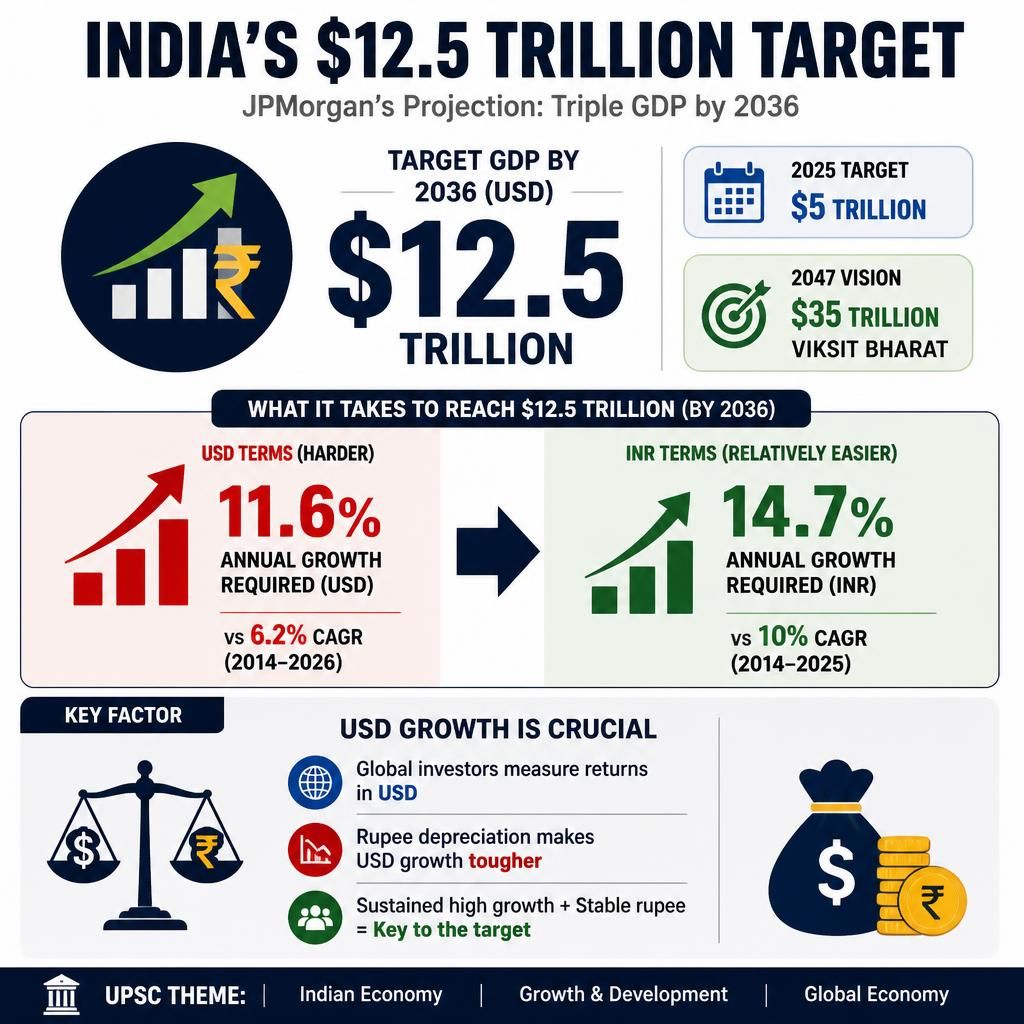
- The projection implies a target of around $12.5 trillion by 2036.
- Achieving this target significantly depends on whether the growth is measured in Indian Rupee (INR) or US Dollar (USD) terms.
- Previous government targets included a $5-trillion economy by 2025 and a Viksit Bharat (developed India) with a $35-trillion economy by 2047.
India's Growth Projection.jpg
Detailed Insights:
- Tripling India's GDP to $12.5 trillion in USD terms by 2036 would require an annual growth rate of 11.6%.
- This 11.6% USD growth rate is nearly double the 6.2% Compounded Annual Growth Rate (CAGR) observed between 2014 and 2026.
- To achieve 11.6% USD growth, India's nominal GDP in rupee terms would need to grow at approximately 14.7% annually.
- India's nominal GDP in rupee terms grew at a CAGR of 10% between 2014 and 2025, based on older data series.
- Tripling the nominal GDP in INR terms is considered more achievable, requiring an 11.6% average growth rate.
- For international investors, returns are primarily measured in USD terms, making USD-denominated growth crucial.
- Rupee depreciation against the US dollar makes achieving USD-denominated growth more challenging.
Key Concepts Involved:
- Gross Domestic Product (GDP): The total monetary value of all finished goods and services produced within a country's borders in a specific time period.
- Nominal GDP: GDP measured at current market prices, without adjusting for inflation.
- Real GDP: GDP adjusted for inflation, reflecting the actual volume of goods and services produced.
- Compounded Annual Growth Rate (CAGR): The average annual rate at which an investment or economy grows over a specified period longer than one year.

SuperKalam is your personal mentor for UPSC preparation, guiding you at every step of the exam journey.
Download the App


STUDY RESOURCES
CONTACT US
ⓒ Snapstack Technologies Private Limited