GS 2: GovernanceGS 1: World HistoryGS 2: International RelationsPrelimsGS 2: Bilateral, Regional and Global Groupings and Agreements
'Enemy state' in UN charter: What is it, why Japan wants it removed, Pg4
Japan urges UN to remove 'enemy state' clause from Charter, facing opposition from China and Russia amidst rising tensions and calls for UN reform.
Practice MCQs
782 Students attempted
Key Highlights:
- Japan's Prime Minister Sanae Takaichi urged the UN General Assembly to remove references to "enemy states" from the UN Charter.
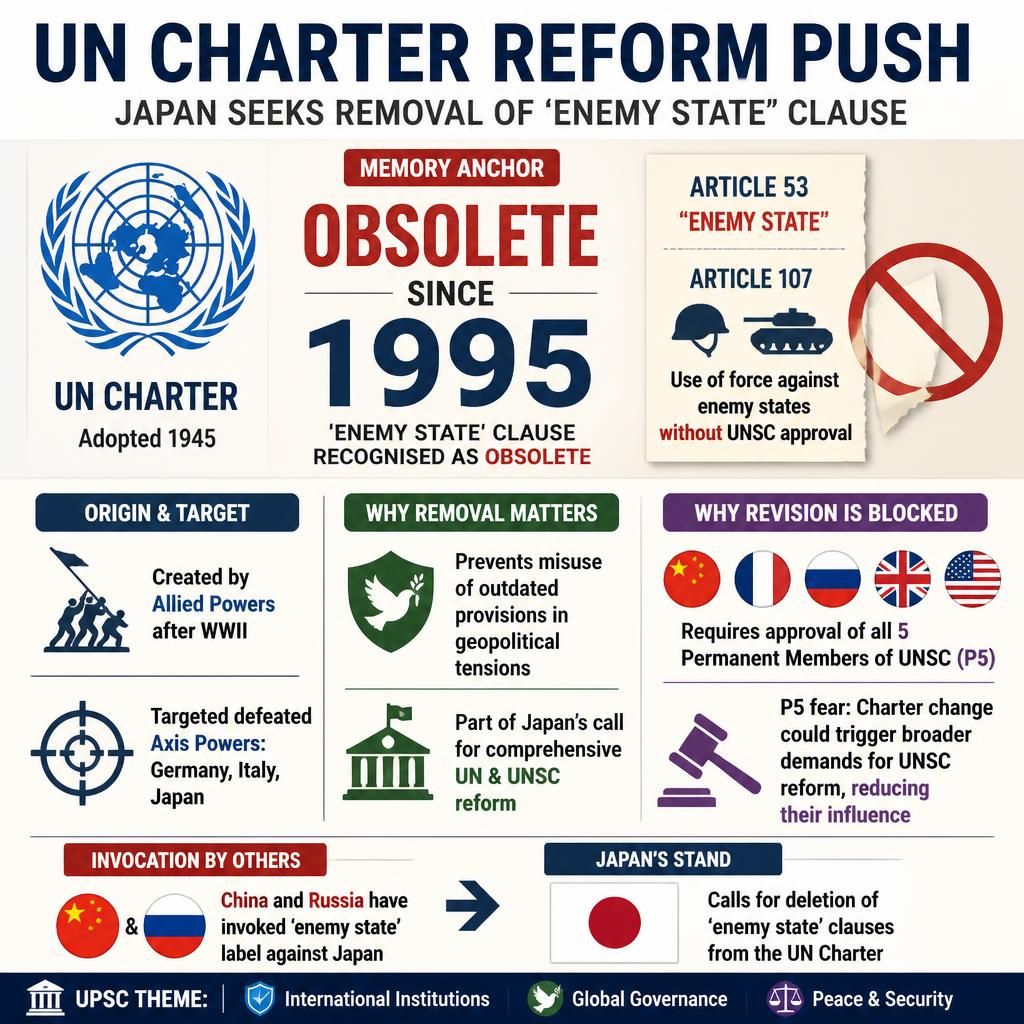
- The UN Charter, adopted in 1945 after World War II, defines "enemy state" in Article 53 as any state that was an enemy of a signatory during WWII.
- This clause historically targeted the defeated Axis Powers (Germany, Italy, Japan) and allowed Allied Powers to take enforcement actions without UN Security Council approval under Article 107.
- China and Russia have recently invoked the "enemy state" label against Japan amidst rising geopolitical tensions and Japan's plans to increase defense spending.
Enemy State Removal.jpg
Detailed Insights:
- The "enemy state" clauses were originally conceived by the Allied Powers to prevent the resurgence of militarism and fascist politics in the defeated nations.
- Article 107 specifically granted the Allied Powers the legal right to use military force against "enemy states" without requiring prior approval from the UN Security Council.
- The UN General Assembly recognized these clauses as "obsolete" in a 1995 resolution and adopted another resolution in 2005 to delete them.
- The removal of these clauses from the UN Charter requires the approval of all five Permanent Members of the UN Security Council (China, France, Russia, United Kingdom, United States), which has not been forthcoming.
- A key reason for the lack of support from the Permanent Members is the concern that any revision to the UN Charter could lead to broader demands for UN Security Council reform, potentially diminishing their influence.
- Japan's call for the deletion of these clauses is part of a larger appeal for comprehensive reform of the United Nations and specifically the UN Security Council.
- China views these clauses as safeguarding the post-war international order, while Russia has used them to invalidate Japan's claims in their territorial dispute over the southern Kuril Islands.
Key Concepts Involved:
- UN Charter: The foundational treaty of the United Nations, outlining its purposes, principles, and organizational structure.
- Enemy State Clause: Provisions within the UN Charter (e.g., Article 53, Article 107) that historically referred to nations defeated in World War II.
- UN Security Council (UNSC): One of the six principal organs of the United Nations, primarily responsible for maintaining international peace and security.
- Permanent Members (P5): The five permanent members of the UN Security Council—China, France, Russia, the United Kingdom, and the United States—each holding veto power.
- UN General Assembly (UNGA): The main deliberative, policymaking, and representative organ of the United Nations, comprising all 193 member states.

SuperKalam is your personal mentor for UPSC preparation, guiding you at every step of the exam journey.
Download the App


STUDY RESOURCES
CONTACT US
ⓒ Snapstack Technologies Private Limited