GS 2: GovernanceGS 3: Disaster ManagementGS 3: Environment & EcologyGS 3: Disaster and Disaster ManagementGS 3: Conservation, Pollution and Degradation
Why Indian cities flood after heavy rain and overheat in summer every year, Pg13
Indian cities face annual urban disasters from extreme weather due to dense construction, weak drainage, and poor governance, costing billions.
Practice MCQs
775 Students attempted
Key Highlights:
- Indian cities face recurrent urban disasters from extreme weather events like heatwaves and heavy rainfall due to dense construction and weak infrastructure.
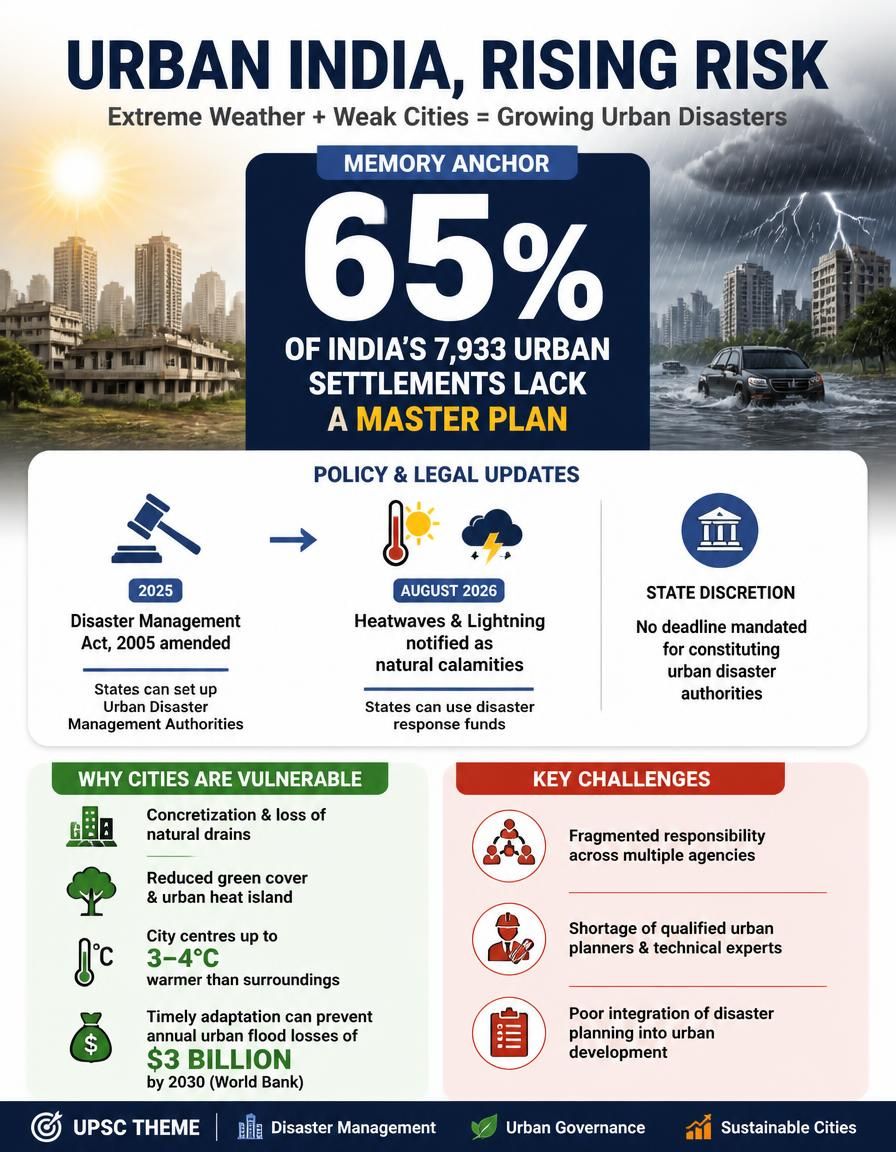
- The Disaster Management Act, 2005 was amended in 2025 to allow states to constitute Urban Disaster Management Authorities in major cities.
- In August 2026, heatwaves and lightning were included in the list of notified natural calamities, enabling states to use disaster response funds.
- A 2024 NITI Aayog report found that 65% of India’s 7,933 urban settlements lacked a Master Plan.
Urban India Risks.jpg
Detailed Insights:
- Urban disasters occur when natural hazards like heatwaves or cloudbursts strike areas with vulnerable populations and inadequate infrastructure.
- Concretization, loss of natural drains, and reduced green cover exacerbate flooding and contribute to urban heat island effects.
- Temperatures in Indian city centers can be 3-4°C higher than surrounding areas, according to the World Bank.
- The World Bank estimates that timely adaptation could prevent annual urban flood losses of about $3 billion by 2030.
- The amendment to the Disaster Management Act, 2005 leaves the formation of urban disaster authorities to state discretion without a deadline.
- Responsibility for disaster management in most cities remains fragmented across multiple agencies, hindering coordinated action.
- A shortage of qualified urban planners and technical experts contributes to poor integration of disaster planning into urban development.
- Effective disaster planning requires integrating flood and heat maps into construction regulations and urban investment decisions.
Key Concepts Involved:
- Disaster Management Act, 2005: A comprehensive law providing for effective management of disasters and matters connected therewith.
- Urban Disaster Management Authority: A body constituted by state governments to prepare and implement urban disaster management plans.
- Notified Natural Calamities: A list of disasters for which states can utilize disaster response funds for relief and mitigation.
- Master Plan: A statutory document that guides the physical development and land use of a city or region.

SuperKalam is your personal mentor for UPSC preparation, guiding you at every step of the exam journey.
Download the App


STUDY RESOURCES
CONTACT US
ⓒ Snapstack Technologies Private Limited