GS 2: GovernanceGS 2: PolityGS 2: International RelationsGS 3: Disaster ManagementGS 3: Environment & Ecology
Why Bihar wants the Farakka treaty scrapped — and why it puts Govt in a bind, Pg7
Bihar's NDA government urges scrapping the 1996 Farakka treaty with Bangladesh, citing detrimental impacts, creating a diplomatic dilemma for the Centre.
Practice MCQs
775 Students attempted
Key Highlights:
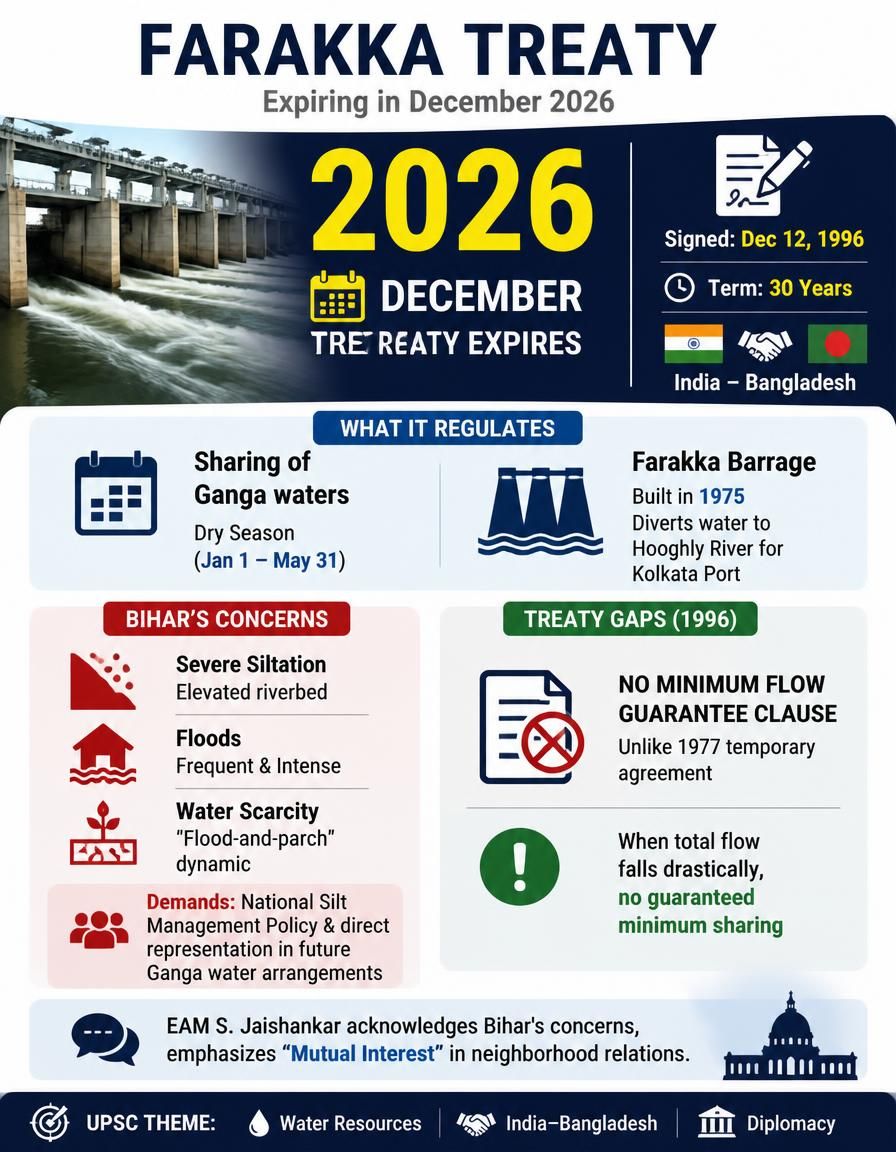
- Bihar's ruling National Democratic Alliance is pushing against the renewal of the 1996 India-Bangladesh Ganges Water Sharing Treaty, also known as the Farakka Treaty.
- The treaty, which regulates the sharing of Ganga waters at the Farakka Barrage, is set to expire in December 2026 after a 30-year term.
- Bihar argues the Farakka Barrage has caused severe siltation, elevated the riverbed, and led to floods and water scarcity in the state.
- External Affairs Minister S. Jaishankar has acknowledged Bihar's concerns, emphasizing the need for "mutual interest" in neighborhood relations.
Farakka Treaty.jpg
Detailed Insights:
- The Farakka Treaty was signed on December 12, 1996, between India and Bangladesh to manage Ganga water distribution during the dry season (January 1 to May 31).
- The Farakka Barrage was constructed in 1975 to divert Ganga water into the Hooghly River to maintain navigability of the Kolkata Port.
- Bihar's government contends that the barrage has created a "flood-and-parch" dynamic, destroying the river's natural water storage capacity upstream.
- The state seeks a National Silt Management Policy and direct representation in any future diplomatic arrangements concerning the Ganga waters.
- Unlike a previous 1977 temporary agreement, the 1996 treaty lacks a "minimum flow guarantee clause" for situations where total flow falls drastically.
- The Centre faces a balancing act between addressing domestic concerns from an NDA ally and maintaining strategic diplomatic ties with Bangladesh.
Key Concepts Involved:
- Farakka Treaty: A bilateral agreement between India and Bangladesh for sharing the Ganges River waters at the Farakka Barrage.
- Farakka Barrage: A dam on the Ganges River in West Bengal, India, built to divert water into the Hooghly River.
- Siltation: The process of sediment or silt accumulating in a riverbed, reducing its depth and water-carrying capacity.

SuperKalam is your personal mentor for UPSC preparation, guiding you at every step of the exam journey.
Download the App


STUDY RESOURCES
CONTACT US
ⓒ Snapstack Technologies Private Limited