GS 1: Art & CultureGS 1: Modern HistoryPrelimsGS 1: Architecture
Tracing Ashoka In Ujjain: What New Dig At Vaishya Tekri Can Reveal, Pg13
Madhya Pradesh government begins fresh excavations at Vaishya Tekri, Ujjain, to reveal more about Mauryan emperor Ashoka's decade-long presence.
Practice MCQs
775 Students attempted
Key Highlights:
- The Madhya Pradesh government has initiated the restoration of Buddhist monuments associated with Emperor Ashoka, beginning with a new excavation at Vaishya Tekri in Ujjain.
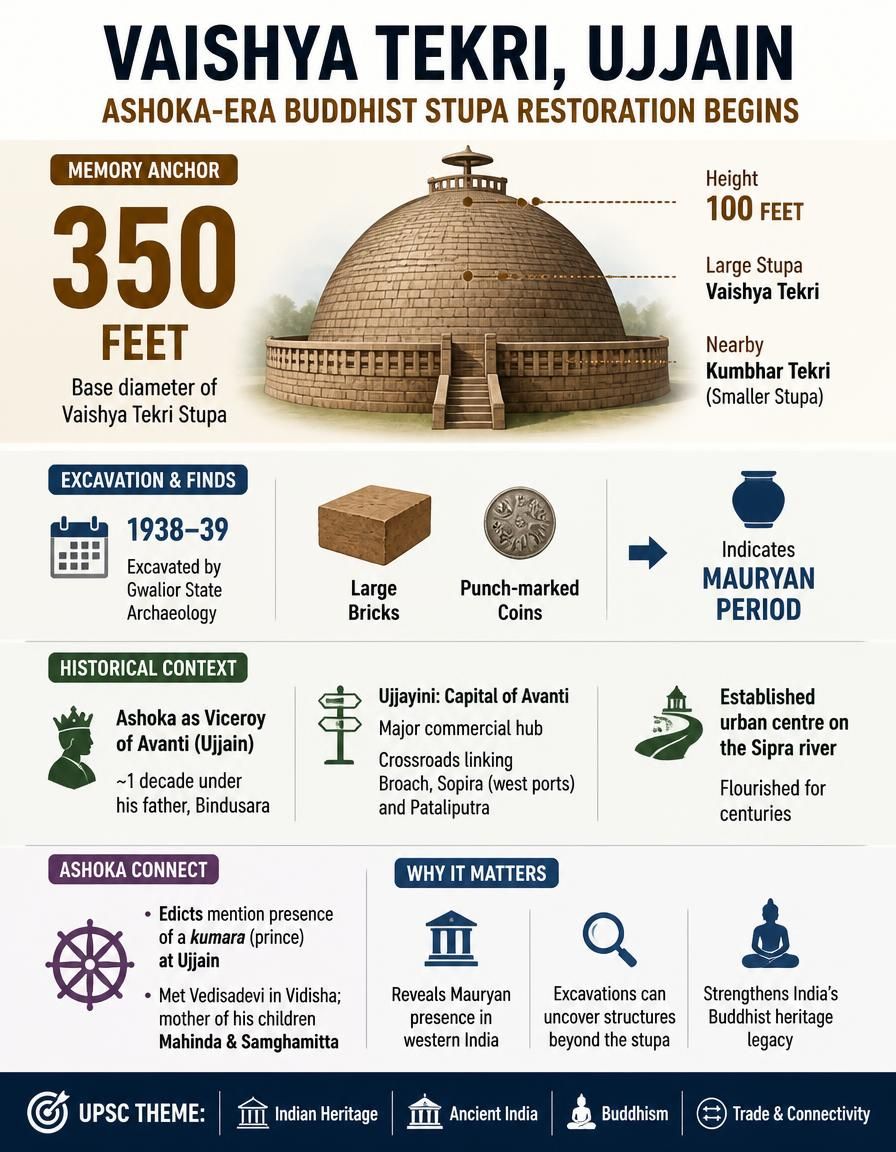
- Previous excavations in 1938-39 at Vaishya Tekri by the Gwalior State Department of Archaeology uncovered large bricks and punch-marked coins, suggesting a Mauryan period origin.
- Vaishya Tekri is identified as a large stupa, approximately 350 feet at its base and 100 feet high, with a smaller stupa named Kumbhar Tekri nearby.
- Historians believe Ashoka served as viceroy of Avanti (Ujjain) for about a decade under his father, Bindusara.
- Scholars advocate for comprehensive excavations to understand the site's evolution and associated structures beyond just the stupa.
Ujjain.jpg
Detailed Insights:
- Ujjayini (modern Ujjain) was the capital of the ancient kingdom of Avanti and a significant commercial hub.
- It served as a crucial crossroads, connecting trade routes to western coastal ports like Broach and Sopira, as well as to Pataliputra.
- Ashoka's own edicts, issued after he became emperor, corroborate the presence of a kumara (prince) at Ujjain.
- Ujjain was an established urban center for centuries before Ashoka's tenure, flourishing along the Sipra river.
- Ashoka reportedly met Vedisadevi in Vidisha, who later became the mother of his children, Mahinda and Samghamitta.
- The current archaeological efforts aim to provide a more comprehensive understanding of the site, moving beyond interpretations based solely on earlier accounts.
Key Concepts Involved:
- Mauryan Period: An ancient Indian empire (c. 322–185 BCE) known for its vast territorial expansion and administrative efficiency.
- Stupa: A dome-shaped structure housing Buddhist relics, serving as a place of meditation and veneration.
- Viceroy: A royal official who governs a country or province in the name of and as representative of a monarch.
- Edicts: Official proclamations or decrees issued by a sovereign or authority, often inscribed on pillars or rocks.
Previous11/11

SuperKalam is your personal mentor for UPSC preparation, guiding you at every step of the exam journey.
Download the App


STUDY RESOURCES
CONTACT US
ⓒ Snapstack Technologies Private Limited