GS 2: GovernanceGS 1: Indian SocietyGS 2: Social JusticeGS 3: EconomyPrelims
The fact is youth unemployment has a household cost, Pg6
India's youth unemployment crisis extends beyond individuals, imposing substantial household costs through reduced consumption and depleted savings, necessitating policy shifts.
Practice MCQs
775 Students attempted
Key Highlights:
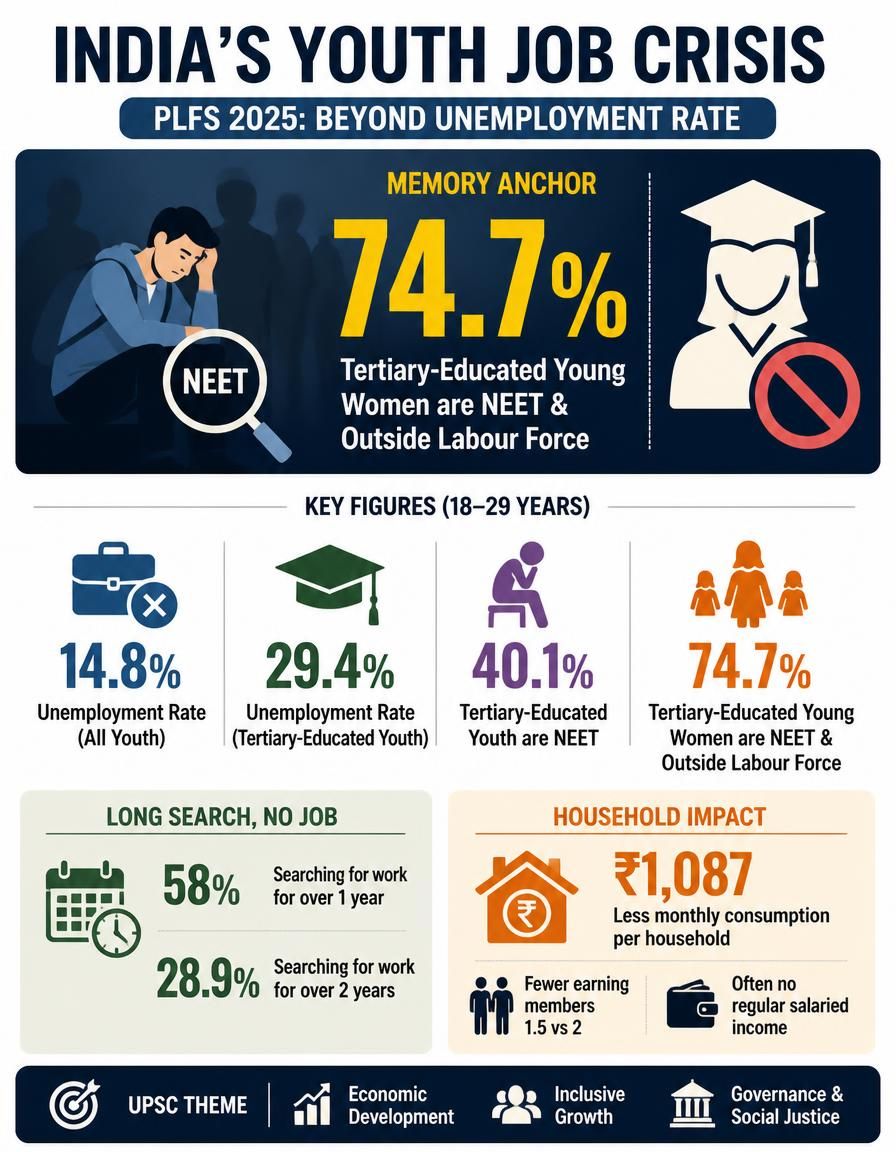
- The latest Periodic Labour Force Survey (PLFS 2025) indicates an unemployment rate of 14.8% among Indian youth aged 18-29.
- For tertiary-educated youth, the unemployment rate rises significantly to 29.4%.
- A broader measure reveals that 40.1% of tertiary-educated youth are NEET (Not in Employment, Education, or Training).
- Among tertiary-educated young women, 74.7% are NEET and outside the labor force, not actively seeking work.
- Households supporting an unemployed tertiary-educated youth spend, on average, ₹1,087 less per month on consumption.
- Nearly three in five (58%) unemployed tertiary-educated youth have been searching for work for over a year, with 28.9% searching for more than two years.
Job crisis.jpg
Detailed Insights:
- The article highlights that the conventional unemployment rate alone does not fully capture the youth employment crisis, as it excludes those who have stopped looking for work.
- The NEET statistic provides a more comprehensive picture by including individuals who are neither working, studying, nor undergoing training.
- The financial burden of youth unemployment extends beyond the individual to the household, impacting family consumption and savings.
- Households with an unemployed educated youth typically have fewer earning members (1.5 compared to 2) and often lack regular salaried income.
- Prolonged job searches deplete household savings and can force young adults to accept jobs below their qualifications, prioritizing "any job" over economic insecurity.
- Current employment policies often treat joblessness as an individual problem, focusing on apprenticeships and skilling, but need to consider the household's economic circumstances.
- Reducing delays in entry into work is crucial not only for the labor market but also to alleviate the financial strain on supporting families.
Key Concepts Involved:
- Periodic Labour Force Survey (PLFS): India's official survey conducted by the National Statistical Office to measure employment and unemployment, providing quarterly urban and annual rural-urban estimates.
- NEET (Not in Employment, Education, or Training): Refers to young people who are neither employed, nor in formal education, nor undergoing vocational training, encompassing both unemployed and economically inactive individuals.
- Unemployment Rate: The percentage of people in the labor force who are unemployed but actively seeking or available for work.
- Demographic Dividend: The potential economic growth that can result from shifts in a population's age structure, where the working-age population is larger than the dependent population.

SuperKalam is your personal mentor for UPSC preparation, guiding you at every step of the exam journey.
Download the App


STUDY RESOURCES
CONTACT US
ⓒ Snapstack Technologies Private Limited