GS 3: Science & TechnologyPrelimsGS 3: Space Technology
Joint ESA-JAXA BepiColombo Mission Successfully Enters Orbit Around Mercury
ESA and JAXA guide their joint BepiColombo spacecraft into Mercury's orbit after nine flybys to unravel early solar system secrets.
Source: Indian Express (Pg. 2)
Practice MCQs
789 Students attempted
Key Highlights:
- The joint mission BepiColombo, developed by the European Space Agency and the Japan Aerospace Exploration Agency, successfully entered orbit around Mercury.
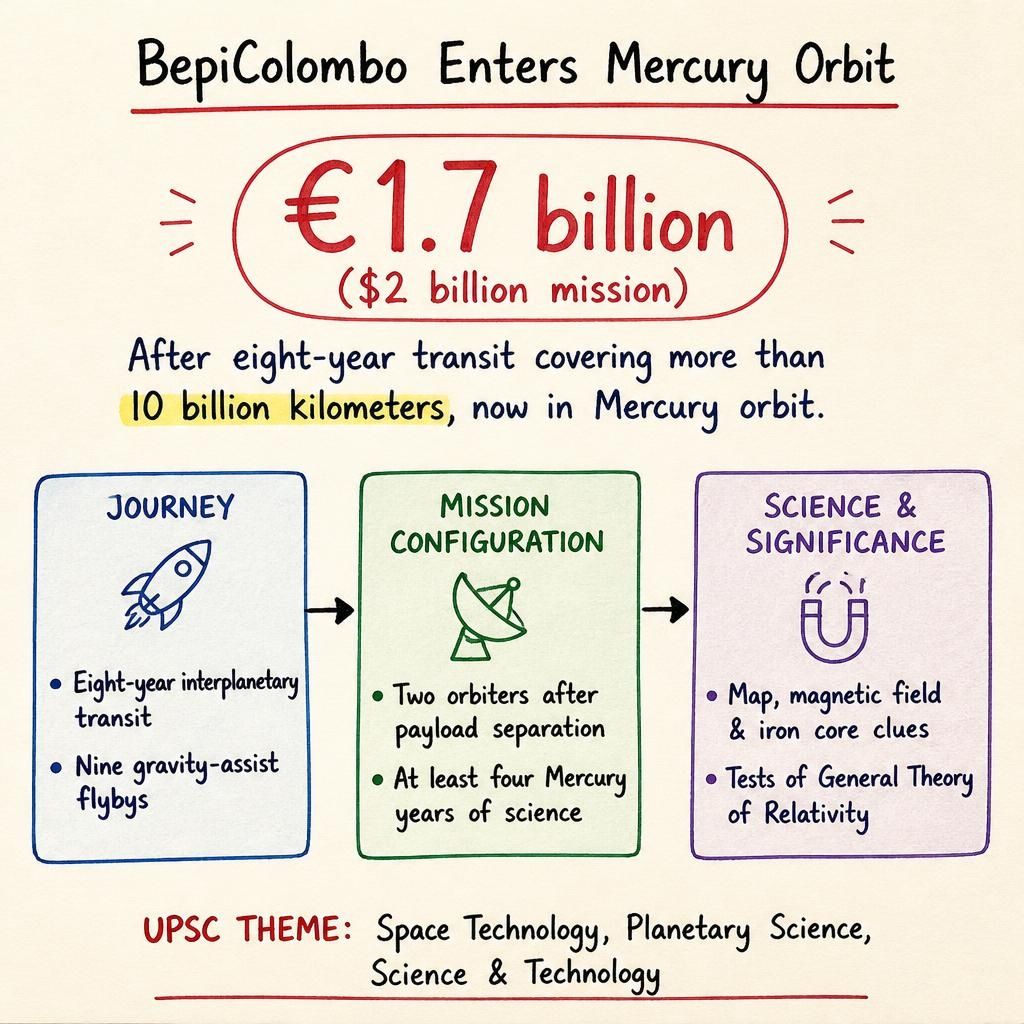
- The €1.7 billion ($2 billion) mission completed an eight-year interplanetary transit covering more than 10 billion kilometers.
- The spacecraft executed nine planetary gravity-assist flybys—one around Earth, two around Venus, and six around Mercury—to decelerate into orbit.
- BepiColombo is the third mission to visit the innermost planet, following the Mariner 10 flybys and the MESSENGER orbital mission.
- The conjoined probe will separate into two distinct orbiters to conduct simultaneous dual-platform scientific mapping for at least four Mercury years.
BepiColombo.jpg
Detailed Insights:
- The mission payload separates into the European Mercury Planetary Orbiter for cartography and the Japanese Mercury Magnetospheric Orbiter for magnetic field analysis.
- Inserting a probe into Mercury orbit demands immense braking energy to counter the intense gravitational pull of the nearby Sun.
- Data on Mercury’s disproportionately dense iron core will offer vital clues about planetary formation conditions in the early solar nebula.
- Radioscience instruments onboard the orbiter will conduct high-precision tests of the General Theory of Relativity by tracking orbital perihelion shifts.
- The orbiters rely on multi-layer ceramic insulation and radiator cooling loops to endure solar radiation temperatures exceeding 427 degrees Celsius.
Scientific/Technical Concepts Involved:
- Gravity Assist: Utilizing a planet’s orbital velocity and gravitational field to modify a spacecraft’s trajectory without expending fuel.
- Magnetosphere: A planetary magnetic bubble that shields a celestial body by deflecting high-energy solar wind streams.
- Perihelion Precession: The continuous orbital rotation of a planet's point of closest approach toward the Sun over time.

SuperKalam is your personal mentor for UPSC preparation, guiding you at every step of the exam journey.
Download the App


STUDY RESOURCES
CONTACT US
ⓒ Snapstack Technologies Private Limited