GS 2: GovernanceGS 3: Science & TechnologyGS 2: Social JusticePrelimsGS 2: Government policies and interventions for development in various sectors
ICMR SAMPADA Survey Reports Lower Anaemia Prevalence Across India
ICMR’s nationwide SAMPADA survey of two lakh individuals reveals lower anaemia prevalence, with severe cases dropping below two percent across demographic groups.
Source: PIB
Practice MCQs
789 Students attempted
Key Highlights:
- Indian Council of Medical Research (ICMR) released findings from the SAMPADA (Survey for Assessment of Markers of Population Health, Activity, Diet and Anthropometry) 2023–2025 report.
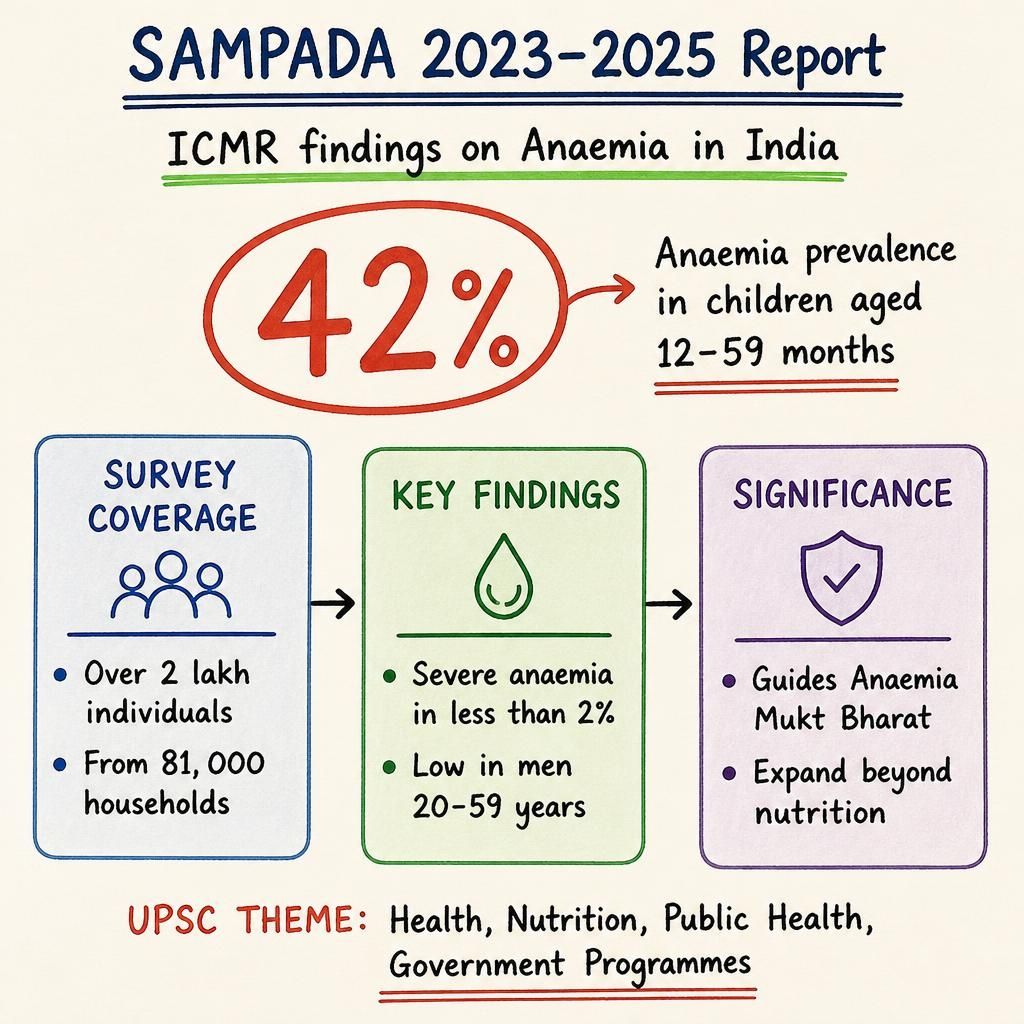
- The nationwide survey covered over 2 lakh individuals from 81,000 households across 183 districts in 35 States and Union Territories.
- The study reported a significantly lower prevalence of anaemia than earlier surveys, with severe anaemia observed in less than 2% of individuals in most age groups.
- Anaemia prevalence was recorded at 42% in children aged 12–59 months, 46% in adolescent girls, and 56% in women of reproductive age.
- Men aged 20–59 years and adolescent boys recorded lower prevalence rates of 22–23%, with over three-fourths of their cases categorized as mild.
- Iron deficiency contributed to roughly half of the anaemia burden in vulnerable groups, while folate and vitamin B12 deficiencies showed negligible association.
SAMPADA Report.jpg
Detailed Insights:
- The assessment utilized venous blood sampling and automated analyzers, offering a more reliable diagnostic benchmark than finger-prick capillary blood tests.
- High concentrations of mild anaemia indicate reduced risk of severe clinical complications and point to major opportunities for community-level dietary interventions.
- Evidence shows anaemia is not purely nutritional, requiring policy expansion toward addressing chronic inflammation, infections, and inherited blood disorders.
- The comprehensive life-course data provides a vital epidemiological baseline to recalibrate targeted interventions under the Anaemia Mukt Bharat strategy.
Scientific/Technical Concepts Involved:
- Venous Blood Sampling: The drawing of blood directly from a vein, serving as the clinical gold standard for accurate haemoglobin estimation.
- Inflammatory Biomarkers: Biological indicators such as C-reactive protein used to detect systemic inflammation that can suppress red blood cell production.
- Hemoglobinopathies: A group of inherited genetic disorders affecting the structure or synthesis of haemoglobin, leading to non-nutritional forms of anaemia.

SuperKalam is your personal mentor for UPSC preparation, guiding you at every step of the exam journey.
Download the App


STUDY RESOURCES
CONTACT US
ⓒ Snapstack Technologies Private Limited