GS 2: GovernanceGS 3: Environment & EcologyPrelimsGS 3: Conservation, Pollution and Degradation
AQI Data Reveals Severe Air Quality Crisis Across Non-Metropolitan India
Central Pollution Control Board data reveals severe air pollution spikes across non-metro towns, exposing major monitoring station blackouts in 2026.
Source: The Hindu (Pg. 2)
Practice MCQs
789 Students attempted
Key Highlights:
- Data from the Central Pollution Control Board revealed air quality deterioration across several non-metro industrial towns, with Gujarat’s Nandesari recording an index jump of 159 points over four winters.
- Indo-Gangetic Plain centers such as Bhiwadi, Charkhi Dadri, Meerut, and Hajipur consistently mirrored high winter pollution levels typically associated with the Delhi National Capital Region.
- Bihar documented marked seasonal air quality improvements, with Patna’s median winter index dropping by 163 points and Begusarai’s declining by 269 points between 2022 and 2026.
- Operational rules set by the Central Pollution Control Board require monitoring stations to record at least 16 hours of daily data across three pollutants, including particulate matter, to generate a valid reading.
- Severe operational gaps persisted across regional sensors, with 21 ambient monitoring stations logging insufficient operational hours on 200 or more days during 2026.
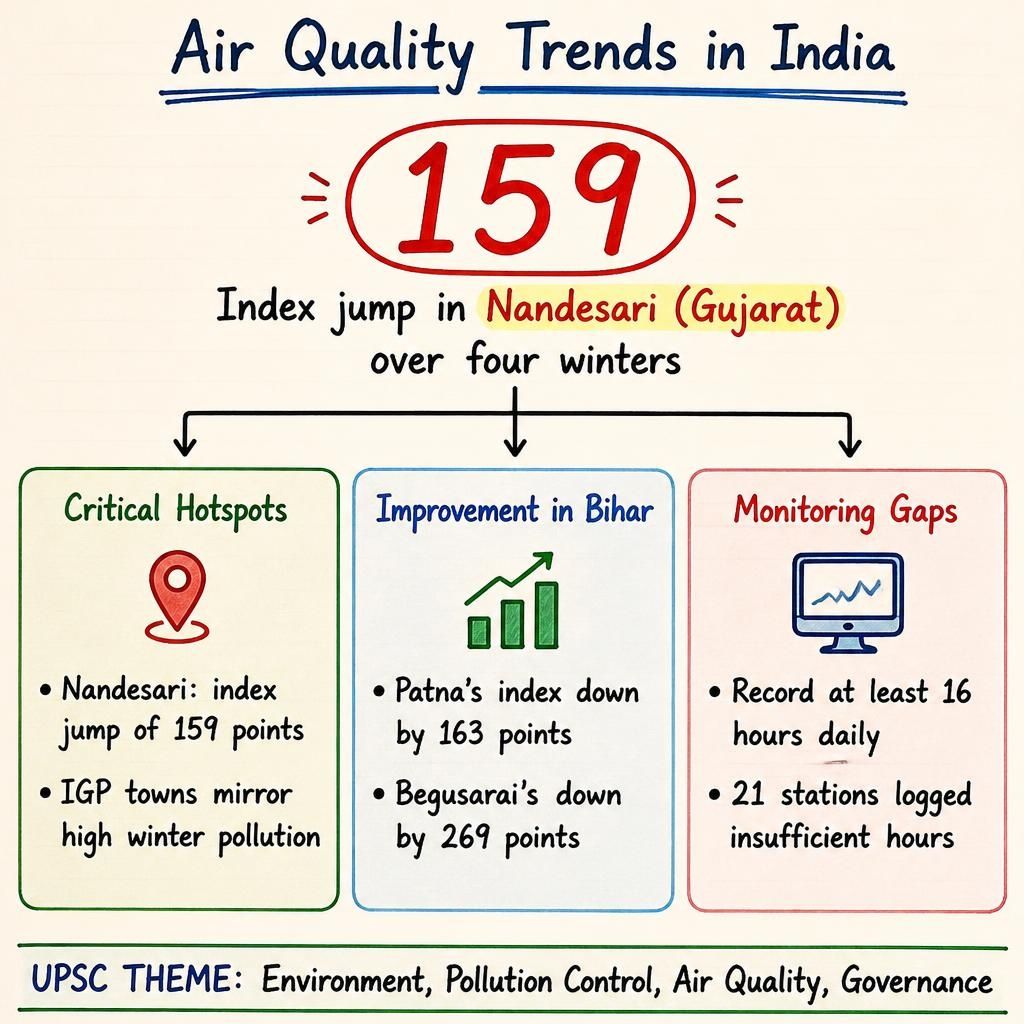
Air Quality Trends.jpg
Detailed Insights:
- Regional winter meteorology creates a uniform Indo-Gangetic airshed, where thermal inversion and shallow boundary layers trap emissions regardless of administrative boundaries.
- Targeted interventions supported by the National Clean Air Programme, including zig-zag kiln retrofitting and tax incentives for cleaner commercial fuels, drove localized emission reductions in Bihar.
- Regulatory enforcement under the Air (Prevention and Control of Pollution) Act, 1981 faces verification challenges when continuous monitoring stations experience frequent, unexplained data blackouts.
- Relying on single monitoring stations in non-metropolitan urban areas distorts baseline pollution metrics whenever sensors experience technical downtime or localized contamination.
Scientific/Technical Concepts Involved:
- Continuous Ambient Air Quality Monitoring Station: Automated network measuring real-time concentrations of ambient pollutants through calibrated, continuous sampling sensors.
- Beta Attenuation Monitor: Radiometric device measuring particulate mass concentration by passing high-energy electron streams through collected filter tapes.
- Atmospheric Boundary Layer: Lowest layer of the troposphere directly affected by terrestrial heating, which contracts during winter to trap surface pollutants.
- Air Quality Index: Standardized numerical indicator that converts concentrations of multiple criteria air pollutants into a singular health risk score.

SuperKalam is your personal mentor for UPSC preparation, guiding you at every step of the exam journey.
Download the App


STUDY RESOURCES
CONTACT US
ⓒ Snapstack Technologies Private Limited