GS 2: International RelationsPrelimsGS 2: Bilateral, Regional and Global Groupings and AgreementsGS 2: Effect of Policies and Politics of Developed and Developing Countries on India's InterestsGS 3: IT and Computers
With Trump-Xi Truce, China Looks to Reshape Asian Order, Pg16
Trump and Xi extend truce amidst strategic competition, as China aims to reshape the Asian security order, challenging US influence.
Practice MCQs
775 Students attempted
Key Highlights:
- U.S. President Donald Trump hosted Chinese President Xi Jinping at the White House for talks aimed at extending a bilateral truce.
- Both leaders previously committed to building a "constructive relationship of strategic stability" during a May meeting in Beijing.
- The visit occurred amidst ongoing tensions, including the Pentagon listing Chinese companies like Alibaba and BYD for alleged "civil-military fusion" activities.
- China aims to reshape the Asian security order, advocating for "Asian solutions to Asian problems" and reduced U.S. influence in the region.
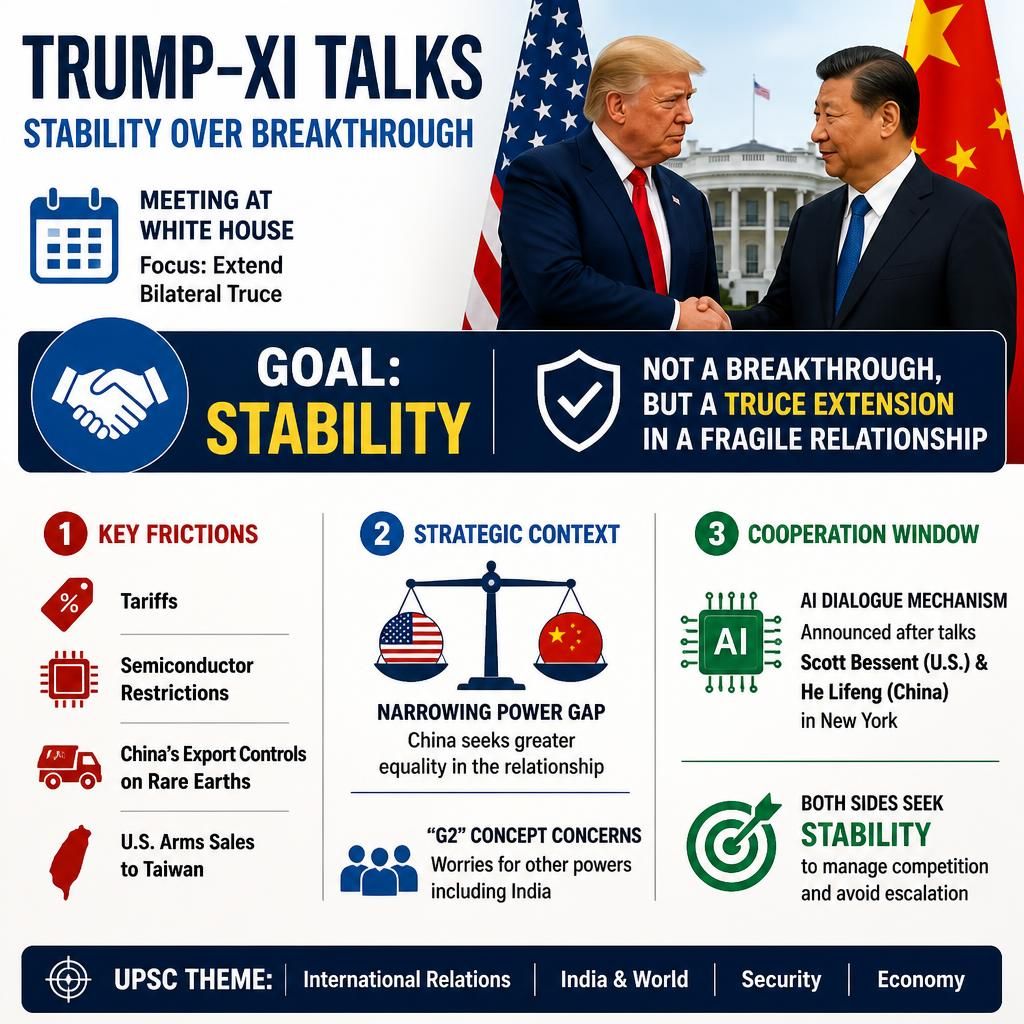
Trump-XI Talks.jpg
Detailed Insights:
- The current meeting between President Trump and President Xi was largely seen as an effort to stabilize a contentious relationship rather than achieve a major breakthrough.
- Mr. Trump's continued interest in a "G2" concept, suggesting a joint U.S.-China leadership, has raised concerns among other regional powers, including India.
- Points of friction between the two nations include tariffs, restrictions on semiconductors, Chinese export controls on rare earths, and U.S. arms sales to Taiwan.
- Despite these issues, both sides have reasons to pursue stability, with China viewing the relationship from a position of greater equality due to a narrowing power differential.
- Discussions between U.S. Treasury Secretary Scott Bessent and Chinese Vice Premier He Lifeng in New York led to the establishment of a dialogue mechanism for AI cooperation.
- Chinese strategists, including Li Kai of the China Institutes for Contemporary International Relations (CICIR), advocate for regional affairs to be managed by Asian countries themselves.
- This approach emphasizes fending off external interference, managing divergences, and facilitating peaceful dispute resolution within Asia.
Key Concepts Involved:
- Constructive relationship of strategic stability: A diplomatic framework proposed by China and accepted by the U.S. to guide bilateral relations, focusing on managing competition and avoiding conflict.
- G2: A hypothetical informal grouping of the United States and China, suggesting they act as a dual-superpower steering committee for global affairs.
- Civil-military fusion: A Chinese national strategy to integrate commercial, academic, and industrial resources with military development to advance the People's Liberation Army's modernization.
- Asian solutions to Asian problems: A principle advocating that Asian countries should lead and manage regional affairs and resolve disputes without external interference.
Previous12/12

SuperKalam is your personal mentor for UPSC preparation, guiding you at every step of the exam journey.
Download the App


STUDY RESOURCES
CONTACT US
ⓒ Snapstack Technologies Private Limited