GS 1: Post-Independence IndiaGS 2: GovernanceGS 2: PolityGS 1: Art & CulturePrelims
Tulu's 'official' tag in Karnataka: What this means, Pg4
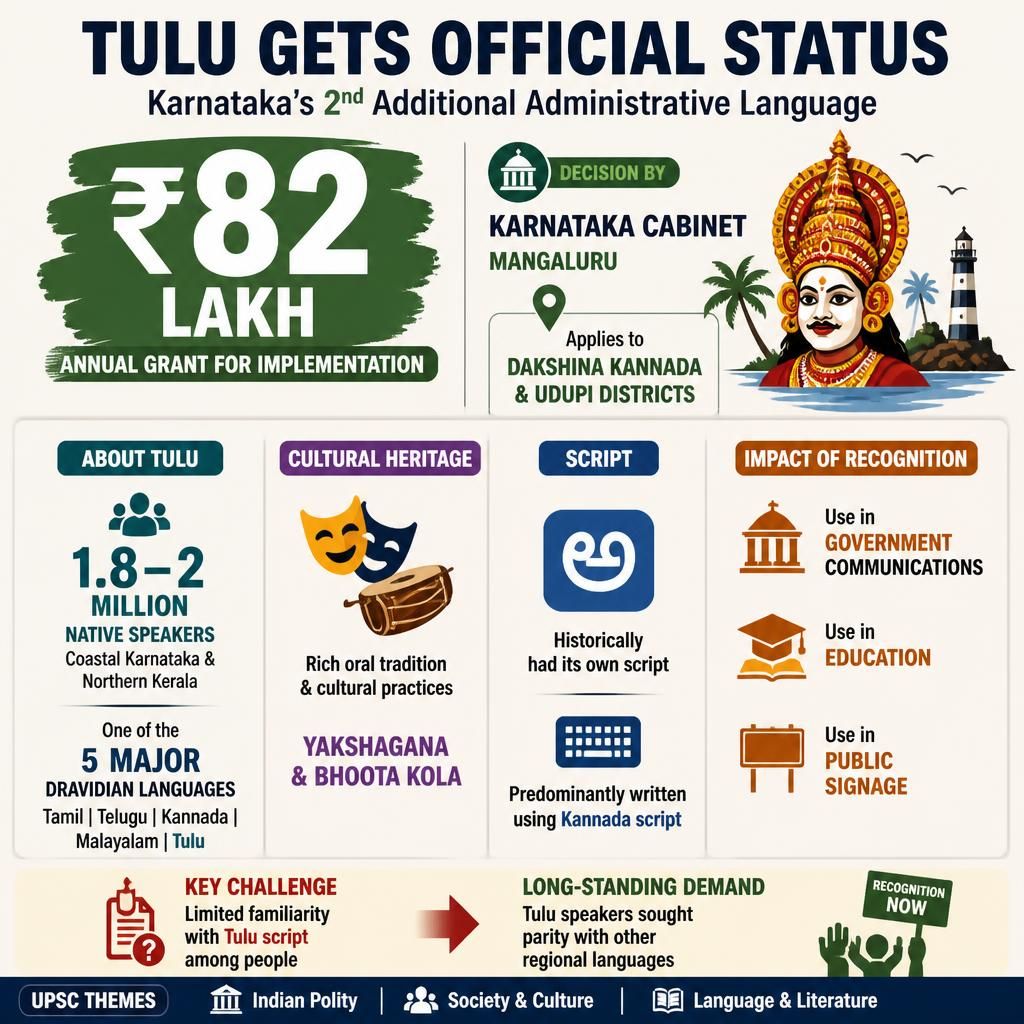
Karnataka government grants Tulu second additional administrative language status in Dakshina Kannada and Udupi districts, recognizing its cultural significance.
Practice MCQs
775 Students attempted
Key Highlights:
- The Karnataka government recently accorded Tulu the status of second additional administrative language.
- This recognition applies specifically to the coastal districts of Dakshina Kannada and Udupi.
- The decision was announced during a special state Cabinet meeting held in Mangaluru.
- An annual grant of Rs 82 lakh has been allocated to facilitate implementation, including translation and training.
Tulu Language.jpg
Detailed Insights:
- Tulu is classified as one of the five major Dravidian languages, alongside Tamil, Telugu, Kannada, and Malayalam.
- It is primarily spoken by approximately 1.8 to 2 million native speakers in coastal Karnataka and parts of northern Kerala.
- The language boasts a rich oral tradition and cultural practices such as Yakshagana and Bhoota Kola.
- Although Tulu historically had its own script, it is predominantly written using the Kannada script today.
- The demand for official recognition has been long-standing, with Tulu speakers seeking parity with other regional languages.
- Official status enables the use of Tulu in government communications, education, and public signage within the designated districts.
- A significant challenge to implementation is the limited familiarity with the Tulu script among the general populace.
- The move is also perceived as a political strategy by the ruling Congress government to connect with voters in coastal Karnataka, a region traditionally considered a BJP stronghold.
Key Concepts Involved:
- Dravidian Languages: A family of languages predominantly spoken in Southern India and parts of Sri Lanka.
- Second Additional Administrative Language: A language recognized for official use alongside the primary official language in specific regions.
- States Reorganisation Act, 1956: A landmark Indian parliamentary act that reorganized states along linguistic lines.

SuperKalam is your personal mentor for UPSC preparation, guiding you at every step of the exam journey.
Download the App


STUDY RESOURCES
CONTACT US
ⓒ Snapstack Technologies Private Limited