GS 2: International RelationsGS 3: EconomyPrelimsGS 3: Indian Economy, Planning, Mobilization of Resources, Growth, Development and EmploymentGS 2: Effect of Policies and Politics of Developed and Developing Countries on India's Interests
The backdrop in which the U.S. Fed raised interest rate, Pg7
US Federal Reserve hikes interest rates by 25 basis points to combat persistent inflation and soaring public debt, defying political pressure.
Practice MCQs
775 Students attempted
Key Highlights:
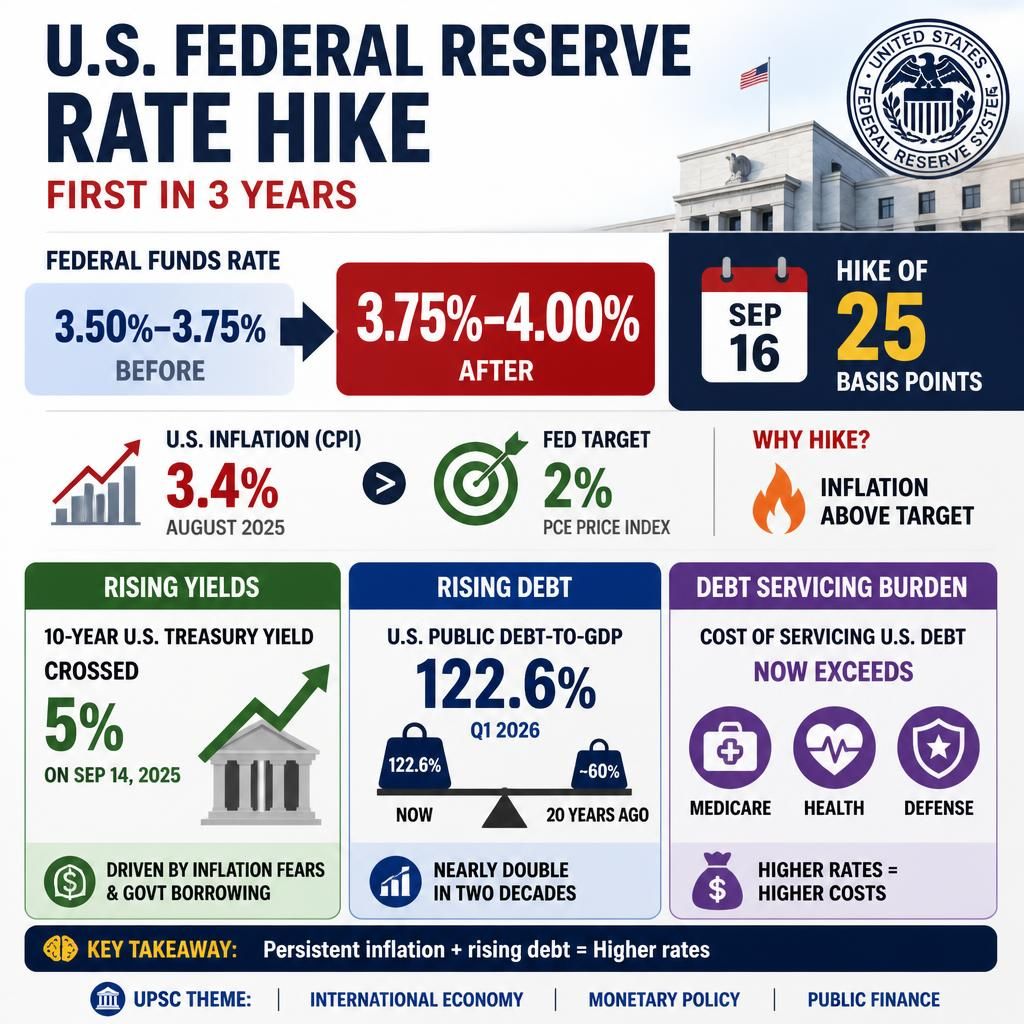
- The U.S. Federal Reserve raised its short-term interest rate, the federal funds rate, by 25 basis points on September 16, marking the first increase in three years.
- The rate moved from a range of 3.5%-3.75% to 3.75%-4%.
- The decision by the Federal Open Market Committee, led by Chair Kevin Warsh, aimed to combat persistent inflation.
- U.S. inflation, measured by the Consumer Price Index, stood at 3.4% in August, remaining above the Federal Reserve's 2% target.
- The increase in interest rates occurred amidst rising U.S. public debt and increasing 10-year U.S. Treasury bond yields.
US Fed Reserve Rate Hike.jpg
Detailed Insights:
- The federal funds rate is broadly comparable to the Reserve Bank of India's repo rate, serving as a key policy tool.
- The rate hike was influenced by inflation, which surged after the U.S.-Israel war with Iran began in February.
- Inflation peaked at 4.2% in May before declining to 3.4% in August, still exceeding the Federal Reserve's target measured by the Personal Consumption Expenditures (PCE) price index.
- Long-term bond yields, including the 10-year U.S. Treasury bond, crossed 5% on September 14, driven by inflation fears and government borrowing.
- The U.S. public debt-to-GDP ratio reached 122.6% in the first quarter of 2026, nearly double what it was two decades prior.
- The cost of servicing the U.S. government's debt now surpasses its spending on Medicare, health, and defense.
- The Stockholm International Peace Research Institute notes that U.S. defense spending accounts for one-third of global military expenditure.
Key Concepts Involved:
- Federal Funds Rate: The target interest rate set by the Federal Open Market Committee for overnight borrowing and lending between banks.
- Inflation: The rate at which the general level of prices for goods and services is rising, and subsequently, purchasing power is falling.
- Consumer Price Index (CPI): A measure that examines the weighted average of prices of a basket of consumer goods and services, used to gauge inflation.
- Personal Consumption Expenditures (PCE) Price Index: A measure of the prices of goods and services purchased by consumers, used by the Federal Reserve as its primary inflation gauge.

SuperKalam is your personal mentor for UPSC preparation, guiding you at every step of the exam journey.
Download the App


STUDY RESOURCES
CONTACT US
ⓒ Snapstack Technologies Private Limited