GS 2: PolityGS 2: International RelationsPrelimsGS 2: Bilateral, Regional and Global Groupings and AgreementsGS 2: Effect of Policies and Politics of Developed and Developing Countries on India's Interests
India and the plausible multilateralism of BRICS, Pg6
India leverages BRICS for strategic autonomy, balancing US ties with a multipolar world vision amid West Asia war and US-China rivalry.
Practice MCQs
775 Students attempted
Key Highlights:
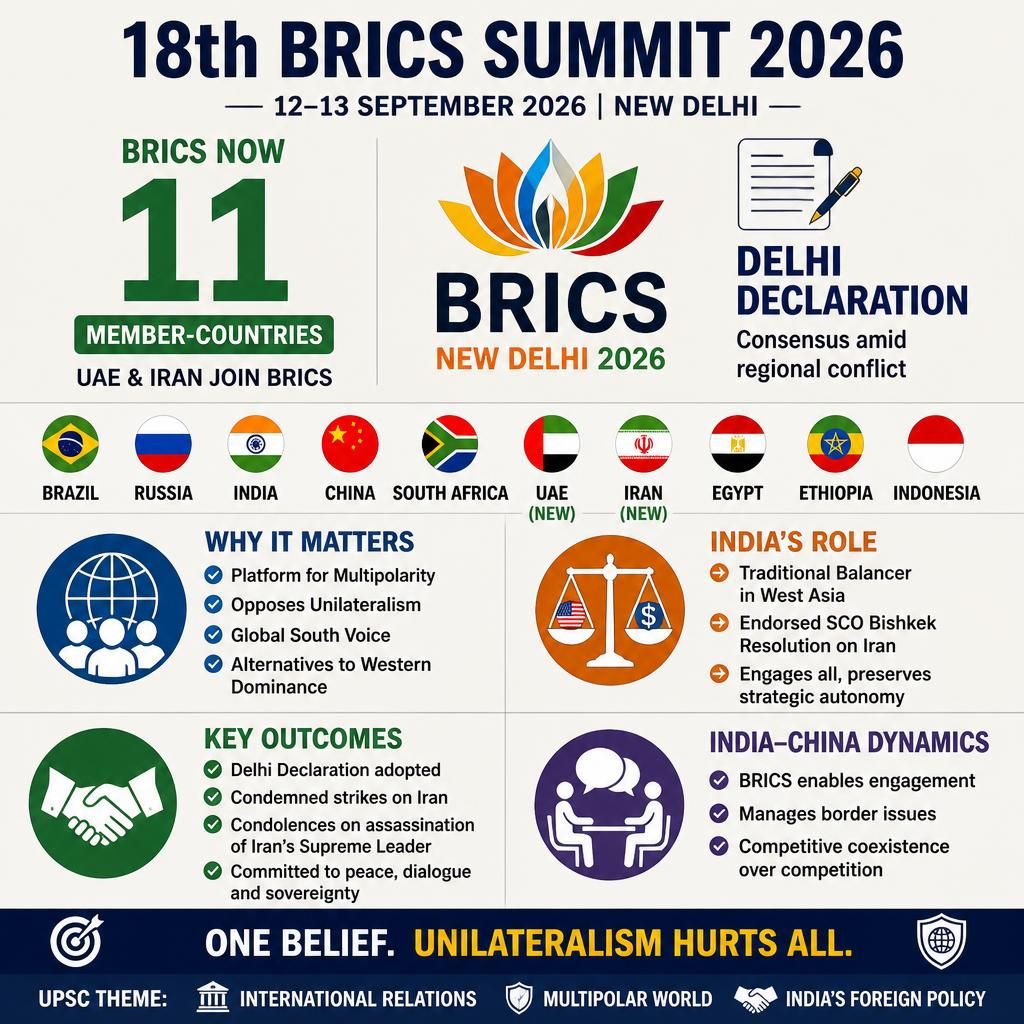
- The 18th BRICS summit was held in New Delhi on September 12-13, 2026, attracting significant global attention.
- The summit occurred amidst the U.S.-Israel war against Iran, which began on February 28, 2026, in India’s extended neighborhood.
- India hosted the summit, bringing together leaders including the Presidents of Iran, Russia, and China.
- The Delhi Declaration was issued, demonstrating consensus among the 11 member-countries, including the United Arab Emirates and Iran, despite regional conflicts.
- India, initially neutral on the Iran conflict, repositioned itself as a traditional balancer in West Asia.
18th BRICS Summit.jpg
Detailed Insights:
- BRICS is viewed by some as a platform to foster multipolarity in the global order, while others express concerns about internal divisions or potential domination by Russia and China.
- India endorsed the Bishkek resolution of the Shanghai Cooperation Organisation (SCO), condemning strikes on Iran and expressing condolences for the assassination of its Supreme Leader.
- Multilateral forums like BRICS provide a crucial platform for India and China to maintain engagement and manage their border issues, fostering competitive coexistence.
- BRICS members generally converge on the view that unilateralism by any power is detrimental to global interests, despite differing approaches on specific issues like Artificial Intelligence regulation or climate change.
- The U.S. approach, characterized by a focus on its own dominance, has led to difficult experiences for several BRICS members, including India facing tariffs and economic impact from the Iran war.
- India's foreign policy, often described as "sabke sath" or multi-alignment, aims for strategic autonomy and avoids becoming a frontline in great-power rivalries.
- The UAE-Iran bilateral meeting on the sidelines of the BRICS summit highlighted the use of multilateral platforms to address bilateral challenges.
- The internal contradictions within BRICS are seen as preventing domination by any single country, while external convergence on building a more representative international system holds the group together.
Key Concepts Involved:
- Multilateralism: The principle of multiple countries working together on a common issue or towards shared goals.
- Multipolarity: A distribution of power in which more than two major nation-states have nearly equal amounts of military, cultural, and economic influence.
- Strategic Autonomy: A state's ability to pursue its national interests and foreign policy objectives independently, without being unduly influenced by other powers.
- Delhi Declaration: A joint statement issued by BRICS leaders at the summit, outlining their collective stance and agreements on various global and regional issues.

SuperKalam is your personal mentor for UPSC preparation, guiding you at every step of the exam journey.
Download the App


STUDY RESOURCES
CONTACT US
ⓒ Snapstack Technologies Private Limited