GS 2: GovernanceGS 2: PolityPrelimsGS 2: Constitutional BodiesGS 2: Indian Constitutional Evolution, Features, Amendments, Basic Structure Doctrine
EC Appointment: Why SC Placed Matter Before CJI, Pg4
Supreme Court refers petitions challenging new EC appointment law, which excludes CJI, to Chief Justice for Constitution Bench consideration.
Practice MCQs
775 Students attempted
Key Highlights:
- A two-judge bench of the Supreme Court referred petitions challenging the Chief Election Commissioner and Other Election Commissioners (Appointment, Conditions of Service and Term of Office) Act, 2023 to the Chief Justice of India (CJI) for consideration of forming a Constitution Bench.
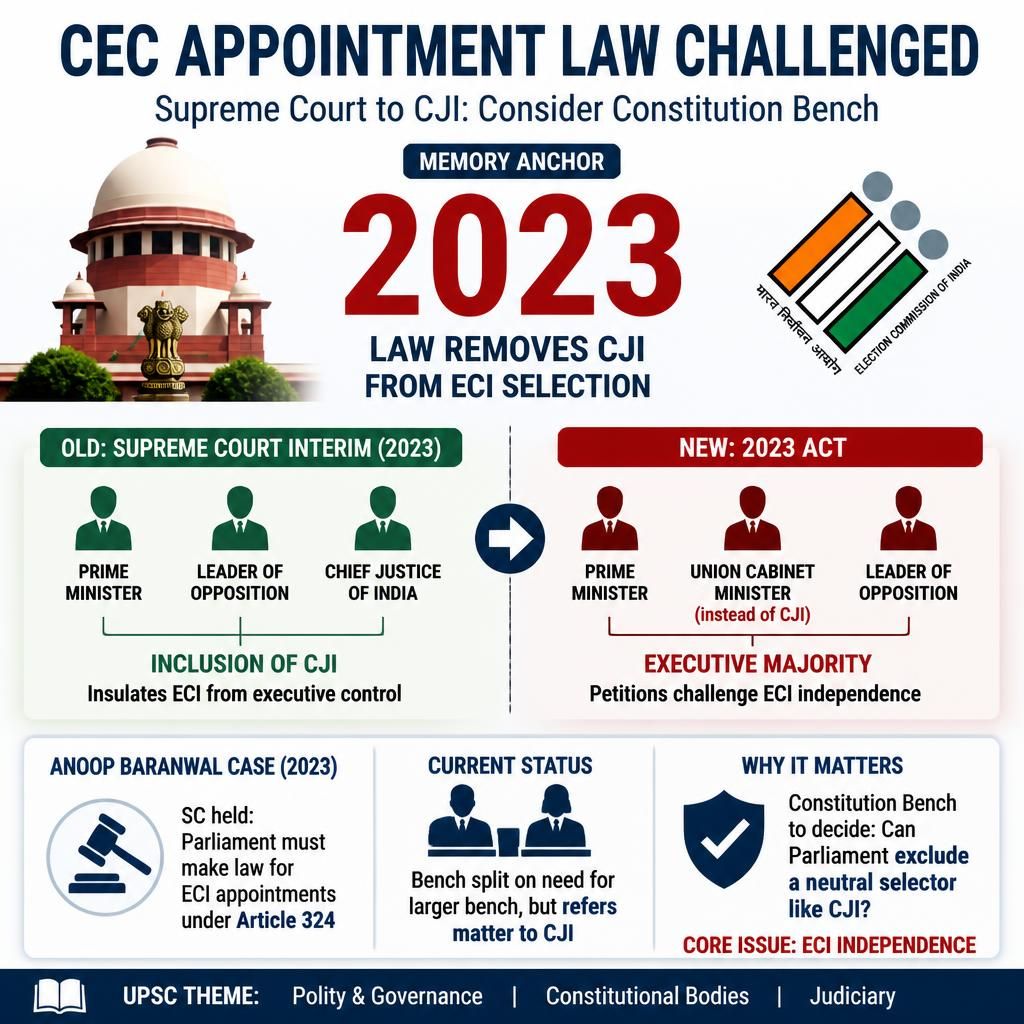
- The 2023 Act removed the CJI from the selection committee for the Chief Election Commissioner (CEC) and Election Commissioners (ECs), replacing them with a Union Cabinet minister.
- This new law superseded an interim mechanism established by the Supreme Court in the Anoop Baranwal v. Union of India case (2023), which included the Prime Minister, Leader of Opposition, and the CJI in the selection process.
- Justices Dipankar Datta and Satish Chandra Sharma, while split on whether a larger bench was immediately necessary, agreed to place the matter before the CJI to avoid delays and address important constitutional questions.
CEC Appointment.jpg
Detailed Insights:
- The petitions argue that the Chief Election Commissioner and Other Election Commissioners (Appointment, Conditions of Service and Term of Office) Act, 2023 undermines the independence of the Election Commission of India (ECI) by giving the executive a majority in the selection committee.
- The Anoop Baranwal judgment of March 2023 had highlighted the absence of a parliamentary law for appointments to the ECI, as contemplated by Article 324 of the Constitution.
- The Supreme Court's interim arrangement in Anoop Baranwal aimed to insulate the ECI from exclusive executive influence by including the CJI in the selection committee.
- Justice Satish Chandra Sharma emphasized that the constitutional validity of the 2023 Act is being examined for the first time, necessitating a Constitution Bench to address the "important question" of whether Parliament was justified in excluding a neutral selector.
- Justice Dipankar Datta, however, believed the current bench could decide the matter, as the principle of insulating the ECI from executive control was already settled in Anoop Baranwal.
- The judges expressed concern over long delays in deciding constitutional references, citing the Anoop Baranwal case itself, which took eight years to reach a final judgment.
- The Chief Election Commissioner and Other Election Commissioners (Appointment, Conditions of Service and Term of Office) Act, 2023 establishes a selection committee comprising the Prime Minister (Chairperson), the Leader of Opposition in Lok Sabha, and a Union Cabinet Minister nominated by the Prime Minister.
Key Concepts Involved:
- Chief Election Commissioner and Other Election Commissioners (Appointment, Conditions of Service and Term of Office) Act, 2023: A law enacted by Parliament to regulate the appointment, conditions of service, and term of office for the CEC and ECs.
- Anoop Baranwal v. Union of India (2023): A landmark Supreme Court judgment that established an interim selection committee for CEC and ECs, including the CJI, until Parliament legislated on the matter.
- Article 324: A constitutional provision that vests the superintendence, direction, and control of elections in an independent Election Commission of India.
- Constitution Bench: A bench of the Supreme Court comprising five or more judges, constituted to decide cases involving a substantial question of law regarding the interpretation of the Constitution.

SuperKalam is your personal mentor for UPSC preparation, guiding you at every step of the exam journey.
Download the App


STUDY RESOURCES
CONTACT US
ⓒ Snapstack Technologies Private Limited