GS 1: Indian SocietyGS 2: Social JusticeGS 3: EconomyPrelimsGS 3: Indian Economy, Planning, Mobilization of Resources, Growth, Development and Employment
The Rural-Urban Divide In Female Labour Force Participation, Pg9
Post-pandemic, India witnesses significant rise in female labour force participation, with rural areas outpacing urban growth, revealing stark regional disparities.
Practice MCQs
767 Students attempted
Key Highlights:
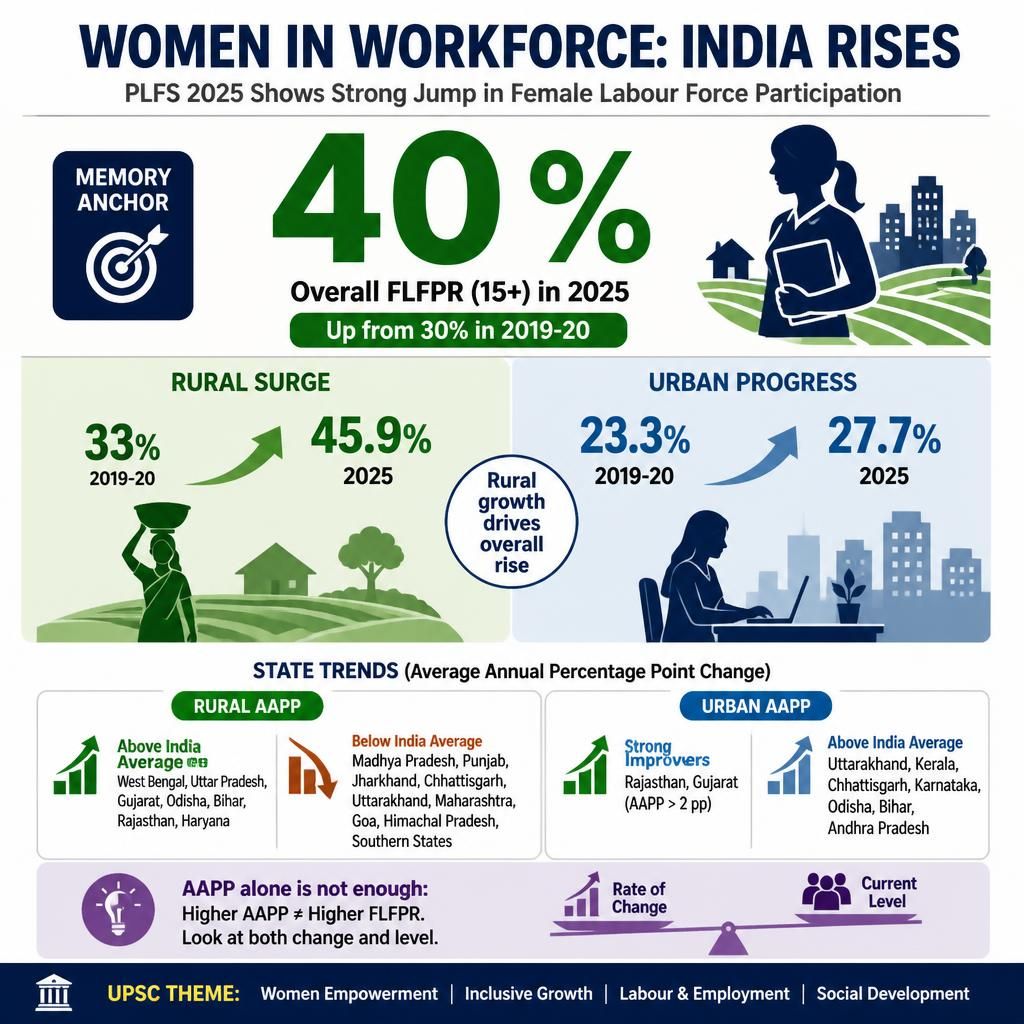
- The overall Female Labour Force Participation Rate (FLFPR) for individuals aged 15 years and above in India increased from 30% in 2019-20 to 40% in 2025.
- This significant rise was primarily driven by rural areas, where the FLFPR surged from 33% to 45.9%.
- In contrast, urban areas saw a more modest increase in FLFPR, from 23.3% to 27.7% during the same period.
- The data is based on the Periodic Labour Force Survey (PLFS) 2025.
FLFPR.jpg
Detailed Insights:
- The increase in rural FLFPR was more pronounced, showing a substantial rural-urban divide in labour force participation trends.
- States like West Bengal, Uttar Pradesh, Gujarat, Odisha, Bihar, Rajasthan, and Haryana recorded an Average Annual Percentage Point (AAPP) change in rural FLFPR above the all-India rural average.
- Conversely, Madhya Pradesh, Punjab, Jharkhand, Chhattisgarh, Uttarakhand, Maharashtra, Goa, Himachal Pradesh, and the five southern States showed AAPP below the national rural average, though most still registered positive annual changes.
- In urban areas, Rajasthan and Gujarat demonstrated particularly strong improvements with AAPP above 2 percentage points per year.
- Uttarakhand, Keralam, Chhattisgarh, Karnataka, Odisha, Bihar, and Andhra Pradesh also recorded urban AAPP above the all-India urban average.
- The analysis highlights that AAPP alone is insufficient, as a state with a lower AAPP might already have a relatively high FLFPR.
- Some states, like Bihar, Uttar Pradesh, West Bengal, and Haryana, started with low rural FLFPR but showed faster improvement with above-average AAPP.
- Other states, such as Odisha, Gujarat, and Rajasthan, started with higher baseline rural FLFPR and continued to show rapid gains with above-average AAPP.
Key Concepts Involved:
- Female Labour Force Participation Rate (FLFPR): The proportion of women in a specified age group (typically 15 years and above) who are either employed or actively seeking work.
- Periodic Labour Force Survey (PLFS): India's official survey conducted by the National Statistical Office (NSO) under the Ministry of Statistics and Programme Implementation (MoSPI) to measure employment and unemployment data.
- Average Annual Percentage Point (AAPP): A measure indicating the average yearly change in percentage points of a particular indicator over a defined period.

SuperKalam is your personal mentor for UPSC preparation, guiding you at every step of the exam journey.
Download the App


STUDY RESOURCES
CONTACT US
ⓒ Snapstack Technologies Private Limited