GS 2: GovernanceGS 3: Science & TechnologyGS 2: International RelationsGS 3: Environment & EcologyPrelims
Global space norms find a firm footing in India’s new re-entry rules, Pg II
India unveils its first planned re-entry guidelines for space objects, establishing accountability and risk assessment for private operators to ensure orbital sustainability.
Practice MCQs
767 Students attempted
Key Highlights:
- India has introduced its first guidelines on planned re-entry of space objects, issued by the Indian National Space Promotion and Authorisation Centre (IN-SPACe).
- The guidelines aim to regulate responsibilities for India's expanding orbital footprint and address the sustainability of outer space activities.
- They were released days after the success of Vikram-1 and coincide with India's third National Space Day.
- The new rules focus on accountability for operators, establish an acceptable casualty risk threshold, and outline a structured permission process.
Space guidelines.png
Detailed Insights:
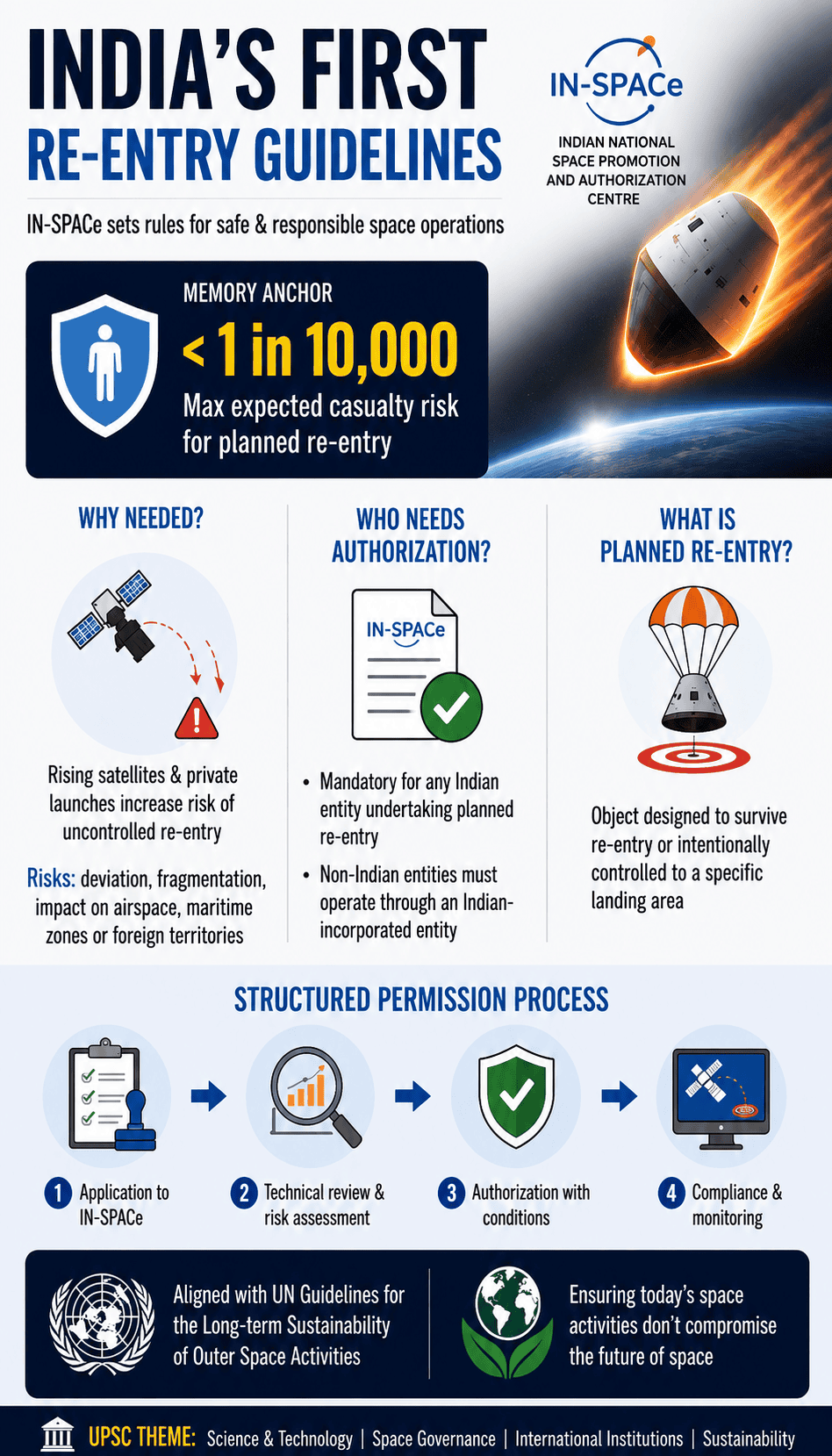
- The necessity for re-entry rules arises from the increasing number of satellites in Low-Earth Orbit and the proliferation of private space launches.
- Uncontrolled re-entry poses significant risks, including deviation from planned paths, fragmentation, and potential impact on airspace, maritime zones, or foreign territories.
- The UN Guidelines for the Long-term Sustainability of Outer Space Activities define sustainability as maintaining space activities while preserving the outer space environment for future generations.
- IN-SPACe authorization is mandatory for any Indian entity undertaking planned re-entry, and non-Indian entities must operate through an Indian-incorporated entity.
- A "planned re-entry" specifically refers to objects designed to survive re-entry or intentionally controlled towards a particular landing area, requiring distinct authorization.
- The guidelines mandate that the expected casualty risk must remain below 1 in 10,000, supported by quantitative survivability and ground-casualty assessments.
- Operators are required to apply for re-entry permissions well in advance and obtain an IN-SPACe advisory note to issue warnings to airborne and marine vessels.
- These guidelines translate international 'soft law' principles, such as those from the Inter-Agency Space Debris Coordination Committee, into binding domestic obligations for Indian operators.
- They also address financial risks under the Space Liability Convention 1972, making operators liable for third-party damage and indemnifying the Indian government.
Key Concepts Involved:
- Indian National Space Promotion and Authorisation Centre (IN-SPACe): An autonomous nodal agency under the Department of Space, Government of India, responsible for promoting, authorizing, and supervising private space activities.
- Planned Re-entry: The controlled return of a space object to Earth, specifically designed to survive re-entry or target a predetermined landing or impact area.
- Space Liability Convention 1972: An international treaty that establishes absolute liability for a launching state for damage caused by its space object on the surface of the Earth or to aircraft in flight.
- UN Guidelines for the Long-term Sustainability of Outer Space Activities: A set of international principles developed to ensure the safe and sustainable use of outer space for current and future generations.

SuperKalam is your personal mentor for UPSC preparation, guiding you at every step of the exam journey.
Download the App


STUDY RESOURCES
CONTACT US
ⓒ Snapstack Technologies Private Limited