GS 3: Science & TechnologyGS 3: Internal SecurityGS 2: International RelationsGS 3: EconomyPrelims
Warning signals for India from NATO’s Ankara summit, Pg8
NATO's Ankara Summit mandates 5% GDP defense spending, shifting global arms market to sellers' advantage, signaling warning for India's defense self-reliance.
Practice MCQs
760 Students attempted
Key Highlights:
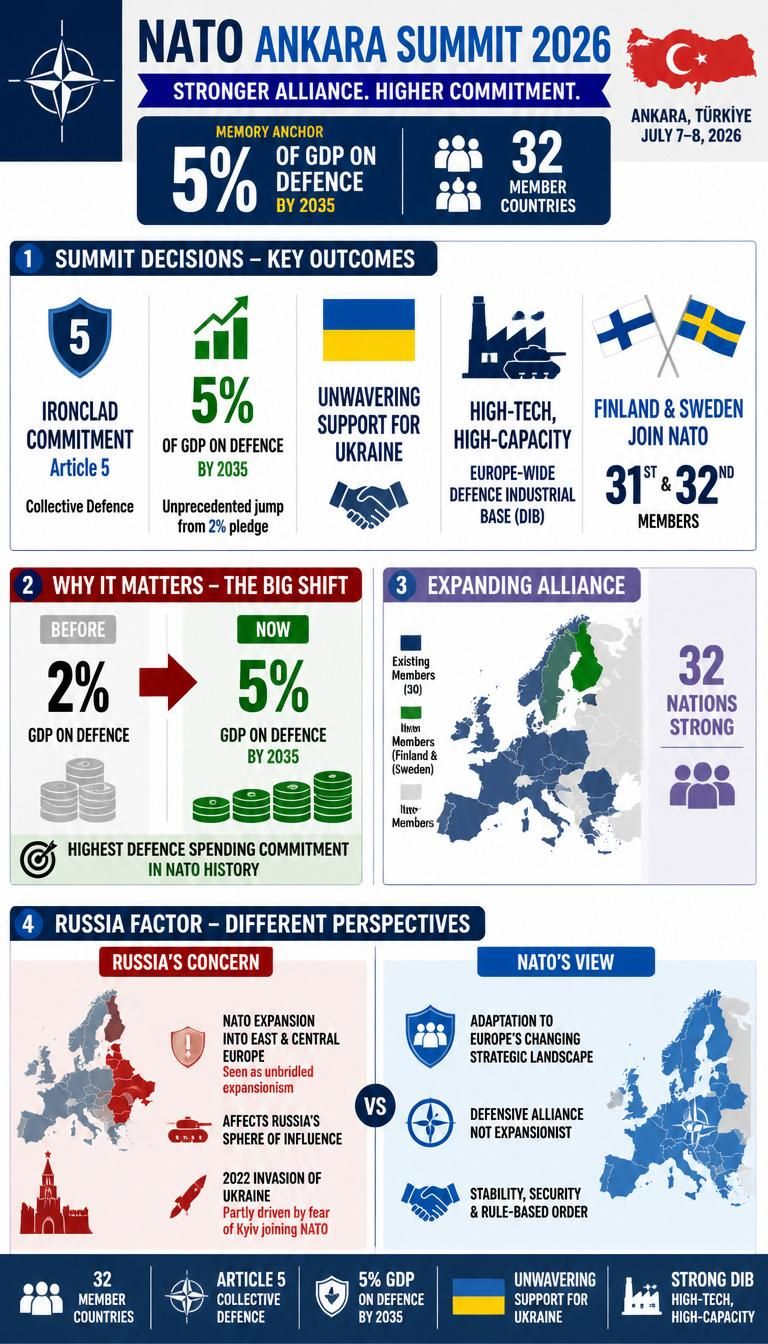
- The North Atlantic Treaty Organization (NATO) held its Ankara Summit in Türkiye on July 7-8, 2026, attended by heads of state or government from 32 member countries.
- Members reaffirmed their "ironclad commitment" to collective defense under Article 5 of the Washington Treaty and the transatlantic bond.
- The summit endorsed "The Hague defence commitment," requiring all NATO members to allocate at least five percent of their GDP to defense by 2035.
- NATO declared "unwavering support for Ukraine" and vowed to build a high-technology, high-capacity Europe-wide Defence Industrial Base (DIB).
- Finland and Sweden became NATO's 31st and 32nd members, abandoning their historically neutral stance.
NATO.jpg
Detailed Insights:
- The commitment to 5% GDP defense spending represents an unprecedented increase from the previous 2% pledge.
- Russia views NATO's expansion into East and Central European countries as unbridled expansionism, impacting its sphere of influence.
- The 2022 Russian invasion of Ukraine was partly motivated by fears of Kyiv potentially joining the Atlantic alliance.
- NATO perceives its transformations as adaptations to Europe's changing strategic landscape, rather than expansionism.
- Historically, NATO shifted its focus from the Cold War to out-of-area operations and later to the Global War on Terror.
- Europe's Defence Industrial Base (DIB) is struggling to scale up production, leading to shortages in critical areas like ammunition.
- The U.S.-Israel bombing campaign, Operation Epic Fury, against Iran highlighted potential weapon and ammunition shortages for the U.S.
- A lack of coordinated alliance-wide priorities within NATO leads to strategic mismatches in air defense, precision-guided munitions, and artillery rockets.
- Europe's dependence on the U.S. for defense spending has significantly increased, with Foreign Military Sales to European customers quadrupling since 2008.
- The surge in European demand for arms is transforming the international arms market from a buyers' to a sellers' market.
- This shift has impacted India, causing delays in the supply of F-404 fighter jet engines for its Tejas light combat aircraft program.
- India's defense sector needs to achieve self-reliance in new-age technologies like drones, artificial intelligence, and cyber warfare.
Key Concepts Involved:
- North Atlantic Treaty Organization (NATO): A politico-military alliance of 32 North American and European countries established in 1949 for collective defense.
- Article 5 of the Washington Treaty: The core principle of NATO, stating that an armed attack against one member is considered an attack against all.
- Defence Industrial Base (DIB): The collective capacity of a nation or alliance to research, develop, produce, and maintain military equipment and technology.
- Foreign Military Sales (FMS): A U.S. government program that facilitates the sale of U.S. defense equipment, services, and training to foreign governments.

SuperKalam is your personal mentor for UPSC preparation, guiding you at every step of the exam journey.
Download the App


STUDY RESOURCES
CONTACT US
ⓒ Snapstack Technologies Private Limited