GS 2: GovernanceGS 1: Indian GeographyGS 3: Environment & EcologyPrelimsGS 3: Infrastructure: Energy, Ports, Roads, Airports, Railways etc.
The green we celebrate, the forests we fell, Pg11
Uttarakhand youth stage 'Black Harela' protest against felling 4,000 trees for highway expansion, sparking fierce environmental debate.
Practice MCQs
760 Students attempted
Key Highlights:
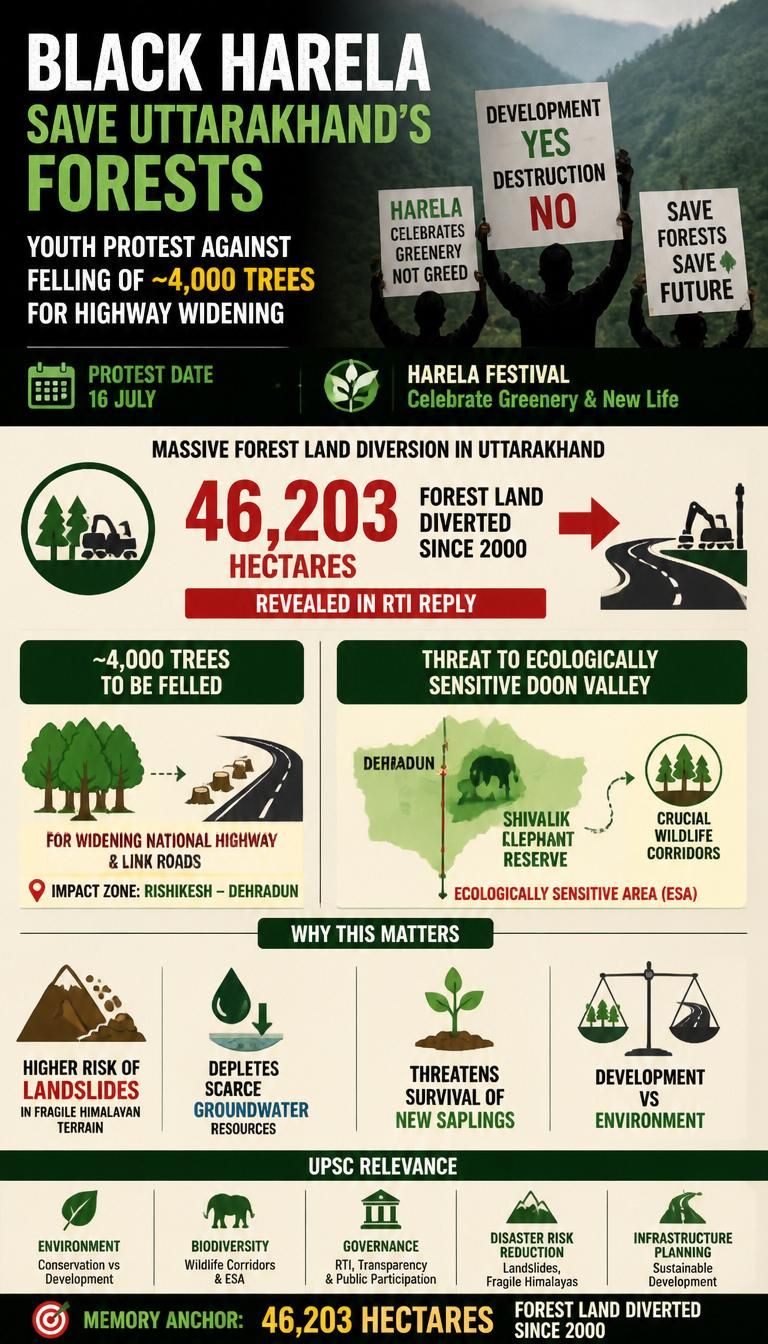
- Young people in Uttarakhand staged a "Black Harela" protest on July 16 against the proposed felling of approximately 4,000 trees for highway widening.
- The protest coincided with the traditional Harela festival, which celebrates greenery and new life in the region.
- The planned tree felling is for widening the national highway and linking roads, particularly impacting areas around Rishikesh and Dehradun.
- An RTI (Right to Information) reply revealed that since 2000, 46,203 hectares of forest land in Uttarakhand have been diverted for various projects.
Black Harela.jpg
Detailed Insights:
- The "Black Harela" demonstration highlighted a conflict between developmental projects and environmental conservation in the ecologically sensitive Himalayan state.
- The activist Anoop Nautiyal questioned the lack of public information regarding the mass felling of trees, especially in Dehradun, where a significant portion of forest land has been diverted.
- The proposed felling directly threatens the Shivalik Elephant Reserve and crucial wildlife corridors in the Doon Valley, an Ecologically Sensitive Area.
- Critics argue that such infrastructure development in fragile areas increases the risk of landslides and depletes scarce groundwater resources, impacting the survival of new saplings.
- The protest draws attention to the irony of the government's "Ek Ped Maa Ke Naam" (Plant a tree in the name of the mother) campaign amidst large-scale deforestation.
- The incident underscores the importance of balancing infrastructure development with environmental protection, particularly in biodiversity-rich regions.
Key Concepts Involved:
- Harela Festival: An annual Hindu festival celebrated in Uttarakhand and parts of Himachal Pradesh, marking the onset of the sowing season and symbolizing greenery and prosperity.
- Right to Information (RTI): A fundamental right under the Right to Information Act, 2005, allowing citizens to request information from public authorities.
- Shivalik Elephant Reserve: Notified in 2002 under Project Elephant, it is a significant conservation area in Uttarakhand known for its high density of elephants and critical migration corridors.
- Ecologically Sensitive Area (ESA): Regions notified under the Environment (Protection) Act, 1986, for their rich biodiversity, fragile ecosystems, or critical ecological functions, where certain activities are regulated to minimize environmental impact.
- Forest Conservation Act, 1980: An act enacted to control the diversion of forest land for non-forestry purposes and ensure the conservation of forests in India.
- Environmental Impact Assessment (EIA): A process of evaluating the likely environmental impacts of a proposed project or development, taking into account socio-economic, cultural, and human-health impacts, prior to decision-making.

SuperKalam is your personal mentor for UPSC preparation, guiding you at every step of the exam journey.
Download the App


STUDY RESOURCES
CONTACT US
ⓒ Snapstack Technologies Private Limited