GS 2: GovernanceGS 2: PolityGS 2: Social JusticePrelimsGS 2: Government policies and interventions for development in various sectors
How should cities reclaim footpaths?, Pg10
Bengaluru's footpath drive sparks debate over Street Vendors Act 2014, raising questions on balancing pedestrian rights with vendor livelihoods and due process.
Practice MCQs
760 Students attempted
Key Highlights:
- The Supreme Court recognized the right to walk on safe, obstruction-free footpaths as a fundamental right.
- Following this, Bengaluru initiated a 10-day 'Safe Footpath' drive, removing thousands of street vendors.
- The drive sparked debate over its compliance with the Street Vendors (Protection of Livelihood and Regulation of Street Vending) Act, 2014.
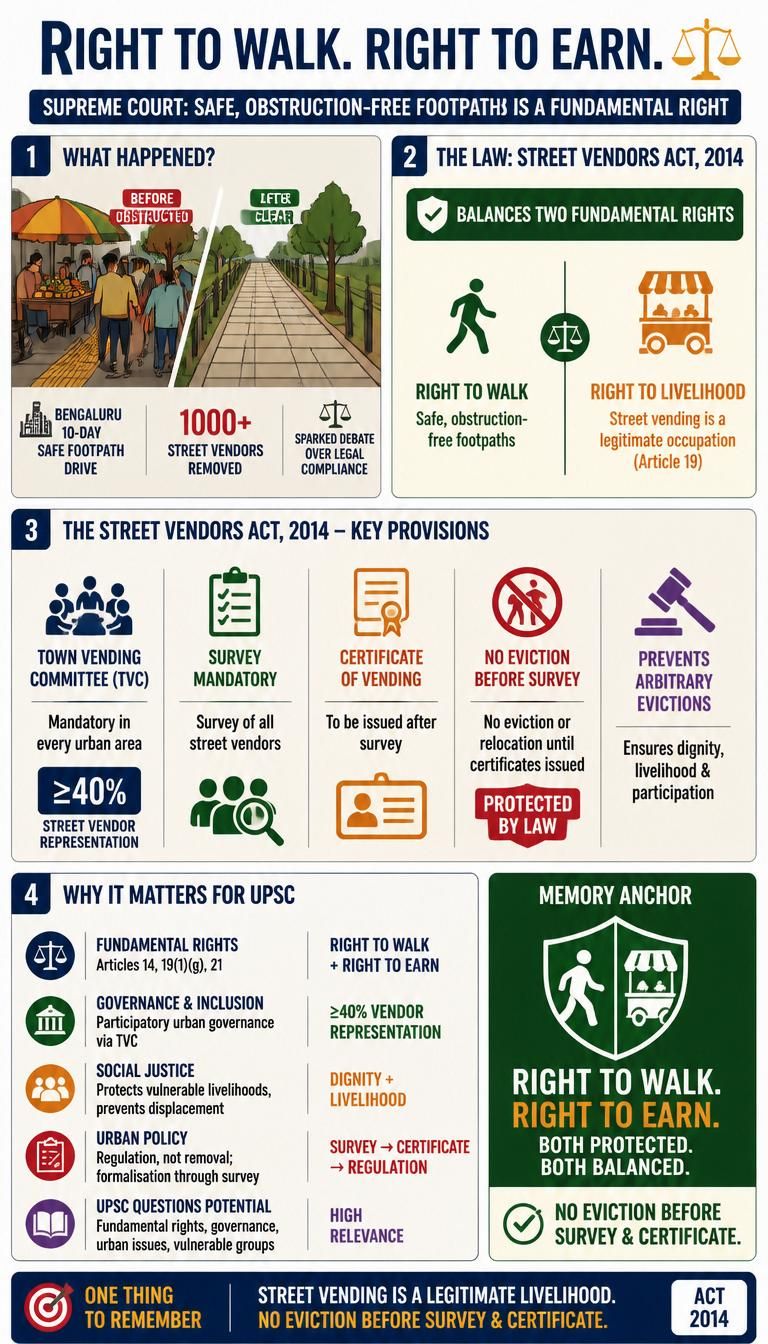
- The Street Vendors Act, 2014, aims to balance pedestrians' right to walk with street vendors' right to livelihood.
Right to Walk.jpg
Detailed Insights:
- The Supreme Court has consistently affirmed street vending as a legitimate occupation protected under Article 19 of the Constitution.
- The Street Vendors (Protection of Livelihood and Regulation of Street Vending) Act, 2014, was enacted to prevent arbitrary evictions and regulate street vending.
- The Act mandates the formation of a Town Vending Committee (TVC), which must include at least 40% street vendor representation.
- The TVC is responsible for conducting a survey of all street vendors and issuing Certificates of Vending.
- The Act explicitly states that no street vendor should be evicted or relocated until the survey is completed and certificates are issued.
- Bengaluru's 'Safe Footpath' drive faced scrutiny because it commenced removals without first constituting a TVC or completing the required survey.
- The law emphasizes a balanced approach, ensuring that reclaiming public spaces does not undermine the livelihood protections for street vendors.
Key Concepts Involved:
- Street Vendors (Protection of Livelihood and Regulation of Street Vending) Act, 2014: A central legislation designed to regulate street vending and protect the rights of street vendors.
- Town Vending Committee (TVC): A statutory body established under the Act to manage and regulate street vending activities within its jurisdiction.
- Article 19: A fundamental right in the Indian Constitution guaranteeing freedom of speech, assembly, association, movement, residence, and profession.

SuperKalam is your personal mentor for UPSC preparation, guiding you at every step of the exam journey.
Download the App


STUDY RESOURCES
CONTACT US
ⓒ Snapstack Technologies Private Limited