GS 2: GovernanceGS 1: Indian SocietyGS 2: Social JusticeGS 3: Environment & EcologyPrelims
Building resilience to protect elderly from climate stressors, Pg II
HelpAge India study reveals climate change disproportionately impacts India's growing elderly population, urging urgent policy for resilience and age-inclusive care.
Practice MCQs
760 Students attempted
Key Highlights:
- A study by HelpAge India highlights that senior citizens are a particularly vulnerable group disproportionately affected by climate change.
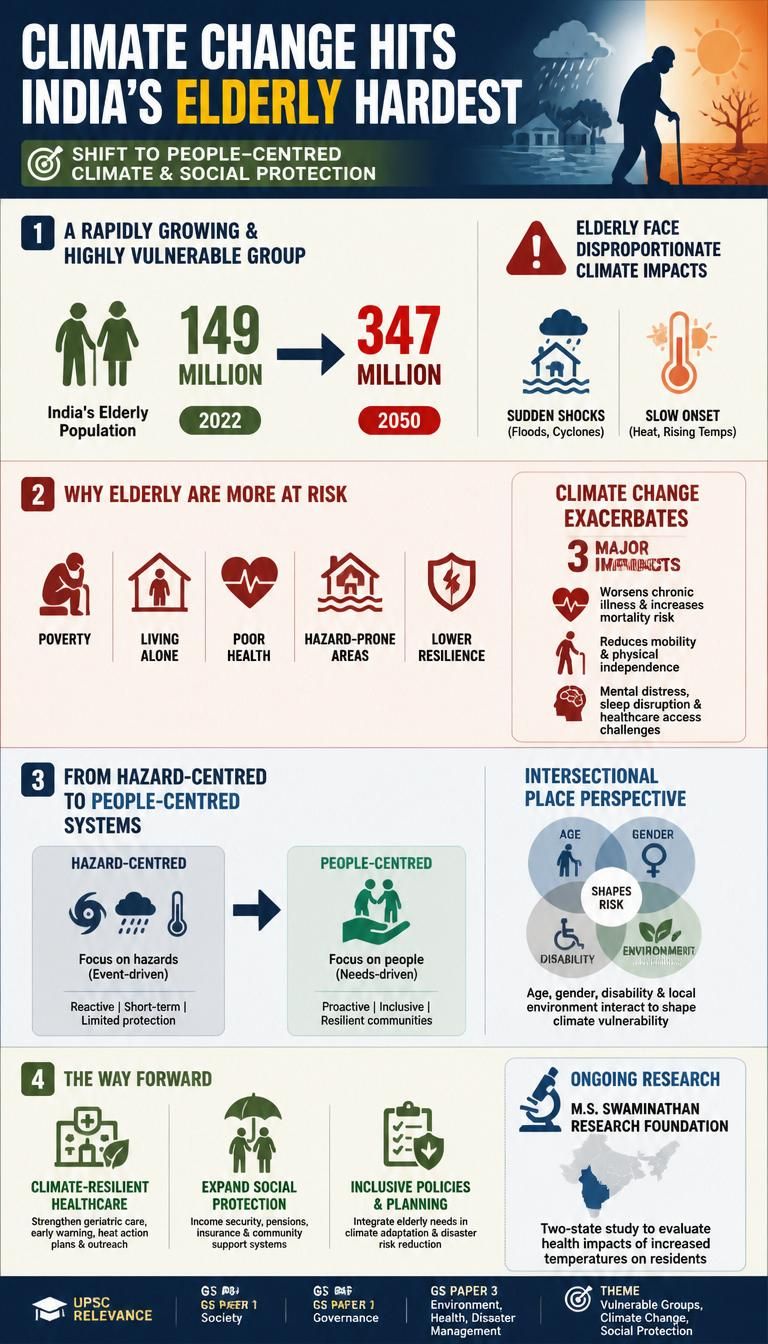
- India's elderly population is projected to increase significantly from 149 million in 2022 to approximately 347 million by 2050.
- Older adults are impacted by both sudden climate shocks, such as floods, and slow-onset stresses like rising temperatures.
- Factors like poverty, living alone, poor health, and residence in hazard-prone areas significantly reduce the resilience of the elderly.
- The report advocates for a shift from 'hazard-centred' to 'people-centred' systems for climate adaptation and social protection.
Elderly.jpg
Detailed Insights:
- Climate change exacerbates chronic illnesses, increases mortality risk, and reduces mobility for senior citizens.
- Older adults frequently experience mental distress, sleep disruption, and challenges in accessing healthcare during climatic events.
- The study employs an Intersectional Place Perspective to analyze how age, gender, disability, and local environmental conditions interact to shape risk.
- Policy recommendations include establishing climate-resilient healthcare and expanding social protection for the elderly.
- The M.S.Swaminathan Research Foundation is conducting a two-state study to evaluate the health impacts of increased temperatures on residents.
- Implementing age-inclusive early warning systems and strengthening community-based care networks are crucial for protecting the elderly.
- Government schemes require redesigning to address the specific vulnerabilities and access barriers faced by older persons.
- The report emphasizes leveraging the One Health approach and generating improved data for effective climate adaptation strategies.
Key Concepts Involved:
- Vulnerable Groups: Populations that are disproportionately affected by environmental, social, or economic crises due to pre-existing disadvantages.
- Intersectional Place Perspective: An analytical framework that examines how multiple social and environmental factors interact to create unique vulnerabilities for individuals or groups.
- One Health: A collaborative, multi-sectoral, and trans-disciplinary approach to achieve optimal health outcomes by recognizing the interconnectedness of people, animals, and their shared environment.

SuperKalam is your personal mentor for UPSC preparation, guiding you at every step of the exam journey.
Download the App


STUDY RESOURCES
CONTACT US
ⓒ Snapstack Technologies Private Limited