GS 3: Science & TechnologyPrelimsGS 3: Indigenization of Technology and New Technology DevelopmentGS 3: IT and ComputersGS 3: Science and Technology in Everyday Life
Are smartphones becoming smarter with the rise of on-device AI?, Pg11
On-device AI revolutionizes smartphones, shifting intelligence from cloud to local hardware, enhancing privacy, speed, and offline capabilities with dedicated NPUs.
Practice MCQs
760 Students attempted
Key Highlights:
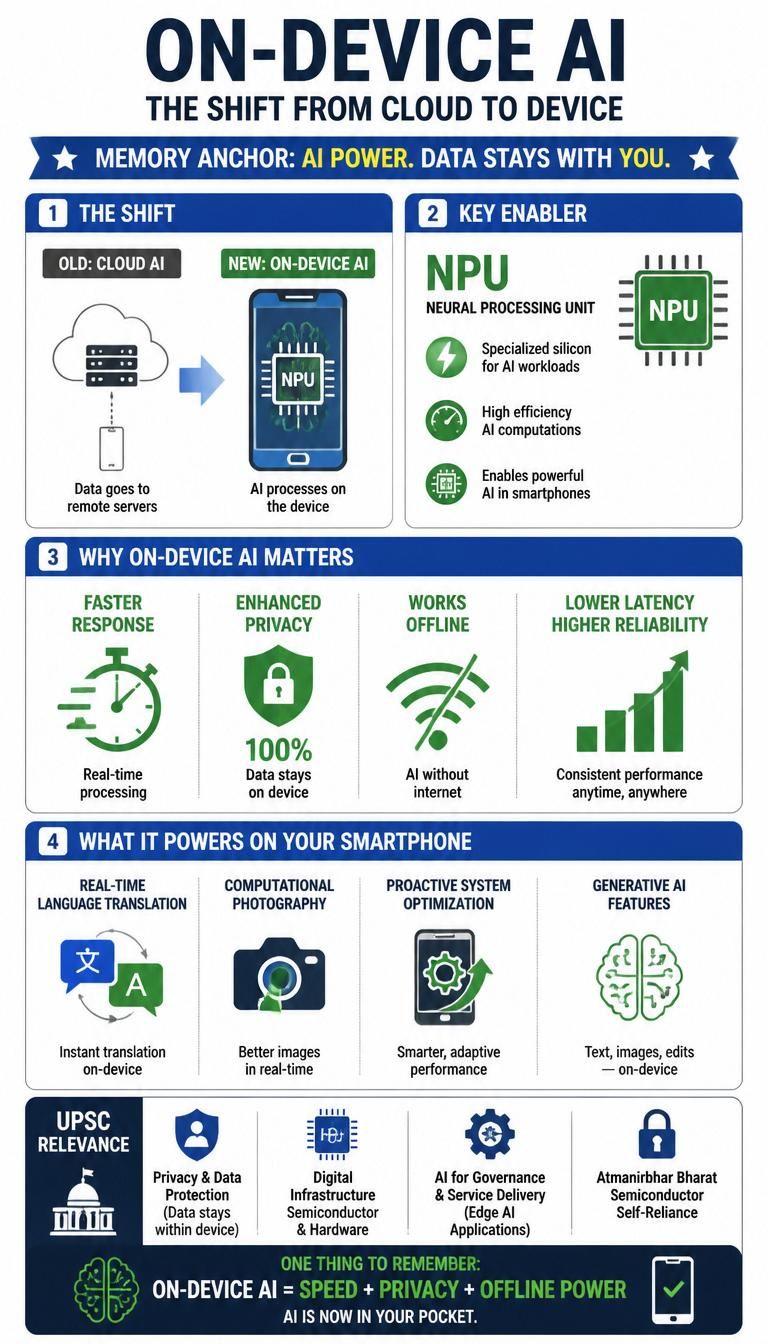
- On-device AI represents a significant shift in the smartphone industry, moving Artificial Intelligence processing from remote cloud servers to the local device hardware.
- This technology involves processing machine learning algorithms and generative AI models directly on the smartphone using dedicated silicon.
- Neural Processing Units (NPUs) are specialized hardware components that enable this shift by efficiently handling AI computations.
- Key benefits of on-device AI include faster response times, enhanced user privacy, and the ability to function without an internet connection.
- It facilitates advanced features such as real-time language translation, computational photography, and proactive system optimization directly on the device.
On device AI.jpg
Detailed Insights:
- Historically, consumer AI relied on cloud processing, where user data traveled to remote data centers for computation before returning to the device.
- The transition to on-device AI is fueled by rapid advancements in semiconductor technology, allowing powerful NPUs to be integrated into mainstream consumer hardware.
- A major advantage of on-device AI is its ability to address privacy concerns, as personal data remains on the device and never leaves the hardware.
- This local processing fosters a more personalized user experience, as the device learns from individual interactions without compromising digital footprints.
- Despite technological advancements, a challenge remains in user adoption, with many consumers perceiving current on-device AI features as non-essential enhancements.
- On-device AI currently faces technical limitations in matching the sheer scale and raw power of large cloud-based language models.
- The industry is converging on a hybrid application model, utilizing the cloud for heavy processing and on-device AI for sensitive or time-critical tasks.
- The future of smartphones is increasingly defined by the sophistication of their integrated AI models rather than just physical specifications.
Scientific/Technical Concepts Involved:
- On-device AI: Processing of machine learning and generative AI models directly on a device's local hardware, rather than remote servers.
- Neural Processing Units (NPUs): Specialized microprocessors optimized for accelerating artificial intelligence and machine learning workloads, particularly neural networks.
- Cloud-based AI: Artificial intelligence processing that occurs on remote servers and data centers, requiring an internet connection for data transfer and computation.
- Generative AI: A category of artificial intelligence algorithms capable of creating new content, such as text, images, or audio, based on patterns learned from existing data.

SuperKalam is your personal mentor for UPSC preparation, guiding you at every step of the exam journey.
Download the App


STUDY RESOURCES
CONTACT US
ⓒ Snapstack Technologies Private Limited