EthicsGS 2: GovernanceGS 2: PolityPrelimsGS 4: Accountability and Ethical Governance
NCERT's new Class 8 book lists 'corruption in judiciary', 'massive backlog' as challenges, Pg1
NCERT's Class 8 book unveils judicial challenges: corruption, backlogs, and accountability mechanisms, alongside discussions on Electoral Bonds and IT Act.
Practice MCQs
724 Students attempted
Key Highlights:
- NCERT's new Class 8 Social Science textbook includes a section on "corruption in the judiciary" and "massive backlog" as challenges.
- The textbook lists approximately 81,000 pending cases in the Supreme Court, 62,40,000 in High Courts, and 4,70,00,000 in District and Subordinate Courts.
- The book references the CPGRAMS, through which over 1,600 complaints related to the judiciary were received between 2017 and 2021.
- The textbook includes discussions on Electoral Bonds and the Information Technology Act, highlighting the judiciary's role.
- Former CJI B R Gavai stated in July 2025 that instances of corruption within the judiciary can erode public confidence.
Detailed Insights:
- The new textbook aims to educate students about the challenges faced by the Indian judicial system, including corruption and case backlogs.
- The inclusion of corruption in the judiciary acknowledges the issue and emphasizes the importance of transparency and accountability.
- The book highlights the judiciary's role in upholding fundamental rights, as demonstrated by the Supreme Court's decisions on Electoral Bonds and the Information Technology Act.
- The reference to CPGRAMS indicates an established mechanism for addressing public grievances related to the judiciary.
- The mention of impeachment proceedings underscores the process for removing a judge in cases of serious allegations, ensuring a fair opportunity for defense.
- The textbook aligns with the National Education Policy 2020 and the National Curriculum Framework (NCF) for School Education.
Key Concepts Involved:
- Judiciary: The system of courts that interprets and applies the law in the name of the state.
- Electoral Bonds: Financial instruments used to donate money to political parties.
- Impeachment: A process by which a legislative body formally levels charges against a high official of government.
- Transparency: The principle that government business should be open to public knowledge and scrutiny.
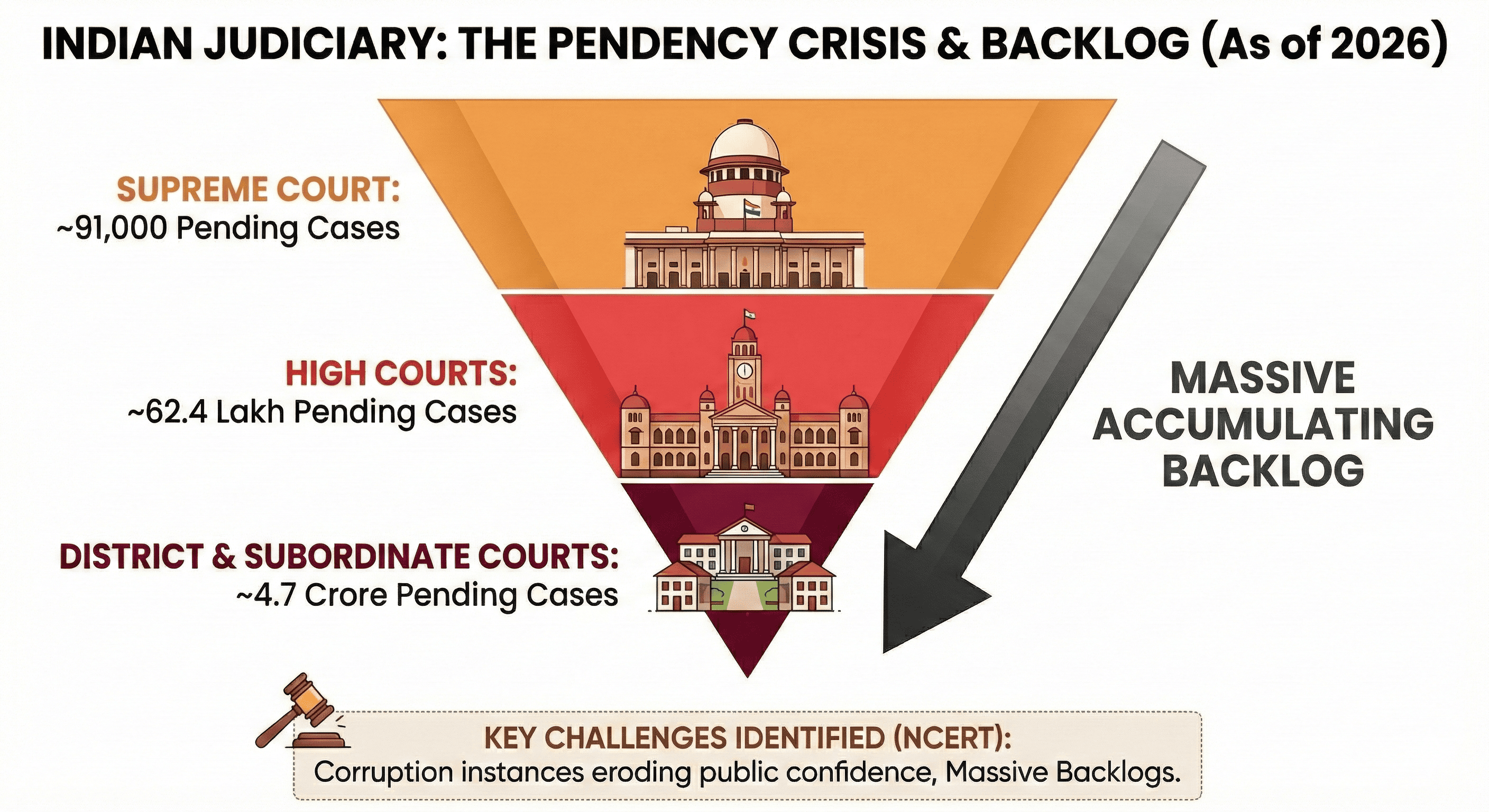
Judicial Pendency

SuperKalam is your personal mentor for UPSC preparation, guiding you at every step of the exam journey.
Download the App


STUDY RESOURCES
CONTACT US
ⓒ Snapstack Technologies Private Limited