GS 2: GovernanceGS 3: Science & TechnologyPrelimsGS 2: E GovernanceGS 3: Indigenization of Technology and New Technology Development
Building Robust Regional Language Datasets for India's Indigenous AI Models
The IndiaAI Mission unveils indigenous foundation models to counter token taxes and expand regional language datasets for inclusive artificial intelligence.
Source: Indian Express (Pg. 15)
Practice MCQs
782 Students attempted
Key Highlights:
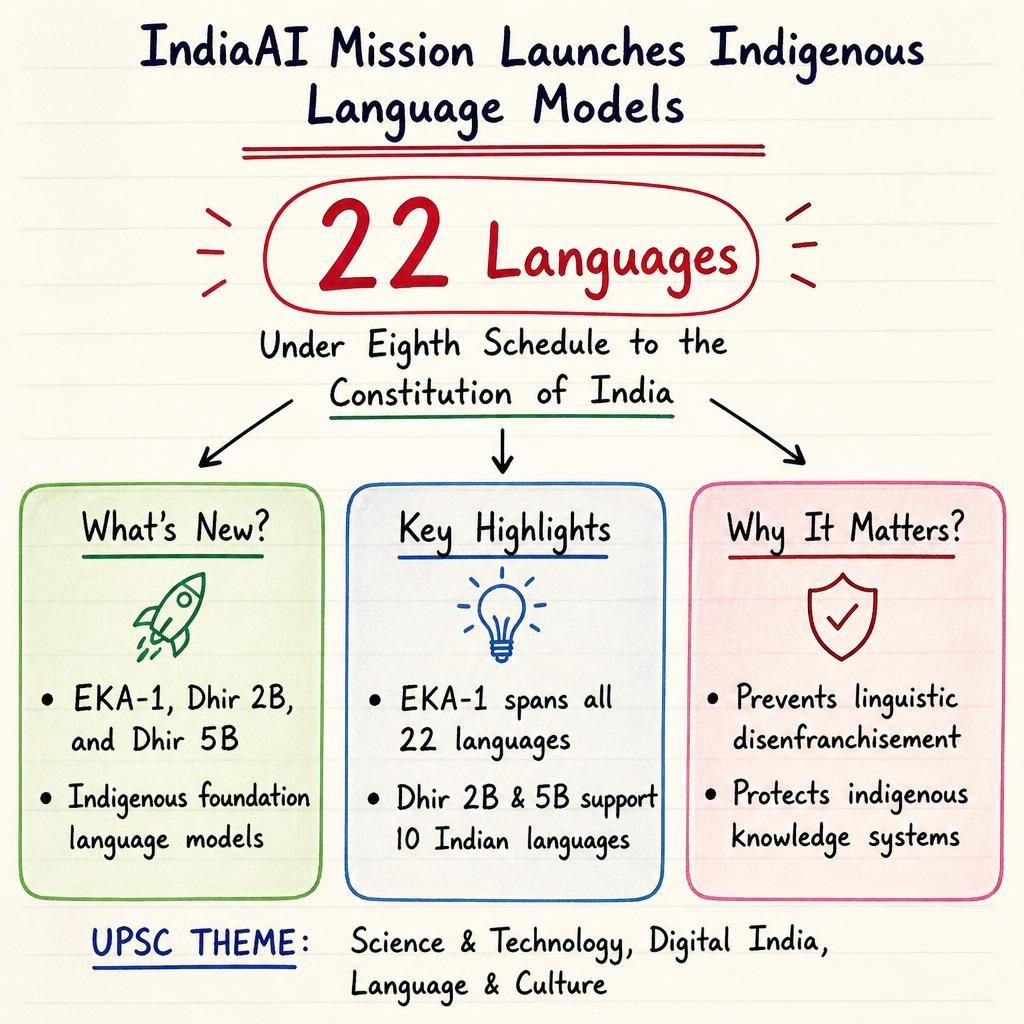
- The IndiaAI Mission under the Ministry of Electronics and Information Technology unveiled three indigenous foundation language models: EKA-1, Dhir 2B, and Dhir 5B.
- The EKA-1 model spans all 22 languages recognized under the Eighth Schedule to the Constitution of India, specializing in reasoning, coding, and mathematics.
- The Dhir 2B and Dhir 5B models support 10 Indian languages to power document retrieval and citizen-facing public service delivery.
- Indian scripts suffer from an acute token tax, taking up to 35 to 140 tokens compared to just 10 tokens for an equivalent English sentence.
- India accounts for over 19,500 spoken languages and dialects, yet the vast majority remain digitally low-resource with negligible computerised training data.
IndiaAI Mission.jpg
Detailed Insights:
- Relying on web scraping for pre-training introduces cultural hallucination, distorting region-specific agricultural, nutritional, and legal guidance.
- Creating effective fine-tuning data requires labour-intensive human annotation by native speakers to preserve local idioms and dialects.
- Standard English-centric tokenizers cause severe computational latency and steep commercial API processing charges for Indic scripts.
- The Digital India Bhashini Mission serves as a vital parallel platform to curate open-source conversational datasets across regional communities.
- Developing native foundation architectures prevents linguistic disenfranchisement and protects indigenous knowledge systems from digital obsolescence.
Scientific/Technical Concepts Involved:
- Large Language Model: A deep-learning algorithm trained on vast text corpora to understand, translate, and generate natural language.
- Low-Resource Language: A language with scarce digital text and audio resources available for training computational machine-learning architectures.
- Tokenizer: A computational component that divides raw text into numerical subword units for artificial intelligence processing.

SuperKalam is your personal mentor for UPSC preparation, guiding you at every step of the exam journey.
Download the App


STUDY RESOURCES
CONTACT US
ⓒ Snapstack Technologies Private Limited