GS 2: GovernanceGS 1: Indian SocietyGS 2: Social JusticeGS 3: EconomyPrelims
Towards Recognising Women Farmers, Pg10
Maharashtra passes landmark Women Farmers’ Empowerment Bill, granting independent recognition and scheme access, addressing gender disparity in agriculture and land ownership.
Practice MCQs
767 Students attempted
Key Highlights:
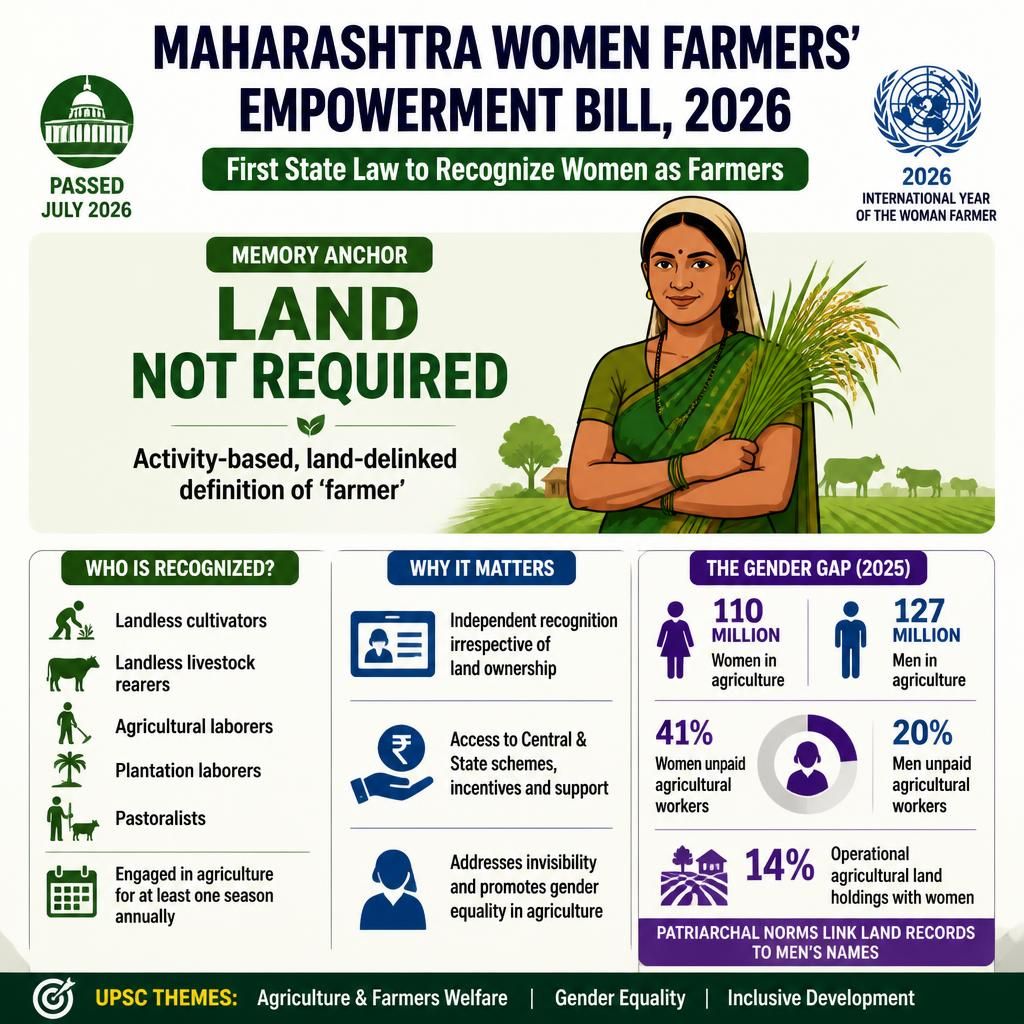
- Maharashtra passed the Women Farmers’ Empowerment Bill in July 2026, granting women independent recognition as farmers irrespective of land ownership.
- This legislation is the first Indian State law to operationalize an activity-based, land-delinked definition of 'farmer', as outlined in the National Policy for Farmers (2007).
- The year 2026 has been designated as the International Year of the Woman Farmer by the United Nations.
- The bill aims to address the invisibility of women in agriculture, who constitute a significant portion of the workforce but often lack formal recognition.
Women Farmer's Empowerment.jpg
Detailed Insights:
- The Women Farmers’ Empowerment Bill broadens the definition of 'agriculture' and 'farmer' to include women engaged in farming for at least one season annually.
- It explicitly recognizes categories such as landless cultivators, landless livestock rearers, agricultural laborers, plantation laborers, and pastoralists.
- In 2025, agriculture employed approximately 110 million women and 127 million men, indicating near gender parity in the workforce.
- Over 41% of female agricultural workers were unpaid in 2025, compared to 20% of men, highlighting a significant disparity.
- Only 14% of operational agricultural land holdings are with women, primarily due to patriarchal norms linking land records to men's names.
- This lack of land ownership-based recognition prevents women from accessing crucial Central and State agricultural schemes and incentives.
- For example, only 23% of beneficiaries under the Pradhan Mantri Kisan Samman Nidhi (PM-KISAN) scheme are women.
- States like Meghalaya (70%) and Kerala (44%) show higher women beneficiaries due to alternative recognition mechanisms such as Kudumbashree collectives.
- Effective implementation of the new bill will require robust information campaigns and either self-registration or identification of women farmers by Gram Sabhas.
- Connecting the new database of women farmers with the Agri Stack and issuing FarmerIDs is essential for their integration into the broader digital agricultural ecosystem.
Key Concepts Involved:
- National Policy for Farmers (2007): A policy that proposed an activity-based, land-delinked definition of 'farmer' to recognize actual cultivators.
- Pradhan Mantri Kisan Samman Nidhi (PM-KISAN): A Central Sector scheme providing direct income support of ₹6,000 annually to eligible landholding farmer families.
- Agri Stack: A proposed digital platform by the Union Ministry of Agriculture & Farmers Welfare to create a unified agricultural ecosystem.
- Gram Sabha: The primary body of the Panchayati Raj system, comprising all adult members registered in the electoral rolls of a village.

SuperKalam is your personal mentor for UPSC preparation, guiding you at every step of the exam journey.
Download the App


STUDY RESOURCES
CONTACT US
ⓒ Snapstack Technologies Private Limited