GS 2: GovernanceGS 3: Science & TechnologyGS 3: EconomyPrelimsGS 3: Indian Economy, Planning, Mobilization of Resources, Growth, Development and Employment
Soaring demand for AI chips: What 'supercycle' means, Pg18
AI fuels semiconductor "supercycle" with soaring chip demand, prompting India's ISM 2.0 to boost domestic manufacturing and R&D.
Practice MCQs
767 Students attempted
Key Highlights:
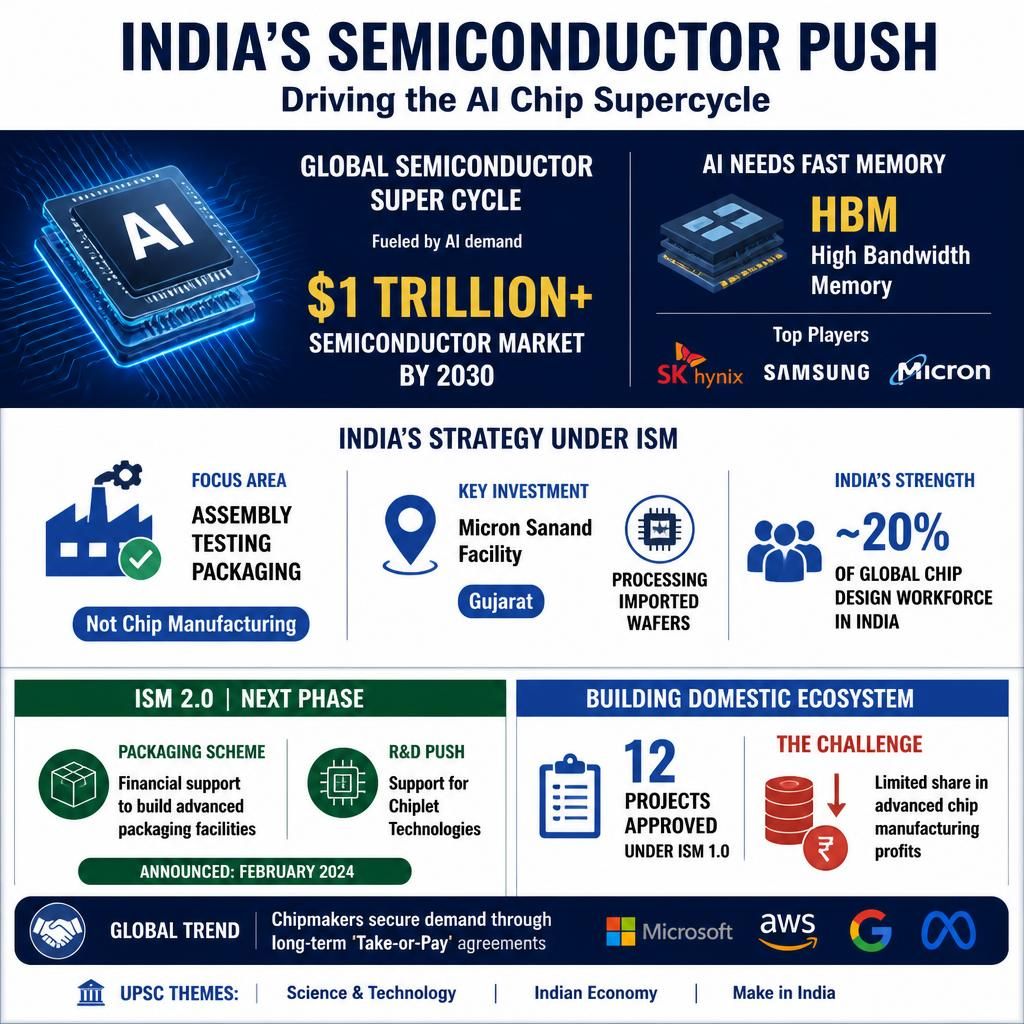
- The SEMICON INDIA conference, under the India Semiconductor Mission (ISM), was held in New Delhi amidst a global "semiconductor supercycle" driven by Artificial Intelligence (AI).
- This "supercycle" signifies a multi-year period of investment and growth in semiconductors due to fundamental technological shifts.
- High-bandwidth memory (HBM) chips are crucial for AI processing, with major players including SK Hynix, Samsung, and Micron.
- India's strategy under ISM focuses on establishing manufacturing capacity in assembly, testing, and packaging, rather than chip production.
- Micron's Sanand facility in Gujarat is a key investment for processing imported wafers.
- ISM 2.0, launched in February, aims to bolster packaging facilities and support R&D in chiplet technologies.
- India contributes significantly to global chip design, with nearly a fifth of the workforce based in the country.
Semiconductor Push.jpg
Detailed Insights:
- The current chip boom is largely driven by the soaring demand from AI data centers, which require specialized infrastructure.
- AI chips, also known as accelerators, perform the massive calculations necessary for running AI models efficiently.
- HBM chips address the challenge of rapid data transfer by stacking layers of memory close to the processor.
- The semiconductor market is shifting towards business-to-business sales, with major tech companies like Microsoft, Amazon, Google, and Meta planning significant investments in AI infrastructure.
- Chipmakers are securing demand through long-term "take-or-pay" agreements, ensuring predictable sales.
- Under ISM 1.0, India approved 12 semiconductor projects, initiating the development of domestic capabilities.
- India currently faces challenges in capturing profits from advanced chip production, leading to some foreign investment shifts towards semiconductor-heavy markets like Taiwan and South Korea.
- ISM 2.0 includes a packaging scheme offering financial support and another scheme to promote R&D in chiplet technologies.
- Chiplets offer a cost-effective and efficient alternative to conventional single-piece silicon chips by combining smaller, specialized units.
- India's strong talent pool in chip design is leveraged through initiatives like the design-linked incentive scheme, supporting startups in developing specialized processors.
- Edge-AI processors, developed by companies like Netrasemi, enable AI computations directly on devices, reducing latency and reliance on cloud infrastructure.
Scientific/Technical Concepts Involved:
- Semiconductor Supercycle: A prolonged period of exceptional growth and investment in the semiconductor industry, driven by new technological demands.
- High-bandwidth memory (HBM): A type of stacked memory that provides high data transfer rates for processors, crucial for AI workloads.
- Chiplets: Smaller, specialized integrated circuits that are combined to form a larger, more complex chip, offering modularity and cost efficiency.
- Edge-AI Processors: Processors designed to perform AI computations directly on a device, rather than in the cloud, enabling faster responses and reduced data transmission.

SuperKalam is your personal mentor for UPSC preparation, guiding you at every step of the exam journey.
Download the App


STUDY RESOURCES
CONTACT US
ⓒ Snapstack Technologies Private Limited