GS 2: GovernanceGS 3: Environment & EcologyPrelimsGS 3: Conservation, Pollution and DegradationGS 2: Government policies and interventions for development in various sectors
Saving the rhino, restoring grasslands, Pg12
India's successful rhino conservation strategy boosts population to over 4,000, expanding range and restoring critical grassland habitats by 2031.
Practice MCQs
767 Students attempted
Key Highlights:
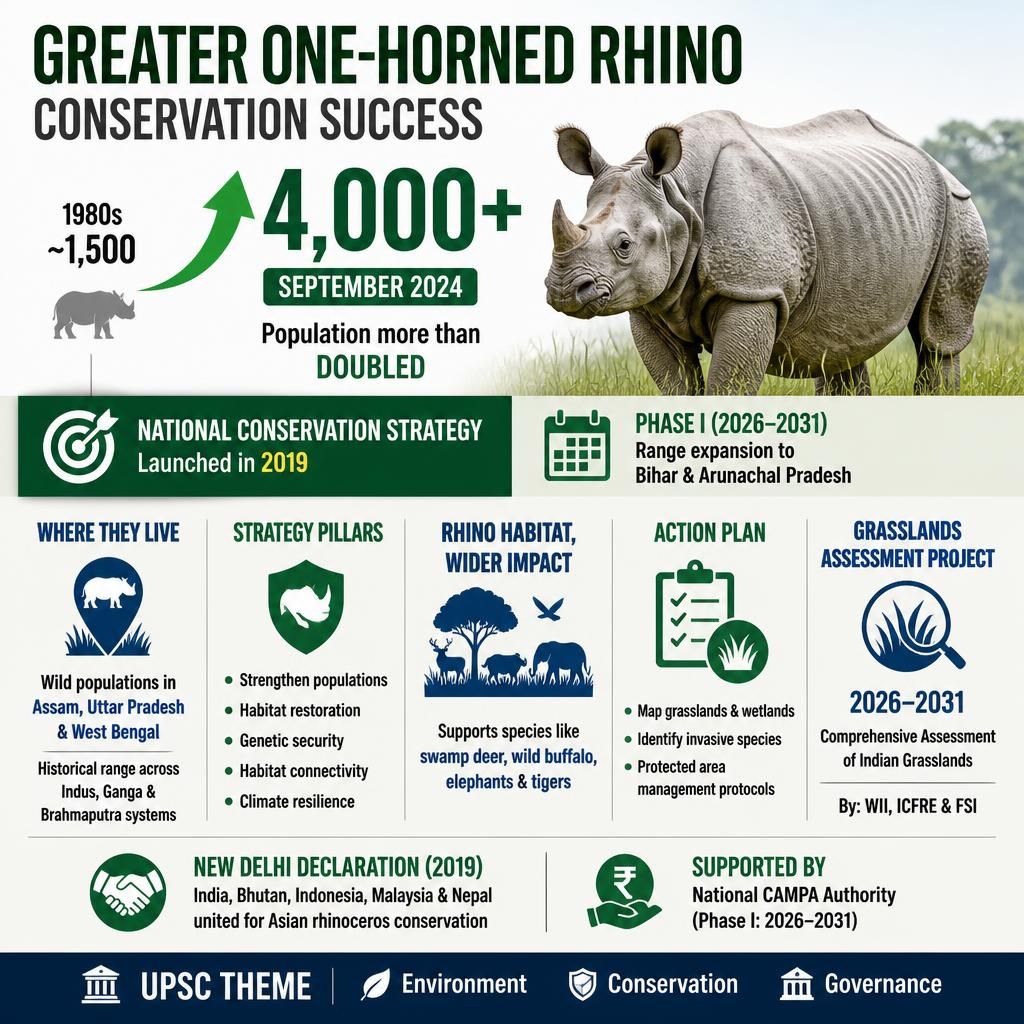
- The population of the greater one-horned rhinoceros in India has increased from approximately 1,500 in the 1980s to over 4,000 by September 2024.
- India launched the National Conservation Strategy for the rhinoceros in 2019 to guide conservation efforts and range expansion.
- A five-year Phase I (2026-2031) is proposed to expand the rhino range into suitable areas in Bihar and Arunachal Pradesh.
- India, along with Bhutan, Indonesia, Malaysia, and Nepal, adopted the New Delhi Declaration in 2019 for Asian rhinoceros conservation.
Rhino Conservation.jpg
Detailed Insights:
- The historical range of the greater one-horned rhinoceros extended across the Indus, Ganga, and Brahmaputra river systems.
- Current wild populations are primarily concentrated in Assam, Uttar Pradesh, and West Bengal.
- The conservation strategy emphasizes establishing secure populations across their historical range, not just safeguarding existing concentrations.
- The National Conservation Strategy framework includes strengthening existing populations, habitat restoration, genetic security, habitat connectivity, and climate resilience.
- Phase I (2026-2031), supported by the National CAMPA Authority, focuses on scientific monitoring, protection, habitat management, and capacity building.
- Rhino habitats are vital for other species like swamp deer, wild buffalo, elephants, and tigers, highlighting their ecological importance.
- The Rhino Conservation Action Plan includes mapping grasslands and wetlands, identifying invasive species, and developing protected area management protocols.
- A five-year project (2026-2031) on the Comprehensive Assessment of Indian Grasslands will be implemented by the Wildlife Institute of India, Indian Council of Forestry Research and Education, and Forest Survey of India.
- This assessment aims to create a National Grassland Atlas and provide long-term management guidelines for grasslands.
- Climate-resilient management, including maintaining access to higher ground and securing ecological connectivity, is recognized as crucial for rhino protection.
- Modern technology like surveillance, genetic tools, and decision-support systems complement the efforts of field staff and local communities.
Key Concepts Involved:
- Greater One-Horned Rhinoceros: A large mammal native to the Indian subcontinent, listed as Vulnerable by the IUCN.
- National Conservation Strategy for the rhinoceros: A policy framework launched by India in 2019 to guide rhino conservation efforts.
- New Delhi Declaration: An international agreement adopted in 2019 by Asian rhino range states to strengthen conservation cooperation.
- National CAMPA Authority: An Indian governmental body that manages funds for compensatory afforestation and wildlife conservation.
- Wildlife Institute of India: An autonomous institution under the Ministry of Environment, Forest and Climate Change, involved in wildlife research and management.
- National Grassland Atlas: A planned comprehensive mapping and assessment of India's grasslands to aid in their restoration and management.

SuperKalam is your personal mentor for UPSC preparation, guiding you at every step of the exam journey.
Download the App


STUDY RESOURCES
CONTACT US
ⓒ Snapstack Technologies Private Limited