GS 2: GovernanceGS 3: Science & TechnologyGS 3: Environment & EcologyGS 3: EconomyPrelims
India’s vast canal network offers a land-free path to solar power, Pg II
India explores vast canal network for Canal-Top Photovoltaics (CTPV) to boost solar capacity, saving land and water, despite high initial costs.
Practice MCQs
767 Students attempted
Key Highlights:
- India is exploring Canal-Top Photovoltaics (CTPV) as an innovative solution to expand solar energy capacity without requiring additional land.
- CTPV systems involve mounting solar panels on elevated structures built over existing irrigation and water-supply canals.
- The technology offers benefits such as land saving, reduced water evaporation from canals, and improved panel performance due to water cooling.
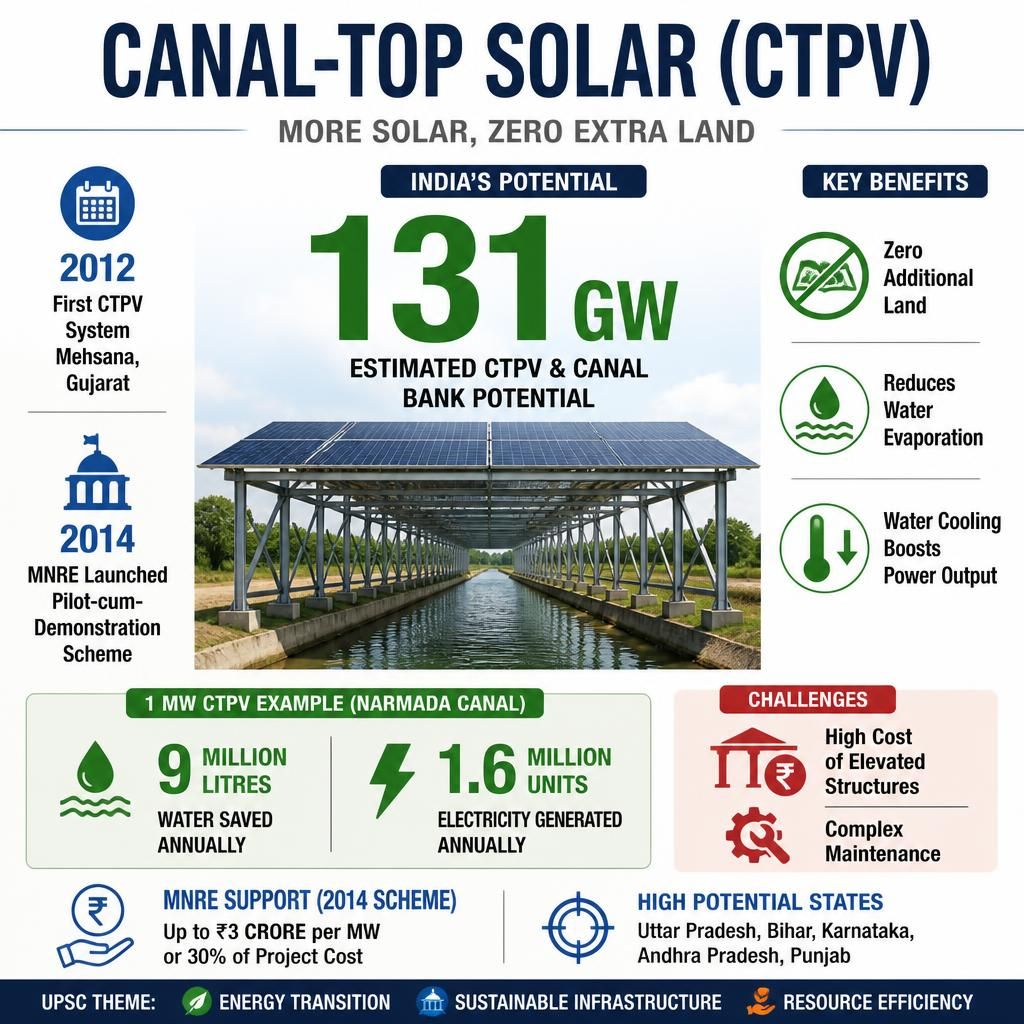
- India commissioned its first CTPV system in Mehsana, Gujarat, in 2012, demonstrating early adoption of the technology.
- The Ministry of New and Renewable Energy (MNRE) launched a pilot-cum-demonstration scheme for CTPV in 2014 to promote its development.
- An assessment estimated India's CTPV and canal bank potential at approximately 131 GW, with Uttar Pradesh, Bihar, Karnataka, Andhra Pradesh, and Punjab identified as states with high potential.
Canal Top Solar.jpg
Detailed Insights:
- CTPV addresses the growing challenge of land acquisition for large-scale solar projects in India's clean energy expansion.
- The cooling effect provided by the water beneath the panels can enhance electricity generation, particularly in hot climatic conditions.
- A 1-MW CTPV system on the Narmada Canal in Gujarat reportedly saves nearly 9 million litres of water annually while generating 1.6 million units of electricity.
- The 2014 MNRE scheme offered financial assistance of up to ₹3 crore per MW or 30% of the project cost for CTPV systems.
- Despite early progress, high system costs due to specialized elevated structures and complex maintenance have limited widespread CTPV deployment.
- The linear nature of canals can pose challenges for CTPV systems, especially regarding grid connectivity and substation proximity.
- The recently approved PM Surya Sarovar Yojana (PM-SSY), focusing on floating solar, signals renewed policy interest in land-neutral solar applications.
- Scaling CTPV requires a renewed policy approach, including tailored financing mechanisms like Viability Gap Funding and standardized guidelines.
Key Concepts Involved:
- Canal-Top Photovoltaics (CTPV): A solar energy generation method where panels are installed on structures built over canals.
- Floating Solar: Solar panels mounted on floating platforms on water bodies like reservoirs and lakes.
- Viability Gap Funding: Financial support provided by the government to make economically desirable but financially unviable projects attractive to investors.

SuperKalam is your personal mentor for UPSC preparation, guiding you at every step of the exam journey.
Download the App


STUDY RESOURCES
CONTACT US
ⓒ Snapstack Technologies Private Limited