GS 3: EconomyPrelimsGS 3: Food Processing and Related IndustriesGS 3: Indian Economy, Planning, Mobilization of Resources, Growth, Development and EmploymentGS 3: Storage, Transport and Marketing of Agricultural Produce
How much of food spending reaches farmers?, Pg13
New study reveals Indian farmers receive 57.8% of at-home food spending, significantly higher than global averages, but less from food consumed away from home.
Practice MCQs
767 Students attempted
Key Highlights:
- A study estimated the share of a consumer's food rupee that reaches Indian farmers using the "Food Dollar series" technique.
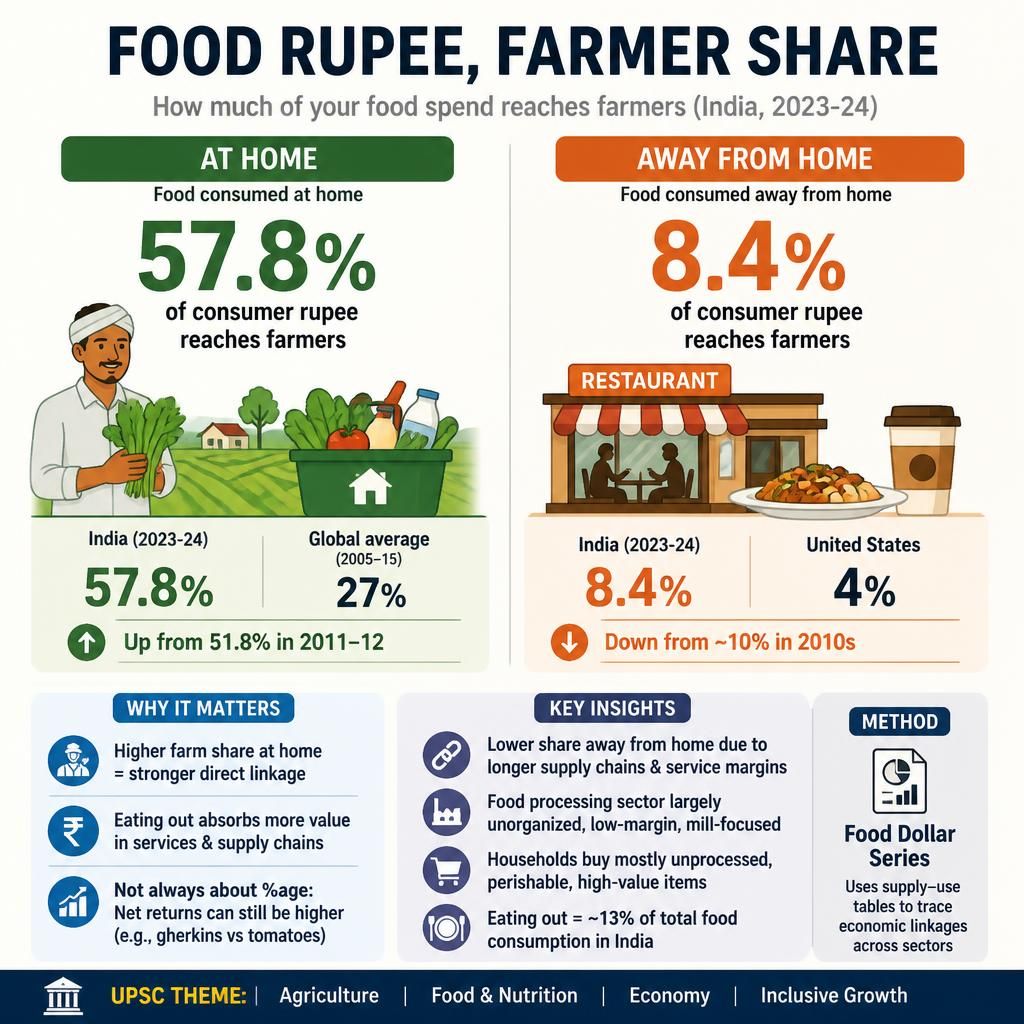
- In 2023-24, farmers received 57.8% of the rupee spent on food consumed at home.
- For food consumed away from home, farmers received only 8.4% of the consumer's rupee in the same period.
- India's farm share for at-home food expenditure is significantly higher than the global average of 27% (2005-15).
- The farm share for at-home food has increased from 51.8% in 2011-12, while for food away from home, it has declined from approximately 10% in the 2010s.
Farmer's Share.jpg
Detailed Insights:
- The "Food Dollar series" technique utilizes supply-use tables to trace economic linkages and transactions between sectors.
- The lower farm share for food consumed away from home is attributed to longer supply chains and value absorption by restaurants and services.
- India's farm share for food away from home is also higher compared to countries like the United States, where it is just 4%.
- Indian households predominantly purchase unprocessed or minimally processed, perishable, high-value food items.
- The domestic food processing industry is largely unorganized, low-margin, and focused on milling, which limits off-farm value addition.
- Eating out accounts for an estimated 13% of total food consumption in India, which is lower than in Western countries.
- A lower farm share does not always equate to lower net returns for farmers, as exemplified by gherkins compared to tomatoes.
- High farm share also does not guarantee farmer profitability due to increasing input costs, as experienced by Amul dairy farmers.
- Recommendations include farmer ownership in downstream food, beverages, and logistics enterprises to capture more value.
- Expanding farmer participation in post-harvest activities is crucial for creating future jobs and better incomes in the sector.
Key Concepts Involved:
- Food Dollar series: An economic technique used to trace how much of a consumer's spending on food accrues to the farm sector.
- Supply-use tables: Statistical tables that map the linkages and transactions between different sectors within an economy.
- Post-harvest activities: Processes and operations that occur after harvesting crops, including cleaning, sorting, processing, packaging, storage, and transportation.

SuperKalam is your personal mentor for UPSC preparation, guiding you at every step of the exam journey.
Download the App


STUDY RESOURCES
CONTACT US
ⓒ Snapstack Technologies Private Limited