GS 3: Environment & EcologyPrelimsGS 3: Conservation, Pollution and DegradationGS 2: Development Processes and Role of NGOs, SHGs and Other StakeholdersGS 1: Changes in Critical Geographical Features, Water Bodies, Ice Caps, Flora and Fauna
Reclaiming Assam’s elephant habitat, one weed at a time, Pg9
Assam project tackles invasive alien plants in elephant habitats, converting cleared biomass into carbon-rich biochar for ecological restoration and conservation.
Practice MCQs
760 Students attempted
Key Highlights:
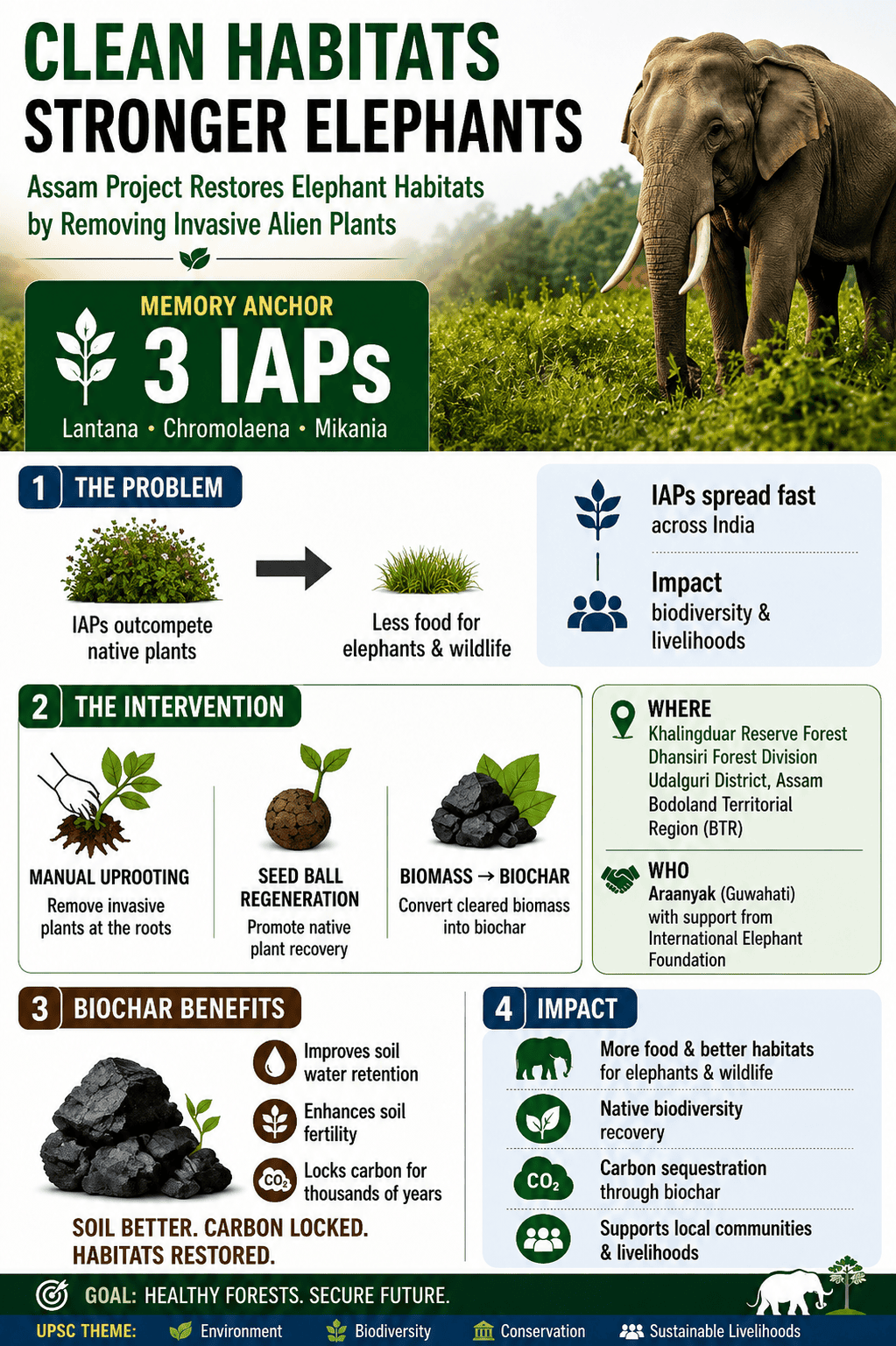
- A project in Assam is working to restore elephant habitats by managing Invasive Alien Plants (IAPs).
- The initiative is focused on Khalingduar Reserve Forest in the Dhansiri Forest Division of Udalguri district, within the Bodoland Territorial Region (BTR).
- Aaranyak, a Guwahati-based conservation organization, is implementing the project with support from the International Elephant Foundation.
- The project targets specific IAP species like Lantana camara, Chromolaena odorata, and Mikania micrantha.
- A key strategy involves converting cleared IAP biomass into biochar to improve soil health and sequester carbon.
Elephant Habitat.png
Detailed Insights:
- IAPs significantly reduce food options for herbivores, including elephants, by outcompeting native vegetation for resources.
- India faces a widespread challenge from IAPs, with studies indicating their rapid expansion across natural areas, impacting biodiversity and livelihoods.
- The project's approach includes manual uprooting of IAPs and seed-ball-assisted regeneration to promote native plant recovery.
- Biochar, produced by heating organic waste in a low-oxygen environment, acts as a stable carbon form that resists decay for thousands of years.
- It enhances soil properties like water retention, nutrient retention, aggregation, and microbial habitat, turning a botanical liability into a carbon-rich asset.
- The Bodoland Territorial Region (BTR) is an autonomous division in Assam, established for self-governance and development of the Bodo people, and is rich in ecological wealth.
- Elephant conservation in India is also addressed by the Project Elephant, a Centrally Sponsored Scheme launched in 1992 by the Ministry of Environment, Forest and Climate Change to protect elephants, their habitats, and corridors.
Key Concepts Involved:
- Invasive Alien Plants (IAPs): Non-native plant species that spread aggressively, outcompeting native flora and disrupting ecosystems.
- Biochar: A charcoal-like substance made by heating organic waste in a controlled environment, used for soil amendment and carbon sequestration.
- Carbon Sequestration: The process of capturing and long-term storage of atmospheric carbon dioxide to mitigate climate change.
- Project Elephant: A Centrally Sponsored Scheme launched in 1992 by the Government of India for the protection of elephants, their habitats, and corridors.

SuperKalam is your personal mentor for UPSC preparation, guiding you at every step of the exam journey.
Download the App


STUDY RESOURCES
CONTACT US
ⓒ Snapstack Technologies Private Limited