GS 3: Science & TechnologyGS 2: International RelationsPrelimsGS 3: Infrastructure: Energy, Ports, Roads, Airports, Railways etc.GS 2: Bilateral, Regional and Global Groupings and Agreements
U.S. to announce nuclear agreement with Saudi Arabia, Pg16
Trump administration pushes controversial US-Saudi civilian nuclear deal, raising concerns over uranium enrichment and weapons proliferation.
Practice MCQs
753 Students attempted
Key Highlights:
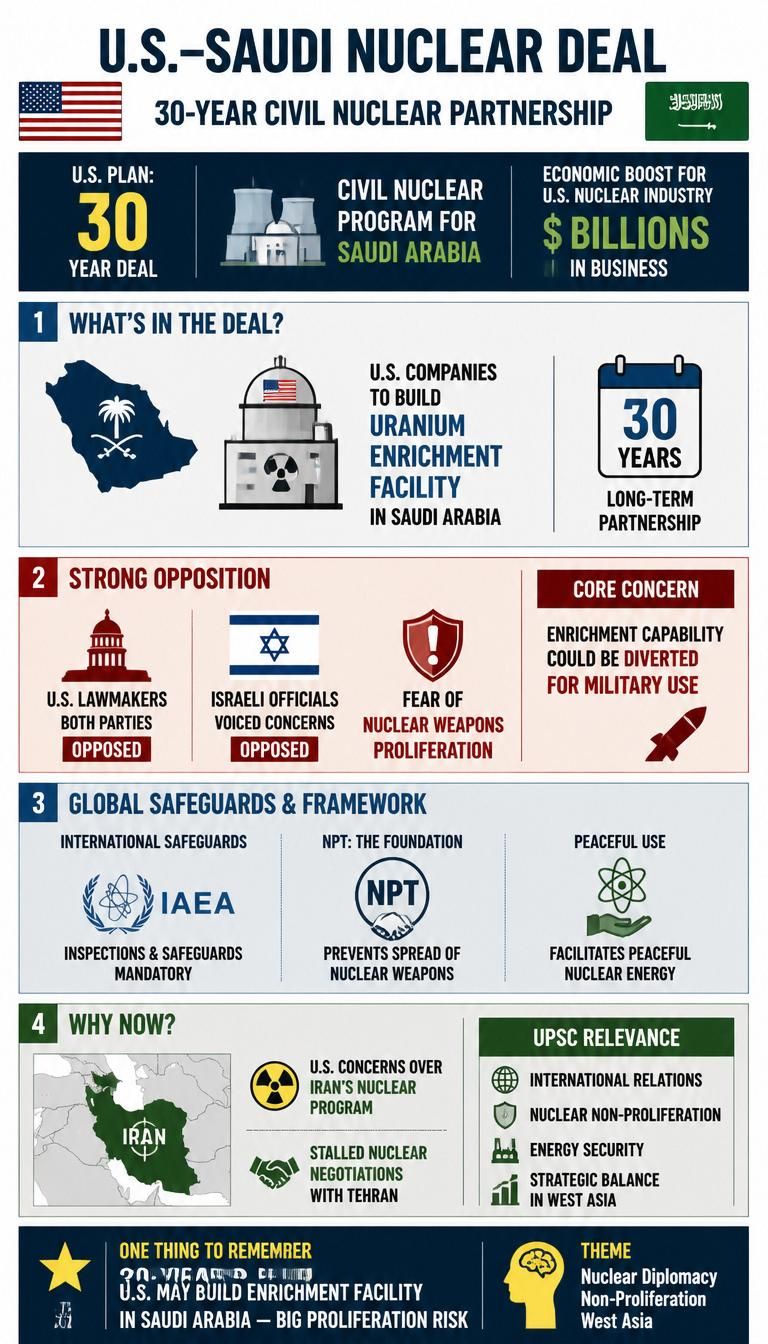
- The United States, under the Trump administration, planned to announce a landmark deal to help establish a civilian nuclear program in Saudi Arabia.
- The agreement was expected to provide billions of dollars for the U.S. nuclear industry.
- A provision in the 30-year deal could potentially see U.S. companies construct a uranium enrichment facility in Saudi Arabia.
- U.S. lawmakers from both parties and Israeli officials voiced opposition due to fears of nuclear weapons proliferation.
Saudi - US.jpg
Detailed Insights:
- The proposed deal emerged during a period of heightened U.S. concerns regarding Iran's nuclear program and stalled negotiations with Tehran.
- The Trump administration highlighted the significant economic benefits the agreement would bring to the American nuclear sector.
- Critics expressed apprehension that a civilian nuclear program, particularly one involving uranium enrichment, could be diverted for military purposes.
- International agreements for nuclear cooperation typically involve stringent safeguards and inspections by the International Atomic Energy Agency (IAEA).
- The Non-Proliferation Treaty (NPT) seeks to prevent the spread of nuclear weapons while facilitating the peaceful use of nuclear energy.
Key Concepts Involved:
- Civilian Nuclear Program: The development and use of nuclear technology for non-military applications, primarily electricity generation.
- Uranium Enrichment: A process that increases the concentration of the fissile uranium-235 isotope, essential for nuclear fuel and weapons.
- Non-Proliferation Treaty (NPT): An international treaty aimed at preventing the spread of nuclear weapons and promoting peaceful nuclear energy.
Previous13/13

SuperKalam is your personal mentor for UPSC preparation, guiding you at every step of the exam journey.
Download the App


STUDY RESOURCES
CONTACT US
ⓒ Snapstack Technologies Private Limited