GS 2: International RelationsGS 3: EconomyPrelimsGS 2: Effect of Policies and Politics of Developed and Developing Countries on India's InterestsGS 2: Important International Institutions, Agencies and Fora
India & key WTO members remain at loggerhead on plurilateral pacts, Pg13
India stands firm against plurilateral e-commerce and investment pacts at WTO, facing global pushback over consensus principles and reform.
Practice MCQs
753 Students attempted
Key Highlights:
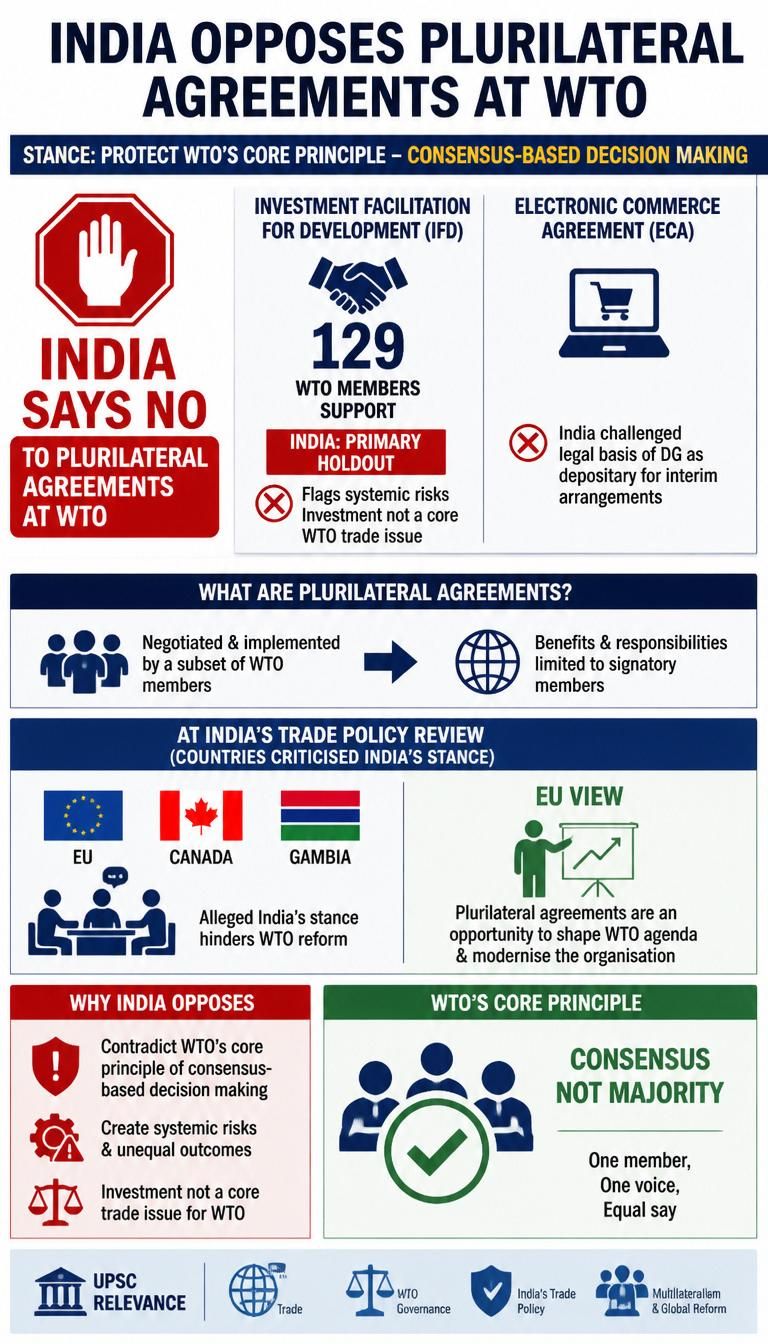
- India is opposing plurilateral agreements on e-commerce and investments within the World Trade Organization (WTO).
- During India's Trade Policy Review, several countries including the EU, Canada, and Gambia questioned India's stance, alleging it hinders WTO reform.
- India maintains that plurilateral agreements contradict the WTO's core principle of consensus-based decision-making.
- India is the primary holdout against the Investment Facilitation for Development (IFD) agreement, which is supported by 129 WTO members.
- India challenged the legal basis of the WTO Director-General acting as depositary for interim arrangements on the Agreement on Electronic Commerce (ECA).
WTO.jpg
Detailed Insights:
- Plurilateral agreements are negotiated and implemented by exclusive groups of WTO members, rather than by all members.
- Major trading powers like the US, EU, and China are backing plurilateral negotiations, where benefits and responsibilities are limited to signatory members.
- The EU encouraged India to view plurilateral agreements as an opportunity to shape the WTO agenda and modernize the organization.
- India opposes the IFD agreement citing systemic risks and stating that investment is not a core trade issue for the WTO.
- At the 14th Ministerial Conference (MC14) in Yaoundé, Cameroon, India was the sole country opposing IFD's incorporation into the WTO framework as an Annex 4 Agreement.
- Annex 4 of the Marrakesh Agreement contains Plurilateral Trade Agreements, which are legally binding only on the specific members that voluntarily sign them.
- The Agreement on Electronic Commerce (ECA) aims to prohibit the imposition of customs duties on electronic transmissions between parties.
- India questioned the institutional basis for the ECA interim arrangements operating without consensus, as required by the Marrakesh Agreement.
- Commerce Minister Piyush Goyal stated that incorporating the IFD agreement risks eroding the functional limits and foundational principles of the WTO.
Key Concepts Involved:
- World Trade Organization (WTO): An intergovernmental organization regulating international trade, aiming to ensure smooth, predictable, and free trade.
- Plurilateral Agreements: Trade agreements within the WTO framework that are binding only on a subset of members who choose to sign them.
- Multilateral Agreements: Trade agreements within the WTO framework that are binding on all 164 member states.
- Consensus-based decision-making: A WTO principle where decisions are made only when no member formally objects.
- Investment Facilitation for Development (IFD): A proposed WTO agreement aimed at making it easier for investors to invest, particularly in developing countries.
- Agreement on Electronic Commerce (ECA): A proposed WTO agreement focused on trade-related aspects of e-commerce, including a moratorium on customs duties on electronic transmissions.
- Marrakesh Agreement: The agreement establishing the World Trade Organization in 1994, outlining its structure and functions.
- Annex 4 of Marrakesh Agreement: The section of the Marrakesh Agreement that lists the Plurilateral Trade Agreements.
- Ministerial Conference (MC): The highest decision-making body of the WTO, meeting at least every two years.

SuperKalam is your personal mentor for UPSC preparation, guiding you at every step of the exam journey.
Download the App


STUDY RESOURCES
CONTACT US
ⓒ Snapstack Technologies Private Limited