GS 2: GovernanceGS 1: World GeographyGS 3: Environment & EcologyPrelimsGS 3: Conservation, Pollution and Degradation
Fires in Brazil’s Amazon fell to historic low in 2025: report, Pg II
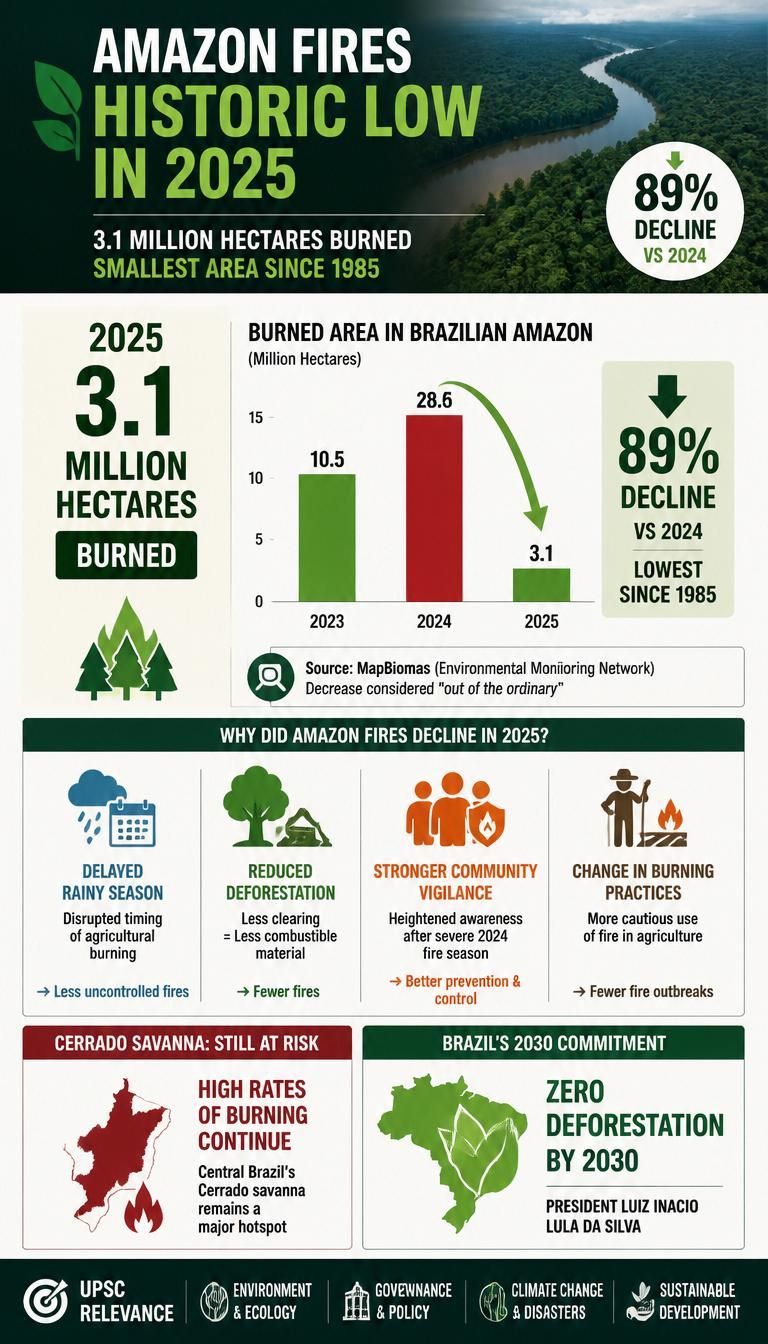
Brazil's Amazon fires plummeted to a historic low of 3.1 million hectares in 2025, reversing 2024's peak due to reduced deforestation and delayed rains.
Practice MCQs
753 Students attempted
Key Highlights:
- Fires in the Brazilian Amazon reached a historic low in 2025, with 3.1 million hectares burned, marking the smallest area since records began in 1985.
- This significant reduction followed a peak in 2024, which was largely attributed to an unprecedented drought and human-caused fires.
- The data was compiled and reported by the environmental monitoring network MapBiomas.
- Factors contributing to the decline included a delayed rainy season, reduced deforestation, and increased community vigilance.
- Brazilian President Luiz Inacio Lula da Silva has committed to achieving zero deforestation in the Amazon by 2030.
Amazon.jpg
Detailed Insights:
- The decrease in burned area in 2025 was considered "out of the ordinary" by MapBiomas coordinator Ane Alencar.
- A delayed rainy season between 2024 and 2025 disrupted the typical period for agricultural burning, which often leads to uncontrolled fires.
- The report also indicated a reduction in deforestation, which consequently lowered the amount of combustible material available for fires.
- Community awareness, heightened by the severe 2024 fire season, played a role in preventing and controlling fire outbreaks.
- While the Amazon saw improvement, the Cerrado savanna in Central Brazil continued to experience high rates of burning.
- Experts have flagged the potential for a "super El Nino" in the current year, which could lead to an extended dry season and increased risk of forest fires.
- The Amazon's dense vegetation is crucial for absorbing greenhouse gases, making its protection vital for global climate change mitigation.
- Official data for the first quarter of 2026 shows deforestation at its lowest rate this decade, aligning with President Lula's environmental pledges.
- Despite his environmental commitments, President Lula has faced criticism for supporting a major offshore oil exploration project near the Amazon.
Scientific/Technical Concepts Involved:
- MapBiomas: A collaborative network that utilizes satellite imagery and machine learning algorithms to monitor and map land use, deforestation, and fire impacts across Brazil's biomes since 1985.
- El Nino: A climate phenomenon characterized by unusually warm ocean surface temperatures in the central and eastern tropical Pacific Ocean, which can significantly alter global weather patterns, often leading to droughts and increased fire risk in certain regions.
- Cerrado savanna: The world's most biodiverse savanna, located primarily in central Brazil, known for its distinct dry season and susceptibility to fires, and facing significant threats from agricultural expansion.
- Greenhouse gases: Atmospheric gases, such as carbon dioxide, that absorb and emit radiant energy, trapping heat within the Earth's atmosphere and contributing to global warming.

SuperKalam is your personal mentor for UPSC preparation, guiding you at every step of the exam journey.
Download the App


STUDY RESOURCES
CONTACT US
ⓒ Snapstack Technologies Private Limited