GS 1: Indian GeographyGS 1: Physical GeographyGS 3: Science & TechnologyGS 3: Disaster ManagementPrelims
Three Cyclones In Three Weeks: What’s Brewing In The Bay?, Pg12
Bay of Bengal witnesses three cyclones in 23 days; experts analyze El Niño, MJO, and IOD interactions driving unusual storm frequency.
Source: The Hindu (Pg. 12)
Practice MCQs
775 Students attempted
Key Highlights:
- Three cyclones, Arnab, Murasu, and Akvan, formed over the Bay of Bengal within 23 days this year.
- Cyclone Arnab made landfall near Yanam, Andhra Pradesh, on October 28.
- Cyclone Murasu made landfall near Ongole, Andhra Pradesh, on November 3.
- Cyclone Akvan formed on November 16 and made landfall near Gopalpur, Odisha, on November 17.
- This succession of cyclones, while not unique, is uncommon, with similar instances reported by the India Meteorological Department (IMD) in 1976 and 1987.
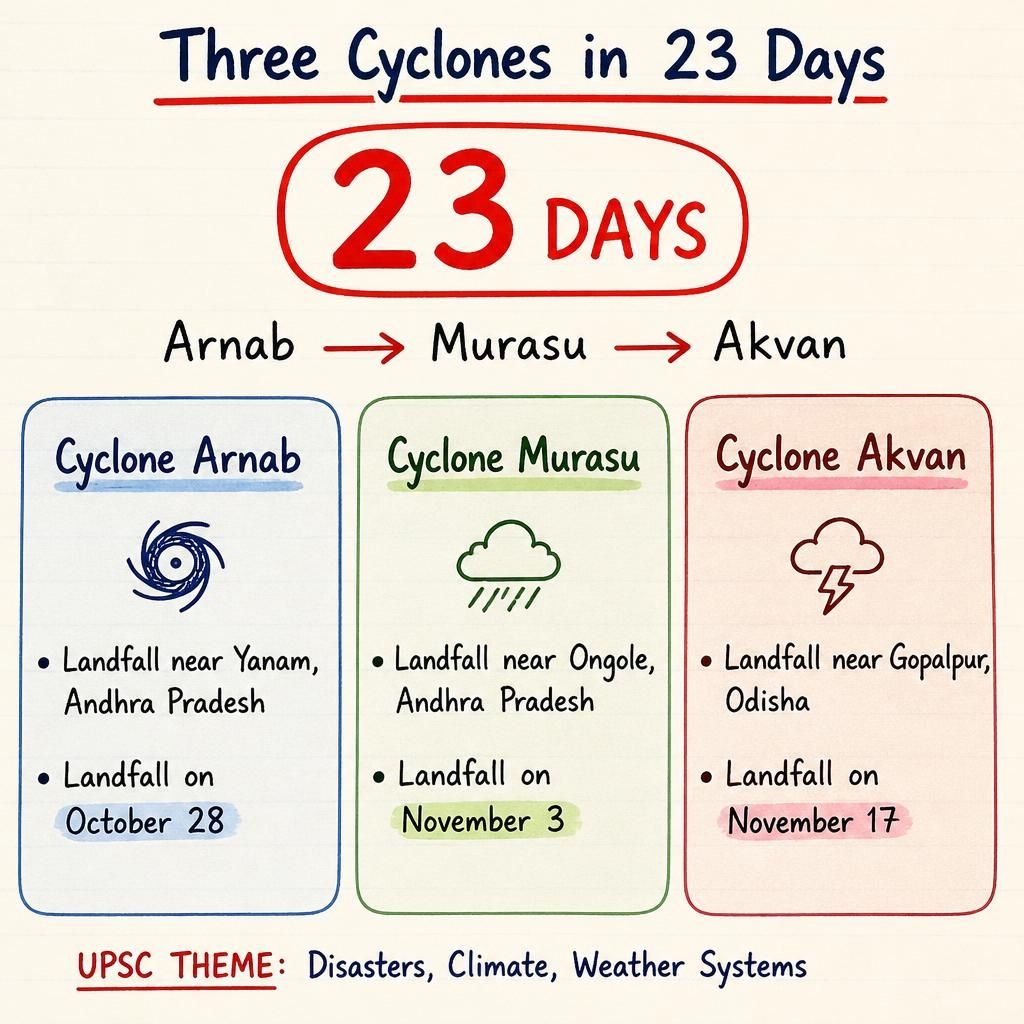
3 Cyclones.jpg
Detailed Insights:
- Cyclones typically form in the Bay of Bengal during two main seasons: April-May and October-December.
- Post-monsoon conditions, characterized by weakened vertical wind shear and warm waters, favor cyclone formation.
- The developing northeast monsoon also contributes to weather disturbances that can intensify into cyclones.
- A study indicated an average of 1.8 post-monsoon cyclones annually between 1982-2022, with increased frequency after 2001.
- El Niño conditions generally reduce cyclone formation in the southern Bay of Bengal by weakening rotational winds.
- La Niña, the opposite phase of El Niño, typically favors cyclone formation in the Bay.
- The Indian Ocean Dipole, currently neutral, describes sea temperature differences in the equatorial Indian Ocean and has shown stronger association with October-November cyclones than El Niño or La Niña.
- The Madden-Julian Oscillation (MJO), a large atmospheric disturbance, was in a phase favorable for cyclone formation over the Bay and Arabian Sea during this period.
- Cyclone Akvan exhibited unusually slow movement, which can both strengthen a storm over warm waters and weaken it by bringing cooler water to the surface.
- The interaction of equatorial Rossby waves and Kelvin waves with the MJO encouraged moisture gathering and air rise in the southern and central Bay, influencing Akvan's development.
Scientific/Technical Concepts Involved:
- El Niño: A climate pattern characterized by the unusual warming of surface waters in the eastern tropical Pacific Ocean.
- La Niña: A climate pattern characterized by the unusual cooling of surface waters in the eastern tropical Pacific Ocean.
- Indian Ocean Dipole: An irregular oscillation of sea surface temperatures in which the western Indian Ocean becomes alternately warmer and then colder than the eastern part.
- Madden-Julian Oscillation (MJO): An eastward-moving disturbance of clouds, rainfall, winds, and pressure that propagates around the global tropics.

SuperKalam is your personal mentor for UPSC preparation, guiding you at every step of the exam journey.
Download the App


STUDY RESOURCES
CONTACT US
ⓒ Snapstack Technologies Private Limited