GS 3: Environment & EcologyPrelimsGS 1: Changes in Critical Geographical Features, Water Bodies, Ice Caps, Flora and FaunaGS 1: Salient Features of World's Physical Geography
Organic Nitrogen a Major Source of Nutrients in Oceans, Pg11
Groundbreaking research identifies atmospheric organic nitrogen, primarily from land-based biomass burning, as a major, overlooked nutrient source significantly impacting ocean productivity.
Source: The Hindu (Pg. 11)
Practice MCQs
775 Students attempted
Key Highlights:
- New research identifies atmospheric organic nitrogen (ON) as a significant, previously overlooked nutrient source for global oceans.
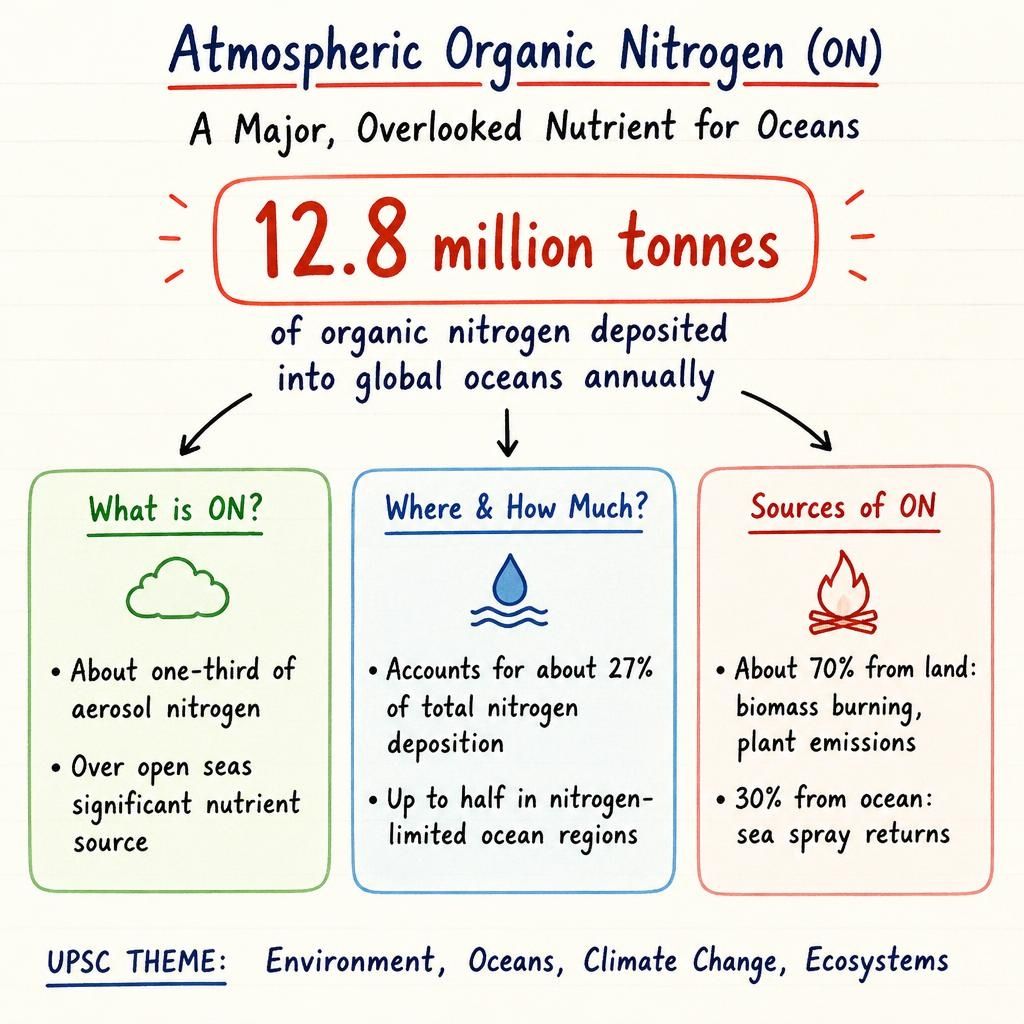
- Organic nitrogen constitutes approximately one-third of aerosol nitrogen over open seas.
- Annually, 12.8 million tonnes of organic nitrogen are deposited from the atmosphere into global oceans, accounting for about 27% of total nitrogen deposition.
- Major land-based sources of this organic nitrogen include biomass burning and particles from plant emissions.
- In nitrogen-limited ocean regions, such as the central Atlantic and Indonesian seas, organic nitrogen can contribute up to half of the total atmospheric nitrogen deposition.
Organic Nitrogen.jpg
Detailed Insights:
- The study involved analyzing 418 marine aerosol samples collected from 21 research cruises across various ocean basins.
- This discovery is crucial for understanding ocean productivity, as marine microbes process organic and inorganic nitrogen differently.
- Terrestrial sources, including wildfires and human activities, contribute about 70% of the total organic nitrogen deposited into oceans, acting as an important external nutrient input.
- The remaining 30% of organic nitrogen deposited in the ocean originates from the ocean itself, primarily through sea spray carrying nitrogen into the air and returning it.
- Accurate accounting for organic nitrogen is essential for refining climate models and understanding marine ecosystem health.
- Nitrogen is a critical limiting nutrient for phytoplankton growth, which forms the base of marine food webs and plays a vital role in the global carbon cycle.
Scientific/Technical Concepts Involved:
- Organic Nitrogen (ON): Nitrogen compounds that are part of organic molecules, such as amino acids and proteins, essential for life.
- Marine Aerosols: Tiny airborne particles over the sea, composed of sea salt, organic compounds, and other substances, influencing climate and cloud formation.
- Ocean Productivity: The rate at which marine organisms, primarily phytoplankton, produce organic matter through photosynthesis, forming the base of marine food webs.
- Biomass Burning: The combustion of organic matter like forests, savannas, and agricultural waste, releasing various gases and particles, including nitrogen compounds, into the atmosphere.

SuperKalam is your personal mentor for UPSC preparation, guiding you at every step of the exam journey.
Download the App


STUDY RESOURCES
CONTACT US
ⓒ Snapstack Technologies Private Limited