GS 2: International RelationsGS 3: Environment & EcologyPrelimsGS 3: Conservation, Pollution and DegradationGS 2: Bilateral, Regional and Global Groupings and Agreements
COP31 Extends Into Overtime As Divisions Persist; Text Lacks Vision, Say Climate Groups, Pg7
COP31 extends into overtime amid deep divisions over fossil fuel phase-out and adaptation finance, with climate groups criticizing the draft text's lack of vision.
Source: The Hindu (Pg. 7)
Practice MCQs
775 Students attempted
Key Highlights:
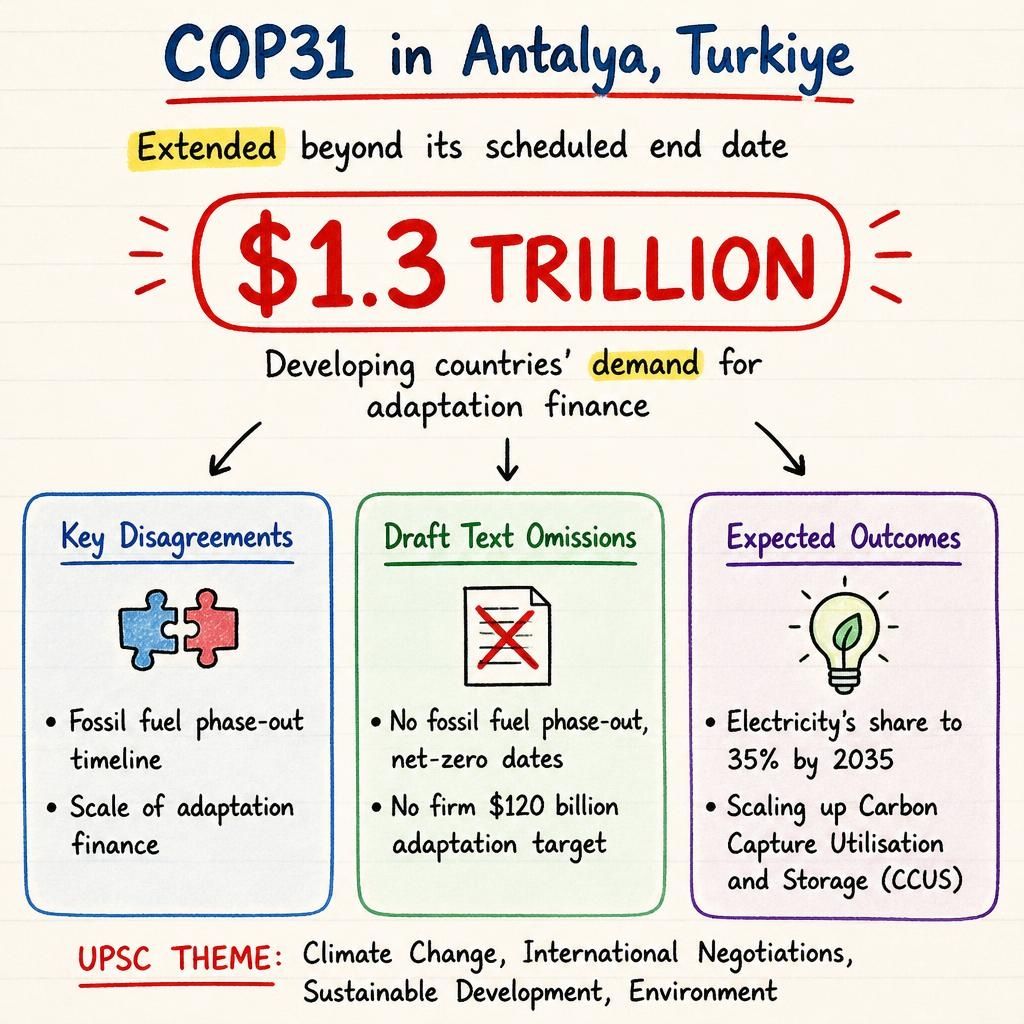
- COP31 in Antalya, Turkiye, extended beyond its scheduled end date due to persistent divisions among participating nations.
- Key disagreements centered on a timeline for phasing out fossil fuels and the scale of adaptation finance for developing countries.
- The latest draft text omitted references to fossil fuel phase-out, net-zero dates, and a firm $120 billion adaptation-finance target.
- Developed nations proposed contributing at least $300 billion annually for adaptation by 2035, while developing countries called for $1.3 trillion.
- Expected outcomes include increasing electricity's share in final energy consumption to 35% by 2035 and scaling up Carbon Capture Utilisation and Storage (CCUS) technologies.
COP 31.jpg
Detailed Insights:
- COP proceedings frequently extend into overtime due to the requirement for unanimous agreement among all participant countries on the final text.
- The core disagreement highlights the familiar division between developed and developing nations regarding historical responsibility and financial obligations for climate action.
- Developing countries emphasize the need for legally binding financial obligations from developed nations to fund climate adaptation efforts.
- Debates also encompass the definition of climate finance (including loans, grants, and for-profit investments) and the appropriate allocation between adaptation and mitigation.
- CCUS technology is criticized by experts as unproven, expensive, and lacking significant breakthroughs in efficiency or cost-effectiveness.
- Climate groups expressed strong disappointment, stating that the draft text lacks ambition, equity, coherence, and a clear vision for climate action.
- The 1.5-degree Celsius warming ceiling, a critical target from the Paris Agreement, has already been breached, underscoring the urgency of effective climate policies.
Key Concepts Involved:
- COP (Conference of the Parties): The supreme decision-making body of the United Nations Framework Convention on Climate Change (UNFCCC).
- Adaptation Finance: Financial resources provided to help countries and communities adjust to the unavoidable impacts of climate change.
- Mitigation: Actions taken to reduce or prevent the emission of greenhouse gases into the atmosphere.
- Carbon Capture Utilisation and Storage (CCUS): Technologies designed to capture carbon dioxide emissions from industrial sources and either reuse or permanently store them underground.
- 1.5 Degree Celsius Warming Ceiling: The aspirational limit for global average temperature increase above pre-industrial levels, as outlined in the Paris Agreement.

SuperKalam is your personal mentor for UPSC preparation, guiding you at every step of the exam journey.
Download the App


STUDY RESOURCES
CONTACT US
ⓒ Snapstack Technologies Private Limited