GS 2: GovernanceGS 3: Science & TechnologyGS 3: Environment & EcologyGS 3: EconomyPrelims
Battery black mass export ban:, Pg11
Centre bans lithium-ion battery black mass exports to boost domestic recycling and secure critical mineral supply amidst global resource competition.
Source: Indian Express (Pg. 11)
Practice MCQs
775 Students attempted
Key Highlights:
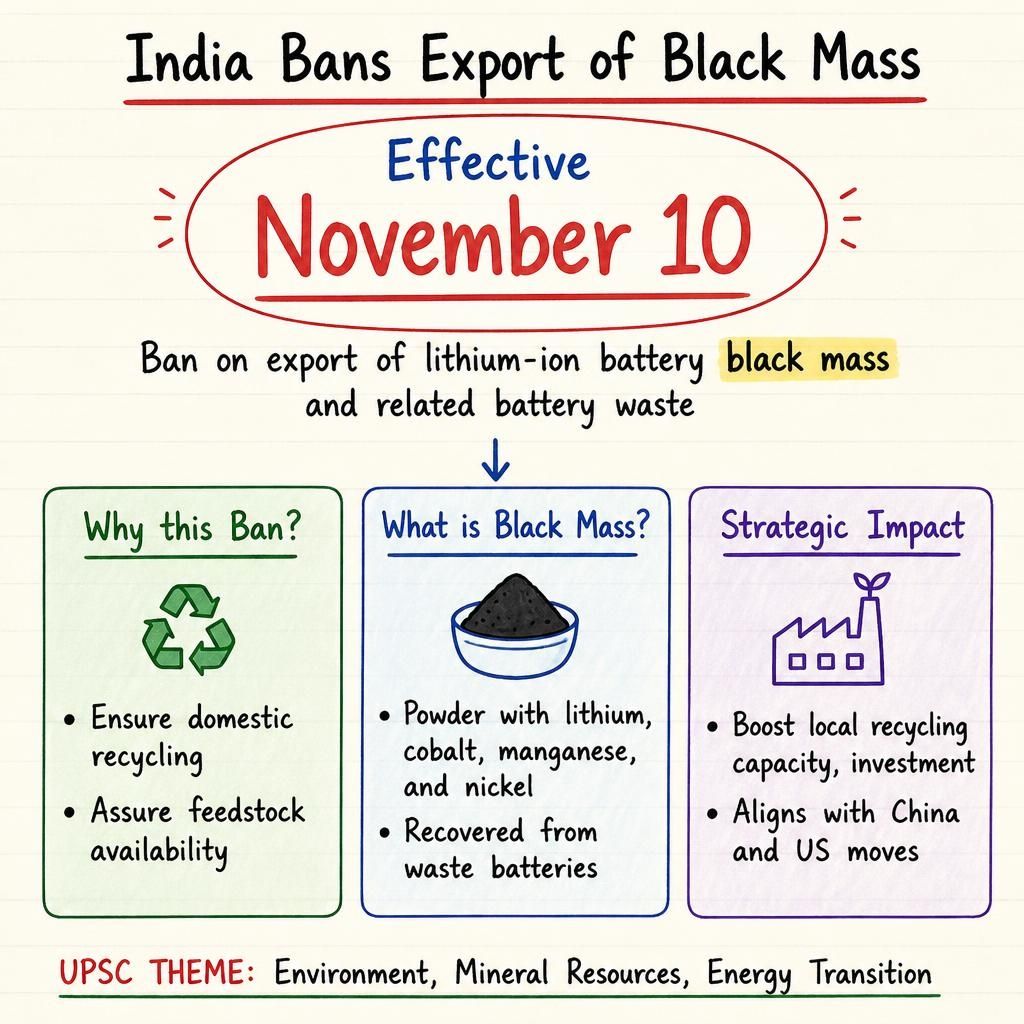
- India has banned the export of lithium-ion battery black mass and related battery waste.
- The decision, effective November 10, aims to ensure domestic recycling and feedstock availability for critical minerals.
- This move is intended to boost local recycling capacity, encourage investment, and create employment in the sector.
- The ban aligns with a global push by nations like China and the US to retain critical minerals within their borders.
- Black mass is a powder containing vital elements such as lithium, cobalt, manganese, and nickel, recovered from waste batteries.
Black Mass Export Ban.jpg
Detailed Insights:
- The Centre's export prohibition is effective immediately, preventing the outflow of valuable raw materials.
- This measure is expected to improve the capacity utilisation of India's domestic recycling and refining units.
- By assuring feedstock availability, the government seeks to foster a robust indigenous battery recycling ecosystem.
- Black mass is generated when waste lithium-ion batteries and consumer electronics are broken down.
- Recycling black mass is crucial for recovering critical minerals that can be reused in new battery manufacturing.
- The Indian ban follows China's recent extension of restrictions on critical mineral exports and the US's year-long ban on black mass exports.
- This strategic policy supports India's self-reliance in securing essential raw materials for its energy transition and electric vehicle goals.
Key Concepts Involved:
- Black Mass: A powder-like material rich in critical minerals, obtained from the recycling of waste lithium-ion batteries.
- Critical Minerals: Elements vital for high-tech industries, renewable energy, and national security, often facing supply chain vulnerabilities.
- Circular Economy: An economic model focused on minimizing waste and maximizing resource utility through reuse, repair, and recycling.

SuperKalam is your personal mentor for UPSC preparation, guiding you at every step of the exam journey.
Download the App


STUDY RESOURCES
CONTACT US
ⓒ Snapstack Technologies Private Limited