GS 2: GovernanceGS 3: Environment & EcologyPrelimsGS 3: Conservation, Pollution and DegradationGS 1: Urbanization, Problems and Remedies
Why Delhi air quality deteriorates in October, Pg8
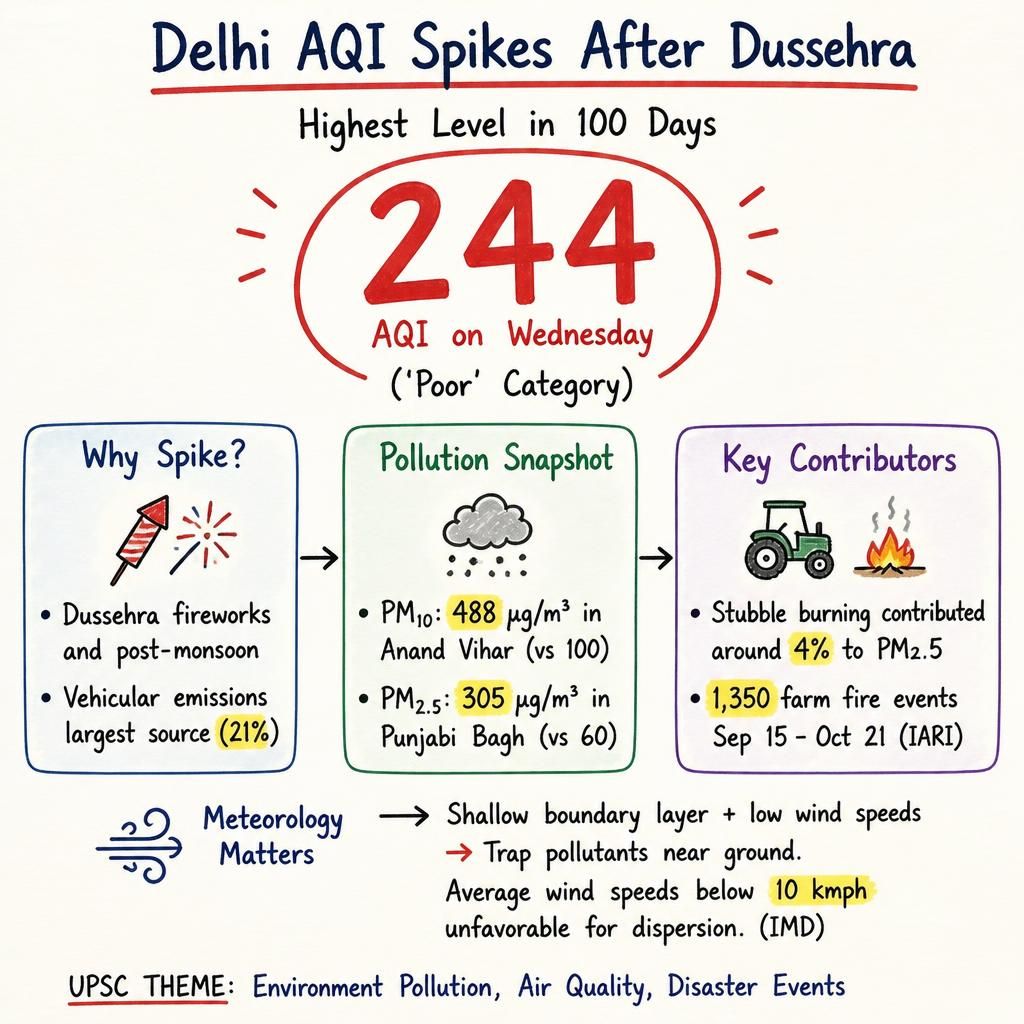
Delhi's AQI spikes to 244 post-Dussehra, driven by fireworks, vehicular emissions, stubble burning, and adverse winter meteorological conditions.
Source: Indian Express (Pg. 8)
Practice MCQs
767 Students attempted
Key Highlights:
- Delhi's Air Quality Index (AQI) reached 244 on Wednesday, marking the highest level in 100 days, following Dussehra celebrations.
- Particulate matter levels, including PM10 and PM2.5, significantly exceeded permissible standards across various city locations.
- Major contributors to the pollution spike include emissions from Dussehra fireworks, post-monsoon weather changes, vehicular emissions, and farm fires.
- Vehicular emissions were the largest source, contributing an estimated 21% to PM2.5 pollution, while stubble burning contributed around 4%.
- Meteorological factors such as shallow atmospheric boundary layers and low wind speeds exacerbate the accumulation of pollutants.
Delhi AQI.jpg
Detailed Insights:
- The AQI of 244 falls into the 'poor' category, indicating potential health impacts for sensitive individuals.
- PM10 levels peaked at 488 micrograms per cubic metre in Anand Vihar, far exceeding the permissible standard of 100 micrograms per cubic metre.
- PM2.5 levels reached 305 micrograms per cubic metre in Punjabi Bagh, significantly above the permissible standard of 60 micrograms per cubic metre.
- A 2024 study by IIT Delhi researchers indicated that fireworks accounted for over 85% of measured elemental mass in PM2.5 during Diwali celebrations.
- As winter approaches, the atmospheric boundary layer becomes shallower, and night-time temperature inversions trap polluted air near the ground.
- The India Meteorological Department (IMD) states that average wind speeds below 10 kmph are unfavorable for pollutant dispersion.
- A 2026 study found that Delhi's boundary layer remained below 1 km from November to January, correlating with higher PM2.5 concentrations.
- The Indian Institute of Tropical Meteorology (IITM) Decision Support System reported stubble burning contributed 4% to Delhi's PM2.5, with a forecast to rise to 15%.
- The Indian Agricultural Research Institute (IARI) detected 1,350 farm fire events across the Northern belt between September 15 and October 21.
Scientific/Technical Concepts Involved:
- Air Quality Index (AQI): A numerical scale used to communicate daily air quality levels and associated health risks.
- Particulate Matter (PM2.5 & PM10): Microscopic solid or liquid particles suspended in the air, categorized by size, which can cause respiratory issues.
- Atmospheric Boundary Layer: The lowest part of the atmosphere directly influenced by the Earth's surface, where pollutants are mixed and dispersed.
- Temperature Inversion: A meteorological condition where a layer of warm air traps cooler air and pollutants closer to the ground.

SuperKalam is your personal mentor for UPSC preparation, guiding you at every step of the exam journey.
Download the App


STUDY RESOURCES
CONTACT US
ⓒ Snapstack Technologies Private Limited