GS 2: GovernanceGS 3: Environment & EcologyPrelimsGS 3: Conservation, Pollution and DegradationGS 1: Changes in Critical Geographical Features, Water Bodies, Ice Caps, Flora and Fauna
The Whales Never Stopped Coming to Gujarat’s Beaches, The Watchers Did, Pg2
Gujarat's coast surprisingly hosts numerous whale strandings, revealing a critical gap in systematic marine mammal monitoring and conservation efforts.
Practice MCQs
767 Students attempted
Key Highlights:
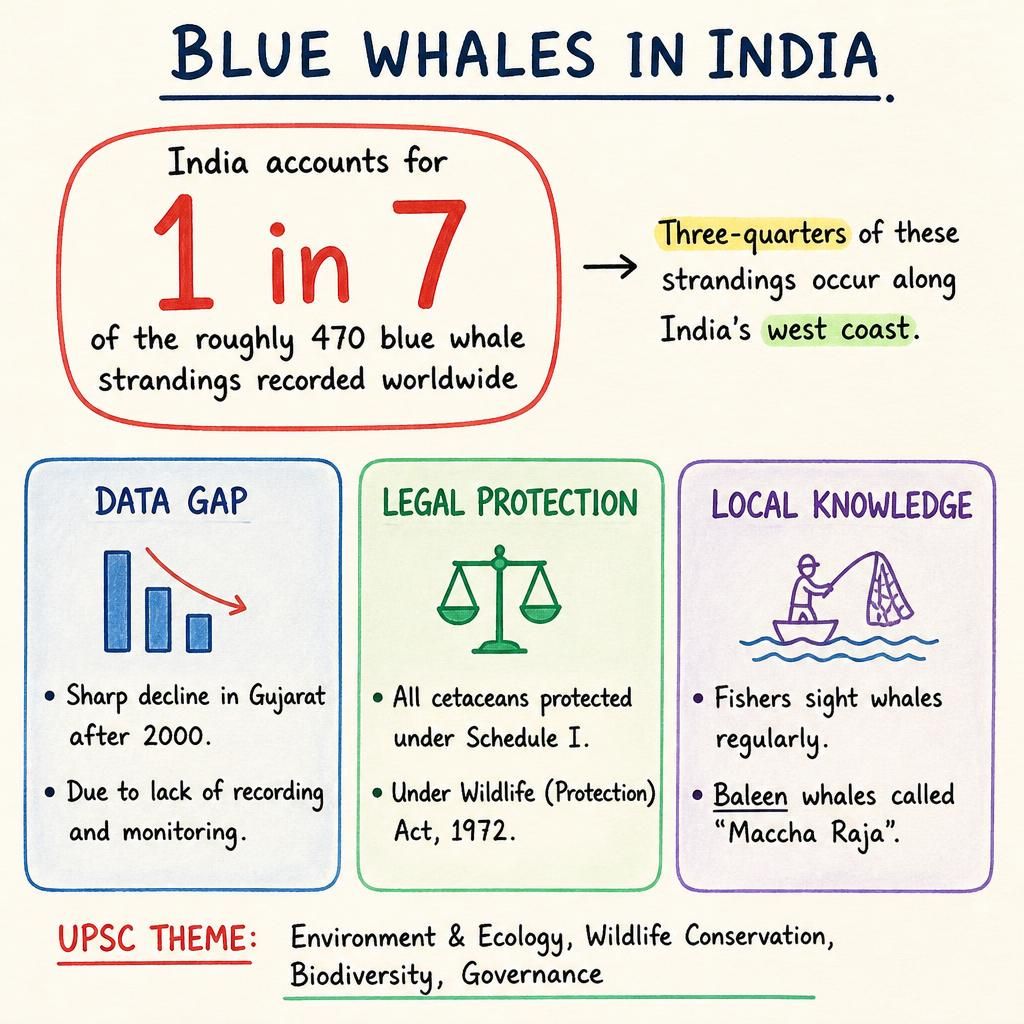
- India accounts for approximately one in seven of the roughly 470 blue whale strandings recorded worldwide, with three-quarters occurring along its west coast.
- Gujarat, historically a significant site for blue whale strandings, shows a sharp decline in recorded incidents after 2000, despite evidence suggesting whales continue to frequent its coast.
- This decline is attributed to a lack of systematic recording and monitoring efforts, rather than an absence of whales.
- All cetaceans in India, including whales, dolphins, and porpoises, are protected under Schedule I of the Wildlife (Protection) Act, 1972, affording them the highest level of legal protection.
- Local fishers in Gujarat regularly sight whales, referring to baleen whales as "Maccha Raja" (king of all fish), indicating their continued presence.
Blue whales in India.jpg
Detailed Insights:
- The article highlights a significant gap between scientific records and local knowledge regarding whale presence along the Indian coast.
- Historically, naturalists like S.T. Moses and specific compilations contributed to Gujarat's blue whale stranding records, but systematic efforts ceased after 2001.
- Recent unrecorded or poorly documented strandings, such as a blue whale in 2016 and a Bryde's whale calf in 2023, underscore the data gap.
- Maharashtra's coast, with 109 marine mammal strandings recorded in 2020-2021, demonstrates the impact of active monitoring on data collection.
- India's waters are home to 30-35 species of cetaceans and the dugong, out of approximately 120 marine mammal species globally.
- Surveys in India's Exclusive Economic Zone (EEZ) have identified Indo-Pacific bottlenose dolphins as the most frequently sighted and spinner dolphins as the most abundant.
- The unique Arabian Sea humpback whales are a genetically distinct, non-migratory population, with only about a hundred individuals remaining.
- Public involvement in reporting strandings to local forest departments is crucial for building a comprehensive database and aiding conservation efforts.
Key Concepts Involved:
- Wildlife (Protection) Act, 1972: An Act of the Parliament of India that provides for the protection of wild animals, birds, and plants, with Schedule I offering the highest level of protection.
- Exclusive Economic Zone (EEZ): An area beyond and adjacent to the territorial sea, extending up to 200 nautical miles from the baseline, within which a state has special rights over the exploration and use of marine resources.
- Cetaceans: An order of aquatic mammals that includes whales, dolphins, and porpoises, characterized by a torpedo-shaped body, paddle-shaped forelimbs, and a horizontally flattened tail.
- Marine Mammal Research and Conservation Network of India: A collective of marine mammal researchers and conservationists that provides resources, workshops, and maintains a database for sightings and strandings.

SuperKalam is your personal mentor for UPSC preparation, guiding you at every step of the exam journey.
Download the App


STUDY RESOURCES
CONTACT US
ⓒ Snapstack Technologies Private Limited