GS 2: GovernanceGS 2: Social JusticePrelimsGS 3: Buffer Stocks and Food SecurityGS 3: Public Distribution System
How to break the ration shop monopoly, Pg13
One Nation One Ration Card (ONORC) reform empowers beneficiaries by breaking ration shop monopoly, significantly reallocating bargaining power in PDS.
Practice MCQs
767 Students attempted
Key Highlights:
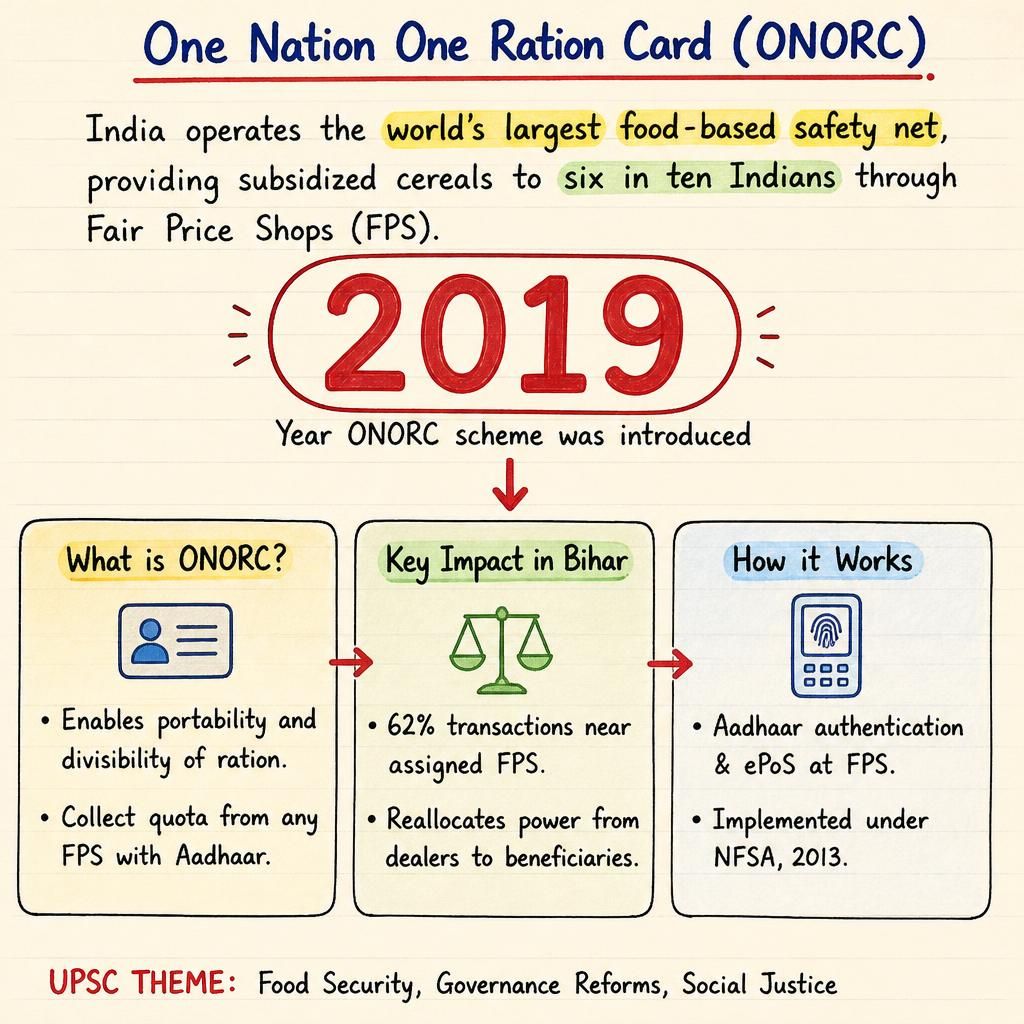
- India operates the world's largest food-based safety net, providing subsidized cereals to six in ten Indians through Fair Price Shops (FPS).
- The One Nation One Ration Card (ONORC) scheme was introduced in 2019 to enable portability and divisibility of ration entitlements.
- ONORC allows beneficiaries to collect their quota from any FPS nationwide using Aadhaar authentication.
- Data from Bihar indicates that ONORC's primary impact is the reallocation of bargaining power from dealers to beneficiaries, rather than solely facilitating long-distance migration.
- The scheme empowers cardholders by allowing them to switch FPS, thereby disciplining dealers and improving service quality.
ONORC.jpg
Detailed Insights:
- Before 2019, ration entitlements were tied to a specific address, creating a significant gap for migrant workers who constantly move for employment.
- The 2020 lockdown highlighted the critical need for a portable food security system for vulnerable populations.
- ONORC comprises two key elements: portability, allowing beneficiaries to draw rations from any FPS in India, and divisibility, enabling partial draws from different locations.
- The reform was initially designed to benefit long-distance migrant families, but its greatest utilization has been in geographically proximate FPS.
- In Bihar, 62% of transactions occurred at a shop near the cardholder's assigned FPS, indicating a preference for local switching (Type 1 portability) over inter-state migration (Type 2 portability).
- This shift in usage demonstrates that ONORC has structurally altered power relations, allowing beneficiaries to threaten exit and negotiate better service from dealers.
- The divisibility feature, while beneficial for allocation across family members, is currently underutilized, possibly due to lack of awareness or dealer incentives.
- ONORC is implemented under the framework of the National Food Security Act (NFSA), 2013, which legally entitles a significant portion of the population to subsidized food grains.
- The scheme relies on Aadhaar authentication and electronic Point of Sale (ePoS) devices at FPS for transparent and secure transactions.
- The Integrated Management of Public Distribution System (IM-PDS) portal facilitates the national portability of ration cards and data management.
Key Concepts Involved:
- One Nation One Ration Card (ONORC): A scheme enabling portability of food security benefits across India, allowing beneficiaries to access subsidized food grains from any Fair Price Shop.
- Public Distribution System (PDS): An Indian government-sponsored chain of shops that distributes food and non-food essential commodities at subsidized rates to the poor.
- National Food Security Act (NFSA), 2013: An Act of the Parliament of India that aims to provide subsidized food grains to approximately two-thirds of the country's population, converting food security into a legal entitlement.
- Fair Price Shops (FPS): Licensed shops under the PDS that distribute essential commodities like rice, wheat, and sugar at subsidized prices to ration cardholders.
- Aadhaar: A 12-digit unique identification number issued by the Unique Identification Authority of India (UIDAI), used for authentication in various government schemes, including ONORC.

SuperKalam is your personal mentor for UPSC preparation, guiding you at every step of the exam journey.
Download the App


STUDY RESOURCES
CONTACT US
ⓒ Snapstack Technologies Private Limited