GS 2: GovernanceGS 2: PolityGS 2: Social JusticePrelimsGS 2: Government policies and interventions for development in various sectors
Drug prices: overcharging claims of ₹8,447 crore remain unpaid, Pg7
Supreme Court questions Centre as ₹8,447 crore in drug overcharging claims remain unpaid, exposing regulatory gaps and patient burden.
Practice MCQs
767 Students attempted
Key Highlights:
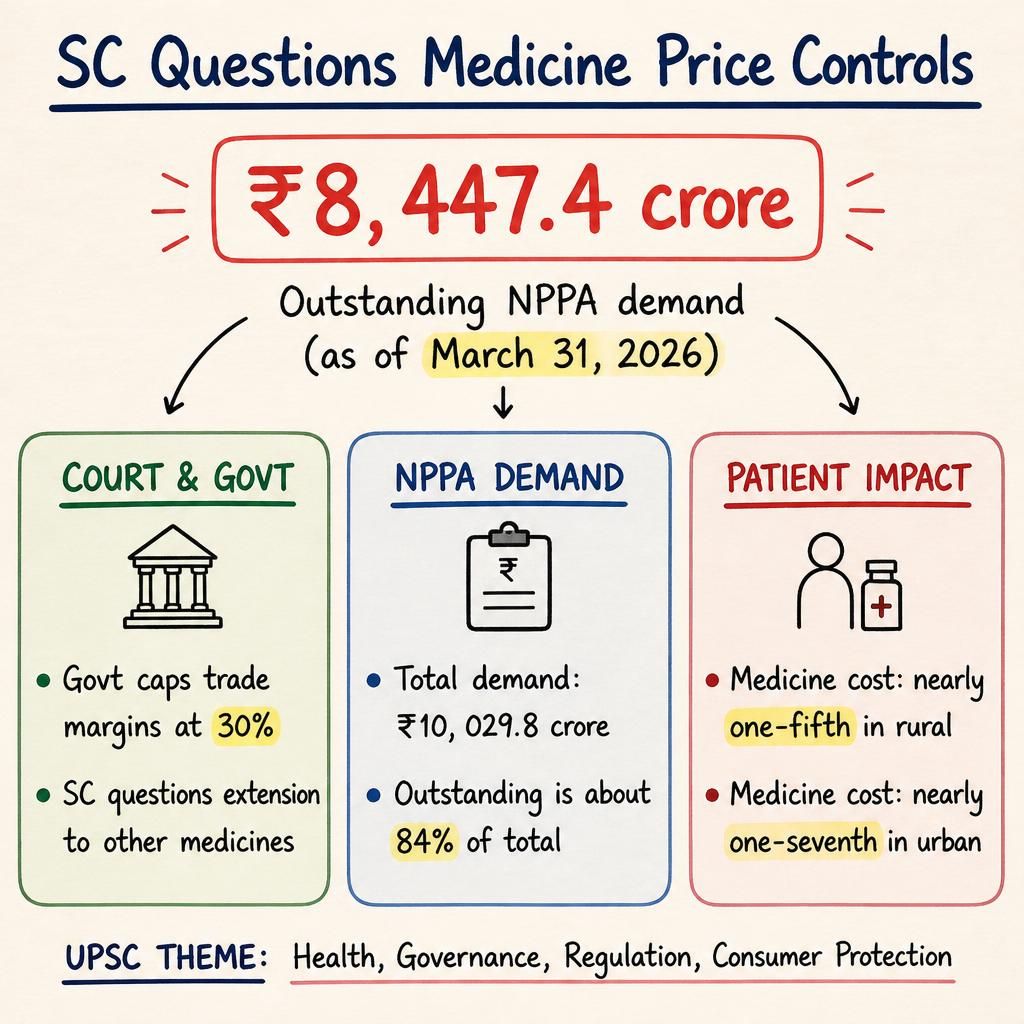
- The Centre informed the Supreme Court about capping trade margins at 30% for non-scheduled anti-cancer medicines.
- The Supreme Court questioned the government on extending similar price restrictions to other medicines and medical products.
- The National Pharmaceutical Pricing Authority (NPPA) has demanded ₹10,029.8 crore for overcharging violations since 1979, with ₹8,447.4 crore remaining unpaid as of March 31, 2026.
- The outstanding amount represents about 84% of the total demanded, with over ₹5,800 crore tied up in litigation.
- Medicine expenditure constitutes a significant portion of household hospitalisation costs, averaging nearly one-fifth in rural areas and one-seventh in urban areas.
Medicine Price Controls.jpg
Detailed Insights:
- The Supreme Court's intervention highlights concerns over steep price differences between supply costs and patient charges for medicines.
- High trade margins, while not always illegal, contribute to increased costs for patients, prompting calls for broader regulatory measures.
- The Drugs (Prices Control) Orders (DPCO) govern medicine pricing in India, and violations can lead to penalties.
- The NPPA, established in 1997, acts as the government's drug-price regulator, pursuing cases of overcharging by pharmaceutical companies.
- Despite the NPPA's efforts, a substantial portion of overcharging claims remains outstanding, indicating challenges in enforcement and recovery.
- There is currently no direct mechanism to compensate consumers for overcharged amounts, though the NPPA accepts consumer complaints.
- The large number of outstanding cases, particularly those in litigation, underscores the complexities in regulating the pharmaceutical market.
Key Concepts Involved:
- Drugs (Prices Control) Orders (DPCO): Legal framework in India that empowers the government to control the prices of essential drugs.
- National Pharmaceutical Pricing Authority (NPPA): A government regulatory body responsible for fixing and revising the prices of controlled bulk drugs and formulations.
- Trade Margins: The difference between the price at which a manufacturer sells a product to a distributor/retailer and the price at which the product is sold to the end consumer.

SuperKalam is your personal mentor for UPSC preparation, guiding you at every step of the exam journey.
Download the App


STUDY RESOURCES
CONTACT US
ⓒ Snapstack Technologies Private Limited